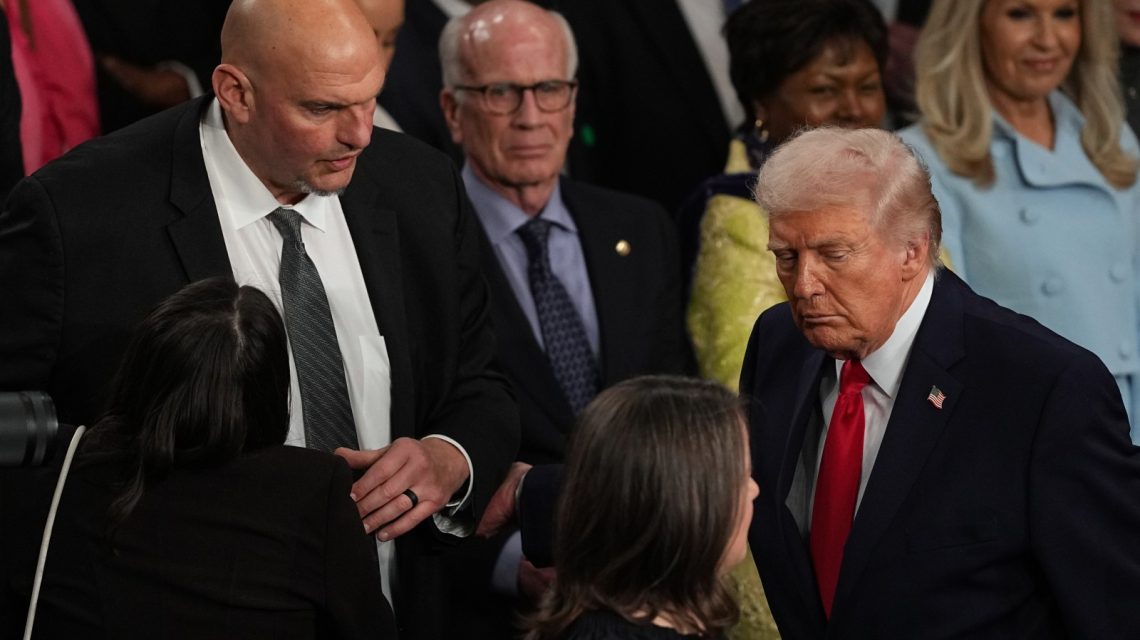
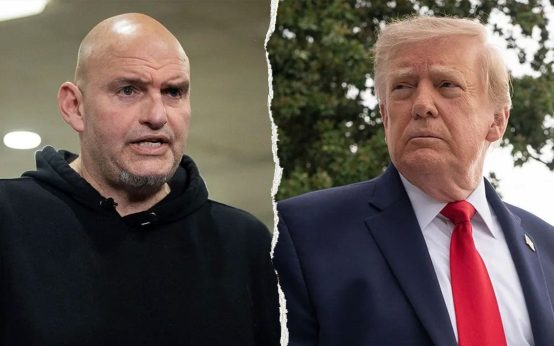
President Donald Trump expressed on Saturday his desire for Democratic Senator John Fetterman of Pennsylvania to switch to the Republican Party. This statement has reignited discussions about Fetterman’s potential political future. The senator has often deviated from his party’s line on significant issues.
During comments made at Joint Base Andrews after returning from a rally in Tennessee, Trump stated, “I’d love to see him as a Republican.” He noted that polling indicates Fetterman performs better as a Republican. Trump praised Fetterman as a “solid person” with “great common sense,” also mentioning conversations with the senator’s parents.
Fetterman has consistently rejected the idea of switching parties. He wrote in The Washington Post affirming his stance as a Democrat, despite often voting with Republicans. His actions have caused tensions within the Democratic Party, especially on matters like immigration and support for Israel. In a video for a Republican event, Fetterman criticized political extremism, emphasizing his commitment to America and rejection of socialism.
As the midterm elections approach, where Senate control is contested, Trump’s comments illustrate efforts to sway Fetterman while Democrats seek to regain Senate majority.
Polling Insights on Fetterman’s Standing
Polls reflect a mixed picture of Fetterman’s political standing. An Inquirer/New York Times/Siena University poll from August revealed 73 percent of Pennsylvania Republicans felt favorable toward Fetterman. This contrasts with 63 percent support for Republican Senator Dave McCormick. Among Democrats, Fetterman’s favorability dropped to 22 percent.
Further, a Quinnipiac University poll from February 2026 found similar patterns. Seventy-three percent of Republicans approved of Fetterman’s job performance, compared to only 22 percent of Democrats and 48 percent of independents. These surveys suggest Fetterman holds unusual political appeal across party lines.
Historical Context of Party Switches
Party switches can play a crucial role in Senate power dynamics. Notable past instances include Jim Jeffords of Vermont, who left the GOP in 2001 to caucus with Democrats, affecting the chamber’s control. Similarly, Arlen Specter’s switch to Democrat in 2009 bolstered the party’s majority during President Obama’s tenure.
Despite speculation and strong Republican support, Senator Fetterman remains a Democrat, denying any current plans to switch parties.
This article was prepared using contributions from Newsweek’s AI assistant, Martyn.
Correction: An earlier version misrepresented John Fetterman’s job approval ratings in a Quinnipiac University poll.
 States Address Cash Welfare Spending Loopholes
  Former Trooper Criticizes Handling of Gang Violence in Twin Cities
  Smith’s Controversial Presence at Anti-Trump Event
  Pope Leo XIV Condemns Use of Death Penalty in Light of Planned Livestream Execution
  Trump Expresses Approval of Sen. John Fetterman and Open to Party Switch
  Justice Department Investigates TV Networks Over Antitrust Law