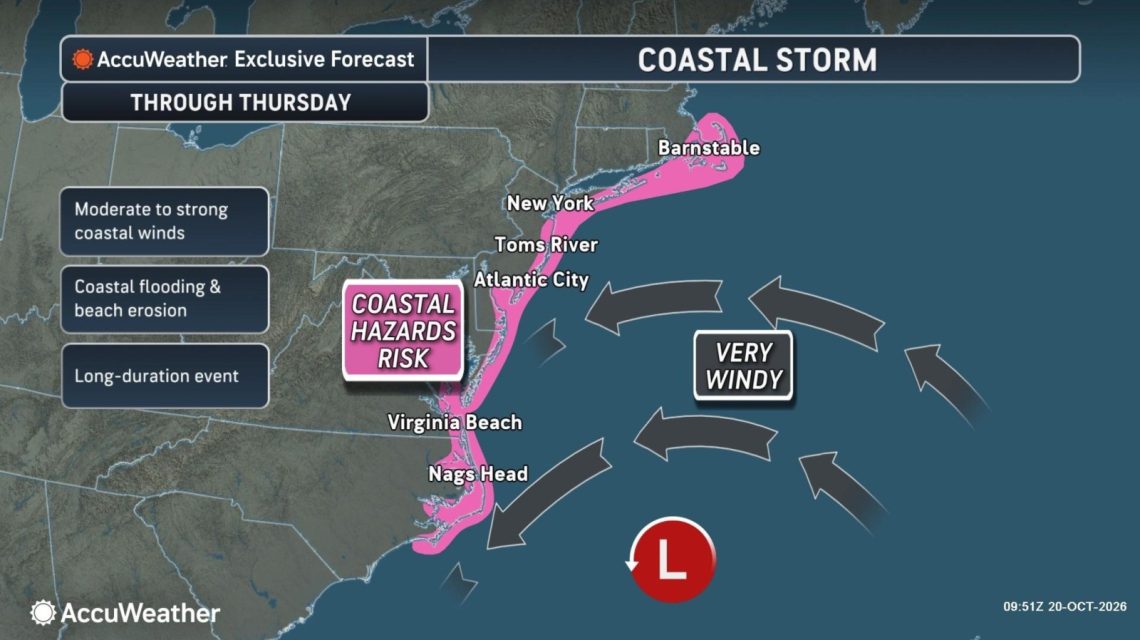
A slow-moving nor’easter is currently posing a significant threat to the East Coast, with the potential for strong winds, coastal flooding, and dangerous surf.
A forecast map shared with Newsweek indicates that the coastal area stretching from North Carolina to Massachusetts faces the risk of moderate to strong winds, coastal flooding, and beach erosion. The storm is predicted to gradually move northward offshore. Forecasters at AccuWeather have noted the possibility of the storm acquiring tropical or subtropical characteristics as it passes over the warm waters of the Gulf Stream.
Impact on Coastal Areas
As of Tuesday, the National Weather Service has issued coastal flood warnings for specific areas including New Jersey, Delaware, Maryland, and Virginia. The storm’s center is anticipated to shift from the waters off the Carolinas toward the mid-Atlantic, southern New York, and New England. This movement will allow coastal hazards to extend northward through the week. AccuWeather reported that while much of the storm’s moisture will remain offshore, coastal communities are expected to experience noticeable effects, even as many inland areas stay dry.
According to AccuWeather, the strongest winds were likely from Morehead City, North Carolina, to Atlantic City, New Jersey, by Tuesday. Forecasts predicted gusts ranging from 40 to 60 mph, with isolated potential of reaching 70 mph. Further north, breezy conditions are expected later in the week along coastal New Jersey, Long Island, southern Rhode Island, and Cape Cod in Massachusetts.
Forecasts and Warnings
Fox Weather predicts several days of hazardous conditions, highlighting severe impacts from late Wednesday into Thursday. It has identified the most pronounced flooding threat from the Outer Banks through Chesapeake Bay to Ocean City, Maryland, with water possibly rising more than 2 feet above normal during high tide.
There is a possibility that the system may briefly transition into a subtropical or tropical storm. According to Alex DaSilva, AccuWeather’s lead hurricane expert, there is a moderate chance for the area of low pressure off the East Coast to develop tropical or subtropical traits. Though subtropical characteristics are more likely, a tropical system cannot be entirely dismissed. The NHC might even assign a name if a subtropical status is attained.
DaSilva explained that tropical systems pull energy from warm ocean waters, while subtropical systems rely on both warm waters and the jet stream. He noted that it is common for nor’easters in October to attempt gaining tropical or subtropical characteristics. Currently, the Gulf Stream’s warmth remains substantial enough to energize these kinds of storms, making coastal flooding and dangerous surf possible throughout the mid-Atlantic coast.
Understanding Nor’easters
The National Weather Service describes a nor’easter as a storm impacting the East Coast of North America, where winds generally originate from the northeast in coastal regions. While these storms can emerge year-round, they are most prevalent and formidable between September and April.
 AI Donations in Midterm Elections: A New Political Hotspot
 A New Chapter Begins in the White House Press Office
 Police Respond to Bizarre Incident with Masked Visitor in Texas
 Investigation Launched After Gage Park Woman Dies Following Fall and Domestic Incident
 Cornell Faculty Discuss Letter from Jane Doe and Concerns Over University’s Response
 Pennsylvania Resident’s Controversial Halloween Display Sparks Response