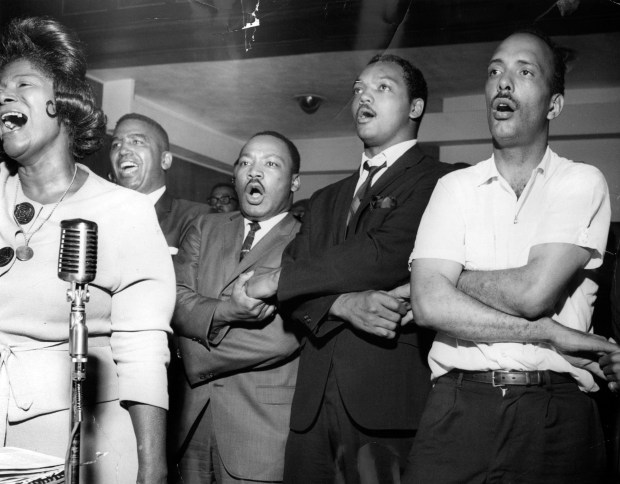
Albert “Al” Raby’s life story is an inspiring journey of transformation and activism. Born in 1933, Raby’s early life showed few signs of his future influence. He went from being a grade-school dropout to an elementary English teacher at Hess Upper Grade Center. This path would lead him to become a pivotal civil rights organizer.
Over his 55 years, Raby left a mark not only on Chicago but across the nation. He became a leader in the Chicago Freedom Movement, fighting segregation and overcrowding in Black neighborhoods. In 1963, he established the Coordinating Council of Community Organizations, orchestrating a massive walkout by Chicago Public Schools students. His efforts were a direct response to segregation policies and overcrowding.
In 1966, Raby invited Rev. Martin Luther King Jr. to Chicago. King spent eight months in a North Lawndale apartment, protesting conditions in housing, education, and employment. Raby later managed Harold Washington’s campaign in the 1983 mayoral race. Under Mayor Washington, he served as director of Chicago’s Commission on Human Relations.
Raby’s ambition expanded beyond domestic boundaries. He participated in the Illinois Constitutional Convention in 1970 and later worked globally, directing Peace Corps volunteers in Ghana from 1979 to 1982. His legacy was honored on October 16th, when a street sign bearing his name was unveiled at 6300 S. Cottage Grove Avenue. This event was marked by Mayor Brandon Johnson declaring February 19th as “Al Raby Day.”
“Al Raby’s fight was rooted in the belief that every child deserves a good school, families deserve good neighborhoods, and governments should be accountable to the people,” Mayor Johnson stated. Kathy Raby, his daughter, shared her joy upon hearing the news, celebrating with her own daughter, Katanya. Together, they maintain the Al Raby Foundation, a nonprofit dedicated to community service, activism, and youth leadership development in Chicago.
Kathy Raby expressed how overdue the recognition was, emphasizing her father’s community contributions. She noted his connections to Woodlawn, where he was raised on Rhodes and mentored at 63rd and Cottage Grove. Chicago historian Shermann “Dilla” Thomas highlighted Raby’s impact, recalling a famous picture of Bernie Sanders being arrested during protests led by Raby.
The unveiling of the street sign is part of the Foundation’s ongoing projects, supporting social justice and racial equity. Recently, the Foundation assisted the Chicago History Museum in updating the “Facing Freedom” exhibit with Raby’s contributions. Their “Family Chats” series collects personal stories about Raby and the civil rights movement.
“We’re collecting stories, doing semi-journalism and historical work,” said Kathy Raby. She emphasized the importance of untold stories and their role in understanding history. Another project, “Learn With Me,” aims to explore Raby’s life, involving viewers in uncovering his story.
Katanya Raby highlighted her grandfather’s dedication to education. She recounted how, in 1963, Al Raby helped lead a boycott involving 200,000 students to demand better educational opportunities. The legacy of those efforts is felt today.
Poet and Urban Gateways CEO Leslé Honoré composed a special poem for the occasion, describing Raby as “the organizer’s organizer.” Honoré emphasized Raby’s dedication to the movement and the importance of service before recognition.
 Researchers Hit Setback in Amelia Earhart Search on Nikumaroro Island
 Lash Technician’s Cancer Diagnosis Leads to Major Life Changes
 Young Boy Hears for the First Time with Hearing Aids
 Understanding and Challenging Manosphere Rhetoric
 Kyle Kennedy: A Life of Advocacy and Education Reform
 Rediscovering Barbara Trapido’s Iconic Novel