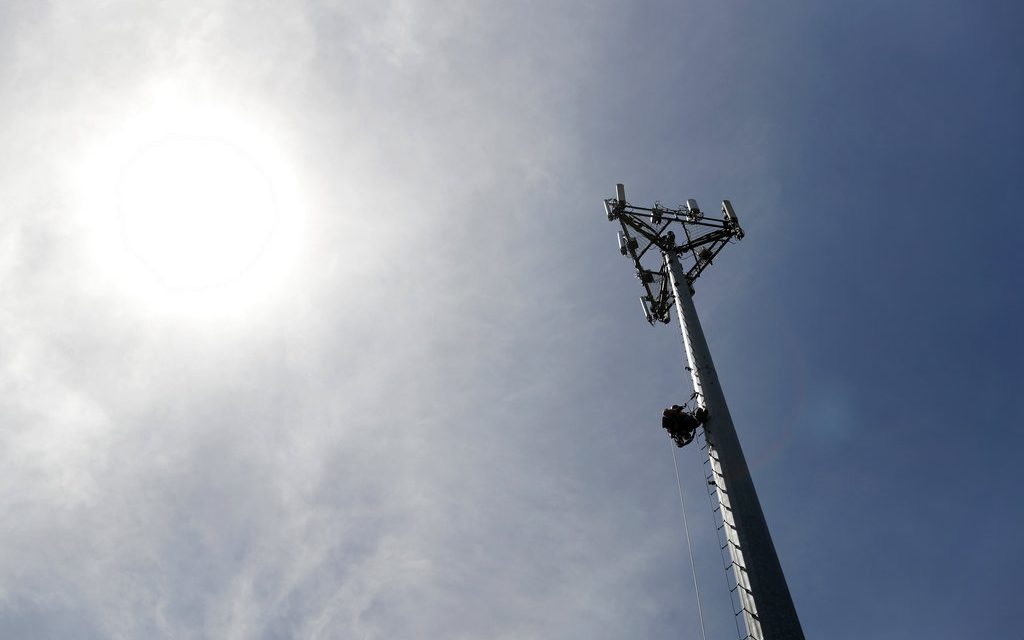
Nick Blase, from True North Management Services, climbed a cell tower on May 22, 2017, in High Ridge, Mo., illustrating a critical issue highlighted by the Federal Communications Commission (FCC). Though 95% of Americans have 5G access from at least one carrier, only 69% of road miles and 39% of land cover receive such service. This figure drops to 60% and 38% in rural regions, highlighting the rural-mobile divide.
This issue isn’t about broadband access at home. It’s about losing mobile service when driving, farming, hiking, or handling emergencies. Building more cell towers is the conventional approach, but extending networks everywhere isn’t economically feasible.
The FCC plans to allocate up to $9 billion to bridge 5G gaps. Instead of solely constructing more towers, considering satellites as an alternative is vital. Direct-to-device satellite service allows standard mobile phones to connect to satellites without needing special equipment. The satellite functions as a floating cell tower, covering previously unreachable locations.
All major carriers, including T-Mobile, AT&T, and Verizon, are integrating satellites into their networks. T-Mobile, for instance, collaborates with Starlink and offers satellite service, either bundled with plans or at an additional cost. A new joint venture aims to expand satellite coverage, pooling spectrum for better service delivery.
Though not a replacement for 5G, satellite service offers essential messaging and low-bandwidth applications. Development is underway for voice and more data-heavy applications. This basic connectivity can turn dead zones into areas where help can be summoned.
Deployment of satellite service relies on the FCC’s 5G Fund for Rural America, initially proposed in the 2010 National Broadband Plan. The FCC’s rules currently focus on conventional 5G delivery, which satellites can’t provide. Instead, the FCC should buy needed coverage and let providers compete to deliver it cost-effectively.
The FCC can ask carriers to bid for subsidies to offer coverage in underserved areas, setting requirements for availability and reliability. This aligns with the Communications Act’s goal to provide reasonable communication service across all regions, comparable to urban standards.
Charging extra for connectivity in rural dead zones isn’t fair. FCC rules require comparable rates in rural and urban areas. Extending these rules to include satellite coverage continues the evolution of universal-service policy.
Adapting to technological advancements, the last cell tower to overcome the rural divide could be stationed in space. Using already authorized funds to reach remote areas where markets fail to reach remains an efficient strategy.
Blair Levin, a former FCC chief of staff, and Larry Downes, author of “Big Bang Disruption,” argue that deploying satellites with federal support can effectively address mobile service disparities.
 The Political Impact of Data Centers in the U.S.
 U.S. Navy Boosts AI-Powered Robotics Contract to Enhance Ship Maintenance
 Remote Work and Social Connections: A Deeper Look
 Review of Afghanistan Withdrawal Expected Amidst U.S. Political Climate
 Tragedy in Baton Rouge: Young Couple Killed by Impaired Driver
 Controversial Tree Removal at East Potomac Golf Links