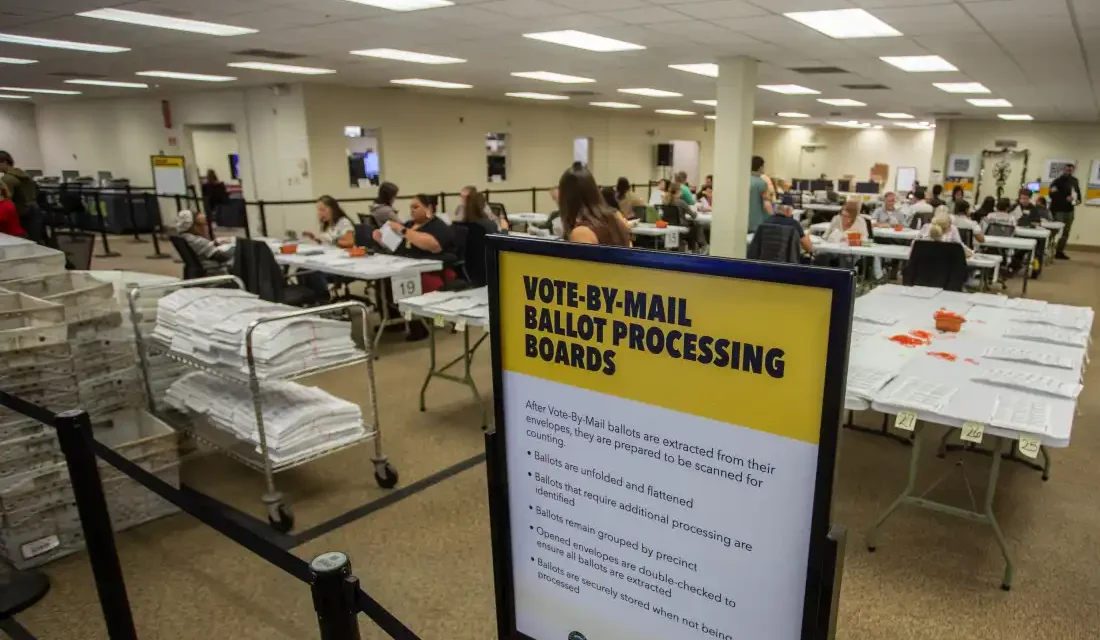
At the Orange County Registrar of Voters Facility in Santa Ana, California, ballots are being extracted and prepared for scanning as part of the vote-by-mail process.

A federal judge rejected an emergency request from the Department of Justice (DOJ) to segregate thousands of ballots in California’s midterm elections. The DOJ aimed to halt processing of ballots belonging to 20,000 individuals it claims are ‘likely’ noncitizens. However, California officials argue that the DOJ’s list is unreliable. An analysis by Los Angeles County found many on the list lack active voter registrations.
Officials also argue that setting aside these ballots so close to Election Day would be unlawful, impractical, and could disenfranchise eligible voters. U.S. District Judge David Carter denied the DOJ’s request for a temporary restraining order. In his 26-page ruling, he emphasized that such federal intervention is unprecedented and concerning.
“Never before in American history has the federal government, on the eve of an election, sought to coerce a state and local government to abandon their own Constitutional elections procedures and bend to the will of the Executive Branch,” Carter wrote.
Judge Carter also highlighted the risk of disenfranchising eligible voters and causing election chaos. He stated that segregating votes causes lasting harm and underscored the threat to democracy if executive allegations could discount votes.
While the DOJ has previously charged individuals for illegally voting as noncitizens, Judge Carter noted that this issue could be resolved through further indictments. In California’s recent court motion, state Attorney General Rob Bonta urged the judge not to endorse what he described as a degradation of democratic values.
The DOJ plans to appeal Carter’s decision, potentially bringing the matter before the U.S. Supreme Court. The urgency arises from the ongoing ballot processing. Once mail ballot envelopes are verified and ballots separated to ensure voter confidentiality, retrieving an ineligible ballot becomes impossible. The DOJ claims votes by noncitizens dilute legitimate citizen votes.
While audits and investigations show that voting by noncitizens is rare, the DOJ’s list remains disputed. A Los Angeles County analysis questioned the federal list, finding that many on it claimed U.S.–birth status in records. USCIS official Nicolas Bartell argued none on the list were U.S.–born, though he acknowledged that four individuals might claim U.S. citizenship.
University of Delaware political scientist Kassra Oskooi criticized the USCIS matching protocol as unreliable, raising further questions about the DOJ’s methodology in compiling the list.
 Mayor Mamdani’s Policing Reform Plans
 Gen Z Voter Shifts and Their Impact on the 2026 Midterm Elections
 Disappearance of US Senate Candidate Raises Questions
 DOJ Rule Change Reduces Appeal Time for Immigrants Facing Deportation
 Hakeem Jeffries’ Bid for House Speaker Faces Progressive Hurdles
 Ohio Judge Dismisses Defamation Lawsuit by Rep. Max Miller