November 2, 2026 – CBS News
An amateur historian might have uncovered a shocking link to the age-old mystery surrounding a famed pirate who plundered an Indian treasure ship long ago. This discovery involves a partner whose name resonates with many New Yorkers.
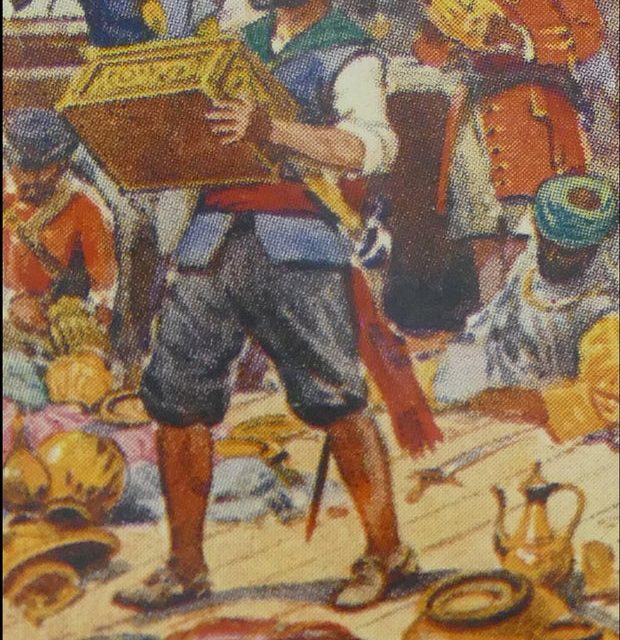
James Bailey became famous five years ago for discovering ancient coins related to English pirate Captain Henry Every. Now, he claims colonial records show that the “King of the Pirates” had help from Thomas Jones, after whom Jones Beach is named, New York’s second most visited state park.
Bailey points out, “Millions of visitors and New Yorkers frequent this beach, unaware of Jones’ major role in possibly the greatest piracy heist ever.” Since Bailey’s initial discovery, he has meticulously examined documents about the 1695 attack on the Ganj-i-Sawai in the Red Sea and the enigma of Every’s fate.
The pirate gang brutally tortured, murdered, and raped those on the royal vessel, inciting worldwide condemnation and igniting history’s first global manhunt. While some were captured and executed, others, including Every, vanished, likely fleeing to Europe or the American colonies.
Bailey refers to depositions from Every’s circle suggesting that Jones was recruited as an escape specialist, aiding the crew in dodging the law after absconding with gold and silver valued at tens of millions of dollars.
Additional records indicate New York’s governor, aiming to suppress piracy at the British crown’s behest, later investigated Jones, who had transitioned into a wealthy whaling business owner on Long Island’s barrier beach that now bears his name.
Ghost stories and enduring legends surround Jones posthumously.
Bailey’s study, intended for publication, offers insights into Jones’ shadowy history; narratives rarely explored in local chronicles, states John Hanc, who authored “Jones Beach: An Illustrated History” that includes insights on Jones. Jones previously served as an English military officer before moving to the American colonies, settling initially in Rhode Island then emerging as a prominent businessman and landowner in New York.
Jones claimed extensive landholdings on early Long Island; a rural area far beyond the burgeoning New York City. Yet whispers regarding the origins of his wealth persisted long after his demise in 1713. Before demolition in the early 1800s, Jones’ decrepit mansion was rumored to be haunted by supernatural happenings. Additionally, his grave suffered repeated desecration by treasure-seeking vandals, prompting relocation to a family burial site behind a nearby church.
A family document from 1906 dismissed pirate tales as “slander” and fictional fabrications. A descendant, Thomas Floyd-Jones, commented, “People aimed to tarnish his reputation, fueled by malice or mischief.” “Over a hundred years posthumously, myths grew through ignorance or superstition,” he noted.
Was Jones a privateer, pirate, or both?
Hanc, along with experts, argue it’s plausible Jones engaged in piracy. Following his British military tenure, Jones served as a privateer, raiding rival merchant ships under English crown authorization during wartime, says Meagan Schulman, a Fordham University doctoral candidate focused on 17th-century piracy untouched by Bailey’s research.
As conflicts subsided, privateers like Jones faced loss of legal status, she says. Those persisting in seafaring plundering were deemed pirates. “Essentially, privateers were government-backed pirates,” explains Schulman, a Jones Beach frequenter. “Some may dub Jones a pirate, yet he likely never self-identified as such.”
Post-Every’s evasion, Bailey’s sourced records reveal Jones’ brief Rhode Island return. By 1696, his father-in-law, Thomas Townsend, a wealthy New Yorker, bestowed significant Long Island property upon him and his spouse, according to property reports.
Bailey speculates that move ensured a fresh start amidst ongoing pirate pursuit throughout New England. On Long Island, Jones established a family homestead, but his pirate legacy lingered. Three years post-Ganj-i-Sawai plunder, New York’s colonial governor, Richard Coote, detailed uncovering piracy links to Jones.
Coote reported in 1698 that a “barrel of treasure” journeyed from the city to Jones’ residence on Long Island. Despite being labeled “formerly a pirate” by Coote, Jones testified ignorance to the funds.
Piracy fostered colonial American wealth.
Bailey’s revelations are intriguing but lack definitive proof, cautions University of Reading’s maritime history professor Richard Blakemore, external to Bailey’s work. “Thomas Jones” remains a common name, he notes. Nevertheless, Jones’ alleged involvement with Every emphasizes piracy’s role in cultivating “fundamental and enduring wealth” for leading Northeast lineage, says Loyola Marymount University’s Kevin McDonald, an author on colonial piracy undisturbed by Bailey’s findings.
“Despite popular views of pirates as renegades, historians frequently argue oppositely, especially with supporting evidence like Bailey’s,” concurs Blakemore.
“Readers might be startled at early British colonies’ socio-economic interconnectivity with piracy.”
 Stephen Hawking’s Complex Personal and Professional Life
 Immersion in French Culture at Ascension Catholic School
 Old MacDonald’s Farm in Humble, Texas, Closing After 34 Years
 Lee McFarlane’s Remarkable Hole-in-One Journey Continues
 Advice for Concerned Grandparents
 Efforts to Counter Food Assistance Cutbacks in San Diego