By November 2, 2026, voters in Alaska will head to the polls for significant races, including a Senate election gaining attention due to a candidate with a nearly identical name to the incumbent senator, Dan Sullivan. The spotlight is also on Alaska’s unique election system. This system has made waves since the state implemented a top-four nonpartisan primary and ranked choice voting in the general election.
Understanding Alaska’s Voting System
What is Ranked Choice Voting?
Ranked choice voting allows voters to rank candidates in order of preference instead of selecting just one. This system started in 2022, aiming to reduce political polarization by moving away from party primaries. The top four candidates from the nonpartisan primary advance to the general election.
During the election, if any candidate receives more than 50% of first-choice votes, they win outright. If not, the process moves to a second round. The candidate with the least votes is removed, and votes are redistributed according to the next preference indicated by voters. This continues until one candidate has a majority.
For example, in a race with 100 votes, if Candidate A gets 50 votes, Candidate B gets 40, Candidate C receives 7, and Candidate D gets 3, Candidate D gets eliminated. Their votes get redistributed to the next choice, possibly giving Candidate A the needed majority.
In 2022, a special House election used this system. No candidate had over 50% initially, so the contest proceeded to ranked choice tabulation. Democrat Mary Peltola eventually secured a majority 15 days after Election Day. She later won her full term with 55% of votes, after initially having 48.8%.
Alaska’s Senate Candidates
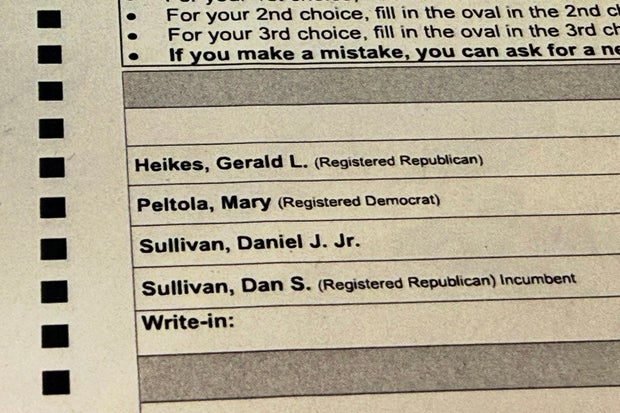
The Alaska Senate race is crucial for controlling the Senate. Voters will choose among four candidates: Incumbent GOP Senator Dan S. Sullivan, his namesake Daniel J. Sullivan, and other challengers Gerald Heikes and Mary Peltola.
Sen. Dan S. Sullivan, a Marine veteran, served in the State Department during George W. Bush’s presidency. His main challenger, Peltola, was the first Democrat in 50 years to represent the state in the House in 2022. Daniel J. Sullivan, a former teacher, also enters the race.
Daniel J. Sullivan’s candidacy led to legal disputes regarding his eligibility on the primary ballot. The state supreme court kept him on the ballot. In August’s primary, Daniel J. Sullivan received 2.5% of votes, while Peltola led with 49.5%, followed by the incumbent senator at 41.4%.
A sample ballot shows the senator as “Sullivan, Dan S. (Registered Republican) Incumbent,” while Daniel J. Sullivan is listed without identifiers, raising concerns over potential voter confusion.
The Justice Department recently filed a lawsuit to block certification of the election if Dan S. Sullivan loses. This lawsuit was dismissed by a federal judge, but the department plans to appeal. Reports suggest political operatives aligned with Peltola may have secretly recruited Daniel J. Sullivan to draw votes away from the senator, though Peltola denies any such involvement.
Alaska’s Vote Counting Process
Experts expect the counting of votes in Alaska to take considerable time. This stems from the state’s vast geography, remote areas, and reliance on mail ballots. Mail ballots are counted if received 10 or, in some cases, 15 days post-election.
Ranked choice tabulation rounds begin 15 days post-election if no candidate achieves 50% in the first round. This makes patience necessary as the process may extend for weeks. Alaska election officials aim to certify results by November 25. In 2022, Peltola’s term was finalized on November 30.
 Mayor Mamdani’s Policing Reform Plans
 Gen Z Voter Shifts and Their Impact on the 2026 Midterm Elections
 Disappearance of US Senate Candidate Raises Questions
 DOJ Rule Change Reduces Appeal Time for Immigrants Facing Deportation
 Hakeem Jeffries’ Bid for House Speaker Faces Progressive Hurdles
 Ohio Judge Dismisses Defamation Lawsuit by Rep. Max Miller