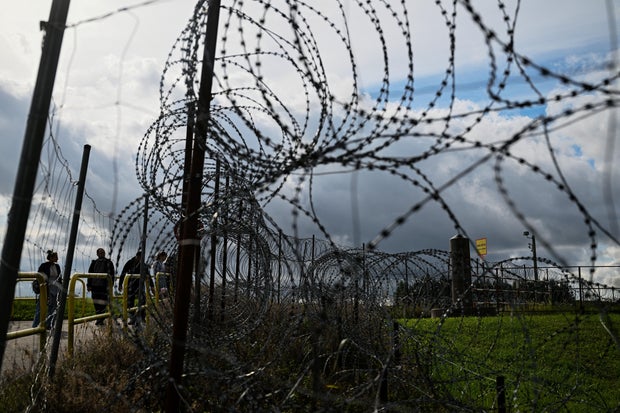
Poland initiated a significant security operation this week along its border with the Russian enclave of Kaliningrad. The Polish national police chief and the prime minister indicated this move could have thwarted a potential sabotage or provocation aimed at the NATO member.
As part of the operation, additional police, counterterrorism units, and elite military special forces GROM have been deployed. The national police chief, Marek Boroń, stated the operation would continue until at least November 8.
Warnings from Polish and allied intelligence agencies highlighted possible sabotage and provocations in early November. These warnings prompted heightened alertness among security agencies before additional forces were sent to the northeast regions of Warmia-Masuria and Podlaskie.
Near the Polish-Lithuanian border with Kaliningrad, tourists observed a razor-wire fence. The village of Grzybina in Podlaskie province, positioned near the strategic Suwałki Corridor, witnessed enhanced security measures.
Prime Minister Donald Tusk reported suspicious activities near Kaliningrad, including individuals carrying flashlights close to the border. The swift action by Polish security forces potentially prevented an attempt at provocation.
Tusk remarked, “We promptly mobilized the necessary security forces on site and successfully prevented any provocation attempts. Although, complete confirmation may remain elusive.” Intelligence pointed to possible acts of diversion or more serious threats against the European Union, including armed intrusions into Poland.
A special command center was established at the national police headquarters to coordinate efforts. The objective is to protect the public, detect suspicious activities early, and prevent attacks on critical infrastructure.
Kaliningrad, bordered by NATO members Poland and Lithuania, holds substantial military and strategic importance. It is believed Russian security agencies, including the FSB and GRU, have a presence in the region.
The Suwałki Corridor, east of Kaliningrad, is crucial as it connects Baltic NATO states with the rest of the alliance, bordered by Russian and Belarusian territory. By Tuesday, Polish authorities had not produced specific evidence of planned sabotage originating from Kaliningrad. However, the alert follows months of such activities across Europe, mostly attributed to Russia.
In a recent press conference with Lithuania’s prime minister, Tusk referenced discussions with NATO Supreme Allied Commander Alexus Grynkewich about heightened sabotage threats, including possible provocations involving aircraft or border crossing attacks.
Simultaneously, MI5 Chief Sir Ken McCallum highlighted growing security threats in Europe, naming Russia as “aggressor number one.” He cautioned against Russia’s hybrid warfare tactics, which remain below NATO’s Article 5 threshold, thus avoiding triggering a collective defense response.
This year alone, incidents across Europe attributed to Russia included an August fire at a Polish factory producing military components and a September arson attack on a Starlink satellite ground station blamed on Russia. Russian drones have repeatedly encroached into NATO airspace during the ongoing war in Ukraine.
Recently, the UK’s Royal Navy intercepted a Russian spy ship off Scotland’s northern coast. Helicopters were deployed to monitor the ship, tracking its activities near a NATO exercise off the Outer Hebrides islands.
 In-Flight Altercation on Qatar Airways Leads to Police and FBI Response
 Virginia Residents Sue Over Alleged Immigration Violations
 Updates on Key International and Domestic Events
 Pope Leo XIV Completes South American Tour with Farewell Mass in Peru
 President Trump’s Critical Asia Trip: Key Meetings and Implications
 U.S. Plans to Restrict AI Chip Exports Before Trump-Xi Meeting