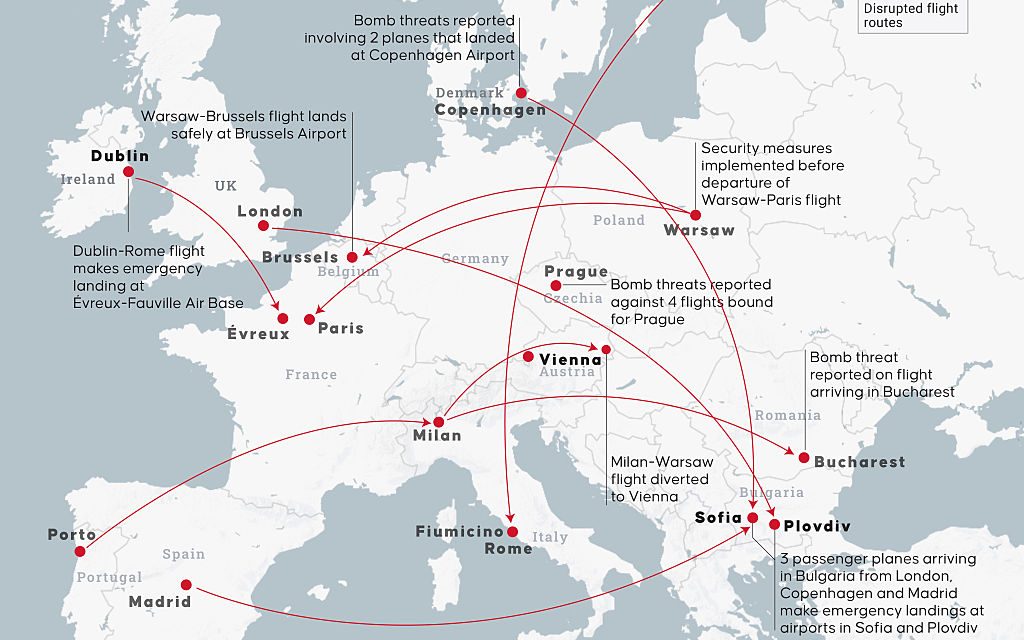
A series of bomb threats targeted numerous flights across Europe and later extended to newsrooms, leaving authorities working to identify those responsible. These threats, identified as hoaxes, were communicated almost daily through anonymous calls and emails starting on November 2.
On Monday, a Wizz Air flight from London to Bulgaria made an emergency landing in Budapest after receiving a bomb threat mid-flight. The following day, seven passenger flights faced threats leading to emergency landings, searches, and diversions. Over two dozen additional flights were affected on Thursday, with threats continuing into Friday. The impacted flights involved countries such as Italy, Ireland, Spain, Bulgaria, Romania, Poland, Finland, Austria, Denmark, Belgium, Portugal, France, Greece, Serbia, Czechia, and the United Kingdom.
An infographic created based on available information as of November 5, 2026. Omar Zaghloul—Anadolu via Getty Images
Authorities, including the U.K. Transport Secretary, have called these hoaxes since no attacks were executed, and all flights landed safely. Still, the hoaxes caused significant disruption, affecting thousands of passengers’ plans, increasing fear among travelers, and impacting the aviation sector.
On Friday, the scope of the threats expanded when an email warning targeted several European broadcasters with claims of planted bombs, causing evacuations at outlets like Sky News, Nova TV in Bulgaria, and RTÉ in Ireland. The email indicated that this week’s events were a small part of future threats against Europe, as reported by Reuters.
Reactions and Speculations
European Union Transport Commissioner Apostolos Tzitzikostas strongly condemned the threats and has activated EU-level aviation security information-sharing measures. At this stage, whether the hoaxes are connected is unclear.
Ireland’s government suggested it is a coordinated disruption campaign. Experts noted the threats might aim to instill fear and disruption, described as psychological warfare or hybrid aggression by Spanish Foreign Minister José Manuel Albares. Elisabeth Braw of the Atlantic Council highlighted these actions as “gray zone conflicts,” existing between war and peace, targeting civilian infrastructure rather than military.
Italian Prime Minister Giorgia Meloni noted the attack on civilian infrastructure was not on military or weapons targets, complicating response options for European countries if a nation is behind it. Braw emphasized that military retaliation is not an option in these scenarios, making them challenging for democratic countries.
Context of Increased Threats
Bomb threats against airlines are not new, yet the number and frequency are concerning, Braw noted. These threats coincide with other geopolitically motivated actions in Europe, including cyberattacks on grocery stores and blood banks in France.
Two pro-Russian hacktivist groups claimed responsibility for the cyberattacks, but their involvement remains unverified. In response, U.S. federal agencies advised hospitals, transportation, and food sectors to enhance security measures. The Russian government denied involvement, describing such accusations as unfounded.
Challenges in Identifying the Perpetrators
Robert Jordan of the Royal United Services Institute mentioned the allure of blaming hostile states like Russia, noting instances where groups have been recruited online for similar activities. Yet, the actual source may be individuals or non-state groups exploiting regional security gaps.
Until the origins of the threats are established, disruptions are likely to persist. Braw stressed the importance of treating each threat seriously in the aviation sector due to potential catastrophic outcomes, which necessitates emergency landings, causing passenger unrest and financial loss.
French prosecutors launched an investigation to determine if foreign powers are involved. Some emails were signed by “fighters of the Male State,” a radical Russian group. However, the group’s dissolution in 2021 and the denials from its founder indicate no confirmed link.
The Ongoing Dilemma
Robert Jordan highlighted that identifying the perpetrators remains a priority for law enforcement and security services. Airports and airlines may need to adjust screening processes in response. Even with identification, responding to similar future hybrid attacks remains a complex issue for democratic nations. Braw pointed out the challenge of balancing threat management with democratic principles, highlighting the increasing acuteness as threats evolve and intensify.
 In-Flight Altercation on Qatar Airways Leads to Police and FBI Response
 Virginia Residents Sue Over Alleged Immigration Violations
 Updates on Key International and Domestic Events
 Pope Leo XIV Completes South American Tour with Farewell Mass in Peru
 President Trump’s Critical Asia Trip: Key Meetings and Implications
 U.S. Plans to Restrict AI Chip Exports Before Trump-Xi Meeting