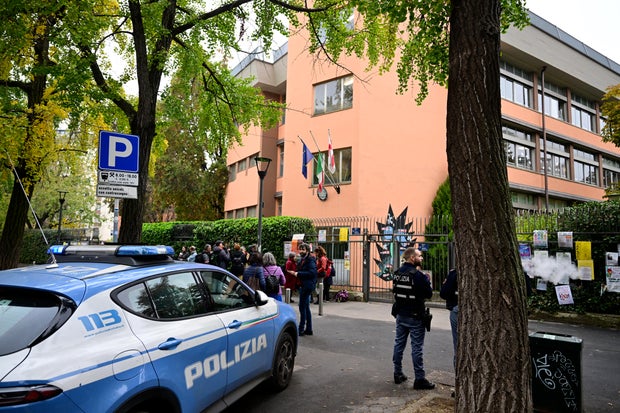
On a recent Wednesday, thousands of schools across Europe were targeted with bomb threats, sparking evacuations primarily in Italy. At least 6,300 Italian schools received these alarming messages, alongside numerous others in Ireland and the U.K. Although no bombs or suspicious devices were reported, investigations are ongoing.
This event follows a spate of similar threats affecting over 20 European commercial flights just days prior. Authorities have yet to assign responsibility but express growing concerns about hybrid warfare tactics reportedly used by Iran and Russia against Europe amidst conflicts in the Middle East and Ukraine.
Impact Across Italian Cities
Schools in cities like Rome, Milan, Naples, and Bologna were disrupted, with classes halted and evacuations conducted as a precaution. Police and bomb disposal experts, along with Postal Police, are scrutinizing the origins of these threats. Reports reveal emails sent in the name of “Mikhail Andropov,” linked to a banned Russian extremist group, were behind these threats.
Further Investigations and Responses
Italian Prime Minister Giorgia Meloni stated that these threats lack tangible danger, aiming primarily to incite fear. Meloni convened with intelligence and cybersecurity officials to discuss possible links to previous threats against airlines. This marks Italy’s third wave of school threats within a month.
Similarly, schools in Ireland and the U.K. received threatening emails. Irish police, the Garda, reported that these threats were assessed as non-credible, recommending against evacuations. In Northern Ireland, investigations suggest these emails originated outside the U.K.
Broader Context of Hybrid Warfare
The threats coincide with international scrutiny of cyberattacks on resources and utilities across Europe and the U.S., with large-scale disruptions attributed mostly to Russia and Iran. Such acts are seen as part of a wider strategy to destabilize regions through non-traditional means.
U.S. Treasury Secretary Scott Bessent’s relocation following a credible Iranian threat emphasizes the growing complexity of these threats. Britain’s MI5 Chief, Sir Ken McCallum, noted evolving threats targeting not only governmental assets but also civilian sectors.
He highlighted Russia’s escalation in hybrid warfare efforts, careful to avoid breaching NATO’s collective defense threshold. Iran is accused of bold moves against harder targets like military bases, in addition to employing criminal proxies for sabotage.
Groups and External Links
Mentioned in ongoing investigations, the Islamic Movement of the Companions of the Right (HAYI), allegedly linked to Iran, claimed responsibility for several attacks. This group, associated with Iran’s Revolutionary Guards, remains under U.K. sanctions.
Experts, reflecting security evaluations, indicate that targeted crimes often involve unwitting criminal operatives acting for minimal financial returns. In March, CBS News found HAYI connections to threats against U.S. and Israeli interests, urging civilians to avoid areas linked to these nations.
The situation underscores the necessity for heightened awareness and enhanced international cooperation to mitigate these unconventional security threats.
 In-Flight Altercation on Qatar Airways Leads to Police and FBI Response
 Virginia Residents Sue Over Alleged Immigration Violations
 Updates on Key International and Domestic Events
 Pope Leo XIV Completes South American Tour with Farewell Mass in Peru
 President Trump’s Critical Asia Trip: Key Meetings and Implications
 U.S. Plans to Restrict AI Chip Exports Before Trump-Xi Meeting