U.S. air travel disruptions persisted for a third consecutive day, with over 5,200 flights impacted on Sunday. Despite the setbacks, Transportation Secretary Sean Duffy anticipated a return to normal schedules by Monday. Airlines were under pressure to align operations following a systemwide ground stop.
Data from FlightAware showed more than 1,600 flights nationwide were canceled on Sunday, while almost 3,600 experienced delays. The previous day saw over 6,400 cancellations and upwards of 8,000 delays.
On ABC’s “This Week,” Duffy stated there was no evidence of a cyberattack or malicious intent, though the exact cause remained undetermined. He reassured safety remained the priority for the Federal Aviation Administration (FAA).
Sunday’s cancellations affected 27% of JetBlue flights and 13% of American Airlines flights, while Southwest, United Airlines, and Delta reported 3% to 5% cancellations.
On Friday, a nationwide FAA ground stop disrupted nearly all departing flights for about five hours. This was the most extensive U.S air travel halt since the September 11, 2001, attacks.
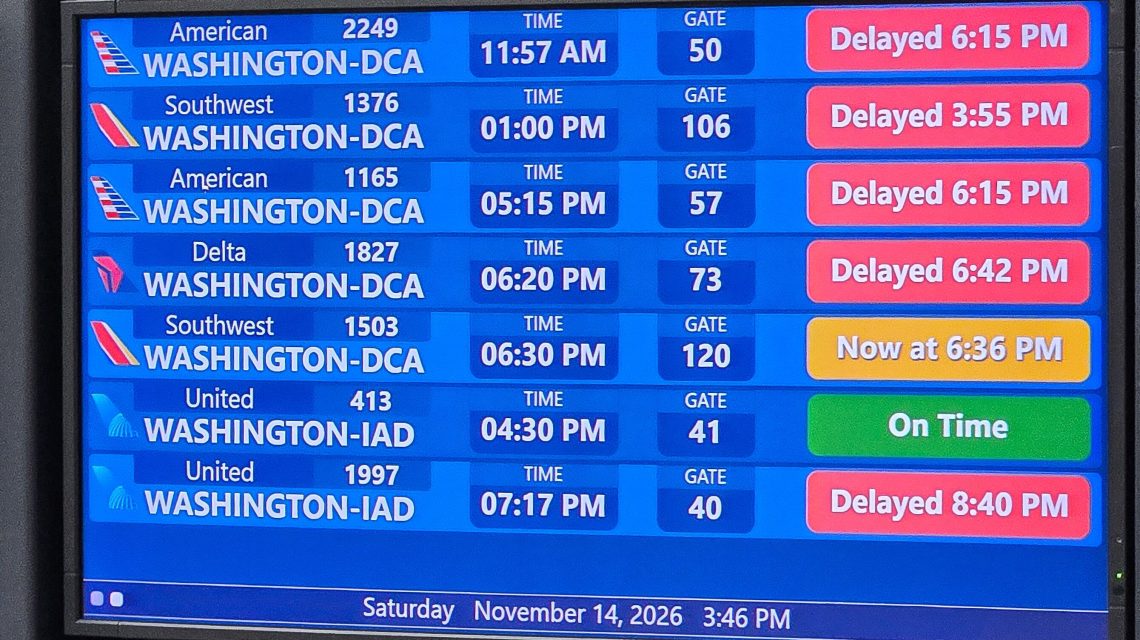
A digital flight information display showed delays to Washington, D.C., for multiple airlines at Orlando International Airport.
The problem stemmed from a new router installed by contractor L3Harris, overloading communication systems at numerous air traffic control centers. This router, installed in El Dorado, Arkansas, interfered with a replacement in Amarillo, Texas, triggering widespread issues.
In response, the FAA disabled the routers’ functionality at the affected locations and similar routers across the control system. Nonetheless, the precise cause of the failure remained unknown, according to Duffy.
Duffy noted the technician responsible for the installation was considered trustworthy and did not intend to sabotage the network, stressing the failure’s cause was still elusive.
This disruption highlights ongoing challenges facing the U.S. air traffic control system, grappling with outdated technology and equipment shortages.
The routers in question were outdated, purchased in 2001, and considered obsolete by 2006. Duffy now calls for $50 billion to upgrade systems, following an earlier $30 billion request, despite Congress approving $12.5 billion last year.
Transportation Secretary Duffy addressed the media at the Department of Transportation headquarters, commenting on the efforts to resume normal operations after major communication interruptions.
Trump Weighs In
President Donald Trump commented on the situation, urging Congress to approve further funding. He advocated for comprehensive upgrades rather than incremental improvements.
Come January, Democrats are set to assume control of Congress from Republicans, following electoral successes in the U.S. midterm elections.
Passengers at Orlando International Airport queued for security, experiencing delays as airlines managed scheduling backlogs post-FAA ground stop.
Duffy’s funding plea faced skepticism from Representatives Rick Larsen and André Carson. They questioned the need for additional funds, with $11 billion of $12.5 billion approved in 2025 for system upgrades remaining unspent.
Duffy explained that the previously allocated funds were restricted to certain expenditures and did not cover new software development necessary for airspace management.
Reporting by Helen Coster and David Shepardson; Editing by Sergio Non and Will Dunham