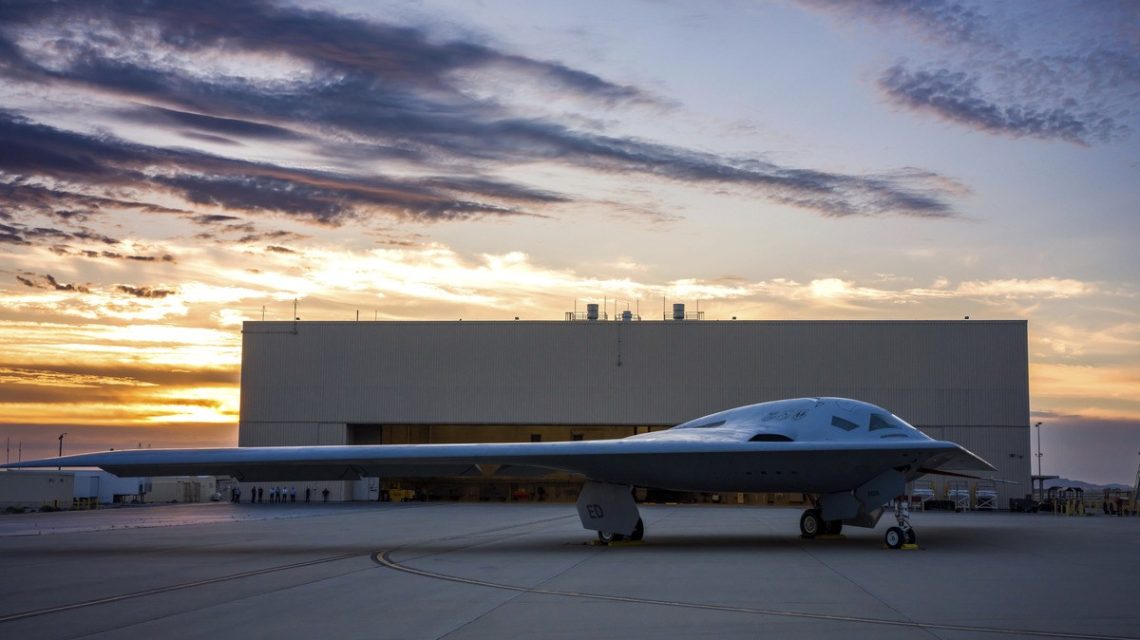
The U.S. Air Force announced a successful weapons test of the B-21 long-range aircraft. This occurred several months before the first batch of next-generation stealth bombers were set to arrive. The test took place at Edwards Air Force Base in California, where a B-21 Raider released a conventional weapon. The specific type of weapon remains undisclosed, and inquiries have been made to the Pentagon for clarification.
Northrop Grumman, the main contractor for the B-21, highlighted the trial as a significant achievement in the progress of America’s next-generation bomber. Air Force Chief of Staff General Ken Wilsbach praised the program, stating it is “excelling” in its development. Wilsbach emphasized the importance of building a “credible, penetrating strike” fleet for the future.
The B-21 Raider will replace existing U.S. bombers, B-1B Lancers and B-2 Spirits, over the next few years. Initially revealed in late 2022, the Northrop Grumman design completed its first flight in 2023. The Air Force plans to acquire at least 100 B-21s, equipped to carry conventional and nuclear weapons. These capabilities include launching the AGM-181 Long Range Stand Off Weapon, a nuclear-capable missile by Raytheon, and deploying B61-12 gravity bombs from the estimated stockpile of 200 B-61 bombs.
The LRSO aims to replace the AGM-86B missile by the late 2030s. According to Air Force Secretary Troy Meink, this weapons test showcases the U.S.’s ability to quickly adapt and target threats if deterrence mechanisms fail. Northrop Grumman’s aeronautics executive, Tom Jones, sees this development as a step towards unmatched deterrence capabilities.
The first B-21s are expected to arrive at Ellsworth Air Force Base in South Dakota within the next year. Whiteman Air Force Base in Missouri and Dyess Air Force Base in Texas have also been chosen to house these advanced bombers. The U.S. military views the B-21 as a sixth-generation bomber, part of an upcoming class of advanced aircraft with greater capabilities than current fifth-generation models like the F-35s and F-22s.
Sixth-generation aircraft will introduce advanced technologies, including the use of cheaper, drone escorts to undertake high-risk tasks, thus safeguarding human pilots. This evolution marks a substantial leap in aviation technology. The projected cost of each B-21 was initially set at $550 million in 2010, but this figure adjusted for inflation reached nearly $700 million by late 2022.
Beyond bombers, the U.S. is also developing sixth-generation fighter jets, with the Air Force’s F-47 and the Navy’s F/A-XX in progress. International interest has grown in similar programs such as the Global Combat Air Programme, involving the U.K., Italy, and Japan, following the collapse of Europe’s FCAS initiative.
The B-21 design bears resemblance to the B-2 but is slightly smaller. Named after the Doolittle Raiders, who executed daring attacks on Japan during World War II, the aircraft symbolizes a legacy of U.S. air power. Former Defense Secretary Lloyd Austin highlighted in 2022 the enduring power of American air capabilities.
To meet demand, Northrop Grumman plans to boost B-21 production rates by 25 percent annually, with expectations of producing between seven and eight bombers each year.
 The Daily Routine of Klook’s CEO Focused on Fitness and Efficiency
 In-Flight Altercation on Qatar Airways Leads to Police and FBI Response
 The Jensen Huang Controversy: Silicon Valley’s Divided Opinion
 Virginia Residents Sue Over Alleged Immigration Violations
 California Lawsuit Against OpenAI: Key Details and Implications
 Updates on Key International and Domestic Events