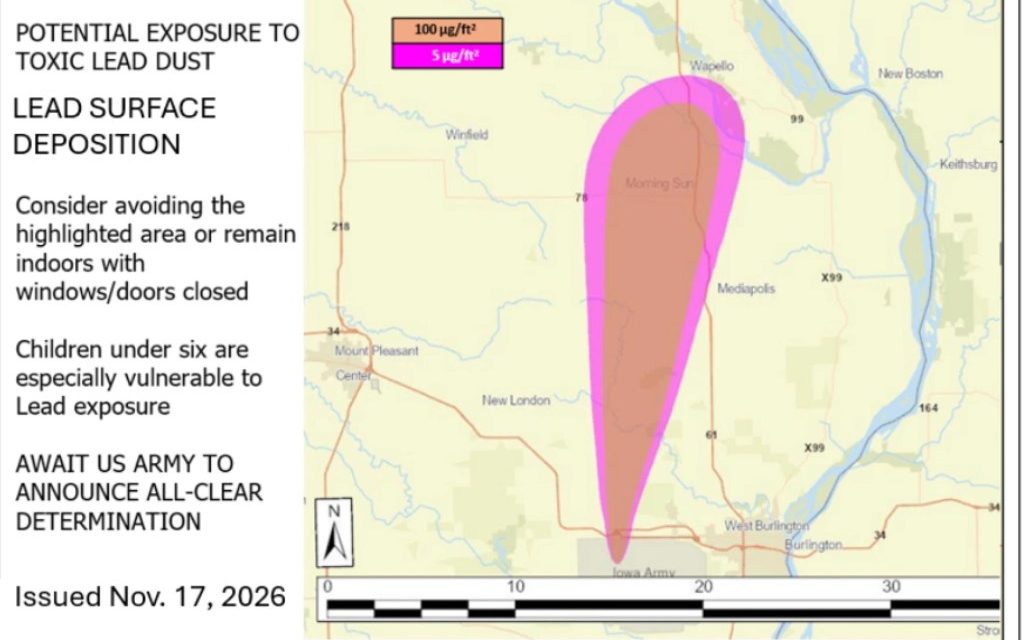
The U.S. Army has postponed a planned detonation of unstable bomb-making chemicals initially set for Friday in southeast Iowa. This decision follows significant public concern over potential environmental and health risks, particularly the possible spread of lead dust. The detonation is now rescheduled for Monday.
Iowa Governor Kim Reynolds played a key role in calling for the delay. She engaged directly with Acting Secretary of the Army Adam Telle. This effort aligns with a lawsuit filed by environmental groups seeking urgent court intervention to halt the detonation.
The discovery of several dozen barrels of degraded lead azide at the Iowa Army Ammunition Plant earlier this year necessitated the planned detonation. The U.S. Environmental Protection Agency (EPA) approved an emergency permit for this action. Moving the volatile chemicals poses a high risk of accidental explosion, particularly in cold weather conditions.
Telle stated the delay aims to execute the detonation just before a predicted temperature drop, minimizing further destabilization. Residents close to Middletown were encouraged to vacate the area in preparation. Details were shared at a local meeting in October, but more comprehensive notice came later for communities potentially affected far beyond the immediate vicinity.
The EPA required the Army to model the potential dispersion of lead dust. This emphasizes the significance of public communication. Many schools and businesses, including those in Danville, canceled operations in anticipation of the detonation. Danville School Superintendent Pat Wallace cited uncertainties in deciding to close schools for the day.
In Mediapolis, both schools and the public library were set to close on Friday. The local fire department planned to clean playgrounds that might accumulate lead particles. Quick vibrations from the detonation could potentially damage old windows nearby.
Army modeling suggests lead particle levels would remain below EPA’s threshold for protective action, though they recommend cleaning cars and surfaces. Residents have expressed concerns on social media regarding the adequacy of these measures.
The delay to Monday aims to mitigate risks associated with cold weather. Middletown residents became aware of the lead azide issue in March following a plant review. Lt. Col. Daniel Nosse assured the community of their commitment to safety. A panel of experts was assembled to devise the detonation plan.
Experts advise residents to take precautions. Lead exposure can affect neurological development, especially in children. Concerns have risen about possible contamination affecting pets and gardens. Morgan Hoenig from Iowa State’s Des Moines County Extension field office noted high demand for soil test kits due to these fears.
Environmental groups’ lawsuit argues the EPA and Army failed to consider safer alternatives. Although chemical neutralization was considered, handling the barrels was deemed too risky. The situation highlights the delicate balance between safety and environmental impact in handling hazardous materials.
 Netanyahu Faces Setback Amid Unity Government Talks
 The Silence of Women in Tech Regarding Jensen Huang’s Return
 Concerns Rise Over Death Sentence of Pakistani Christian Accused of Blasphemy
 The Controversy Surrounding Lake Ontario’s Renaming
 Pakistan to Bolster Saudi Defense Amid Houthi Attacks
 Opportunities and Challenges in Recent Developments