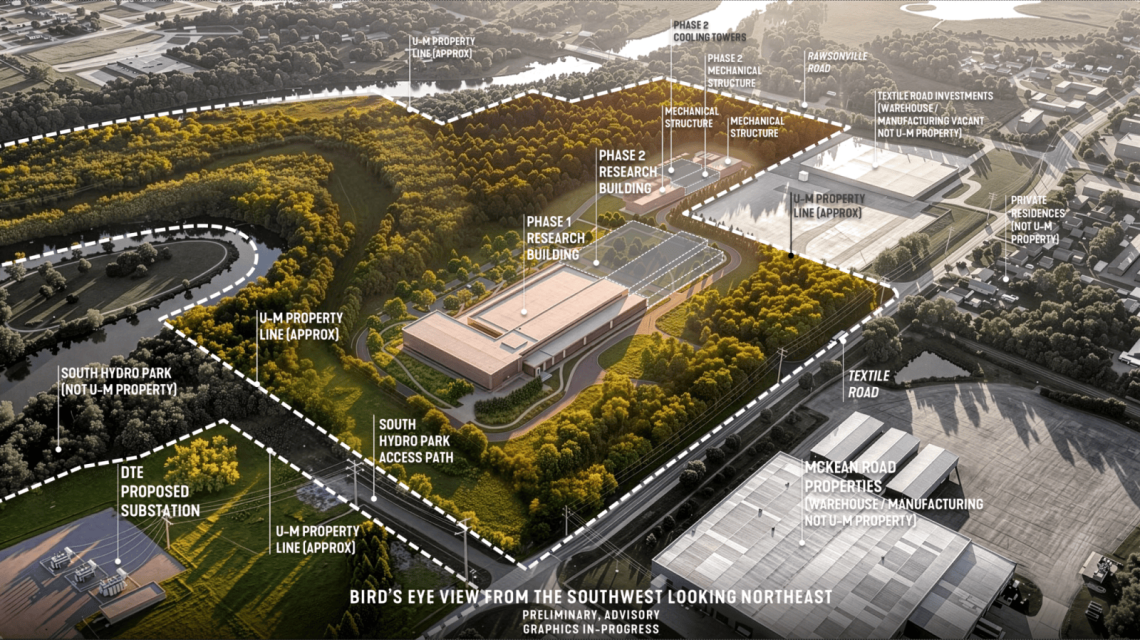
The residents of Ypsilanti Township in Michigan are actively opposing a project proposed by the University of Michigan. Following the Board of Regents’ approval last week, the university aims to fund a new research computing center.
University’s Ambitious Project
The board approved funding for the computing center, costing $785 million, with total expenses reaching $1.25 billion. This center will support research in various fields like medical, science, clean energy, engineering, and national security. It will be located on a 124-acre industrially-zoned site, with an additional 20 acres for a DTE electrical substation. The university describes the project as a “computing and research hub.”
Commitments from the University
University President Domenico Grasso emphasized the project’s significance, calling it essential for advancing scientific discovery in Michigan. The university plans to work with Los Alamos National Laboratory and the state to initially provide 50 megawatts of power, possibly expanding to 100. A $5 million commitment over five years will support the local Ypsilanti community through a Community Partnership Program.
Leadership involves listening and learning, and we are committed to engaging with local residents, Grasso stated.
In correspondence with Congresswoman Debbie Dingell, Grasso specified that the partnership with Los Alamos National Lab requires separate agreements for each activity, with no current obligation from Los Alamos in the National Nuclear Security Administration’s budget profile.
Community Pushback
Critics argue the facility is essentially a data center threatening the local environment. Groups like Stop the Data Center have opposed it for months. Concerns include disruption to the community and environmental impact.
The United Tribes of Michigan (UTM) also voiced opposition, emphasizing the need to preserve Native American sites. They are worried about the facility’s impact on cultural resources and requested involvement in development discussions.
Despite these concerns, a preliminary university review reported no evidence of archeological artifacts or culturally-sensitive materials at the site.
Regents and Community Leaders’ Reactions
Regent Paul Brown, the lone dissenting voter, supports local protests. He criticizes the university for inadequate community engagement and suggests the project disregards local voices, resembling environmental racism.
The university, which is exempt from local building laws and does not pay property taxes, faces legislative proposals to limit its authority. State Representative Jimmie Wilson argued against the university’s unilateral actions and betrayal of public trust.
Impact on Local Resources
The university promises to safeguard the local environment, ensuring the project will neither draw water from nor discharge into the Huron River. They are exploring efficient cooling technologies to manage water and energy use, including potential use of reclaimed wastewater.
Expected water usage for the full build-out could reach 650,000 gallons per day. The project is projected to create numerous jobs including construction and permanent research positions. An environmental impact assessment is ongoing, with construction expected to commence next year and the center opening in 2031.
For further comments or details on this development, Newsweek reached out to the University of Michigan and local officials.
 Leopold Aschenbrenner’s Vision for a Robotic Future
 Latest Developments in Politics, Technology, and Economy
 The Silence of Women in Tech Regarding Jensen Huang’s Return
 Lawmakers Question Nvidia CEO Jensen Huang Over National Security Concerns
 Uber Kids: A New Option for Busy Families
 Why Memorizing Facts Still Matters in the Age of AI