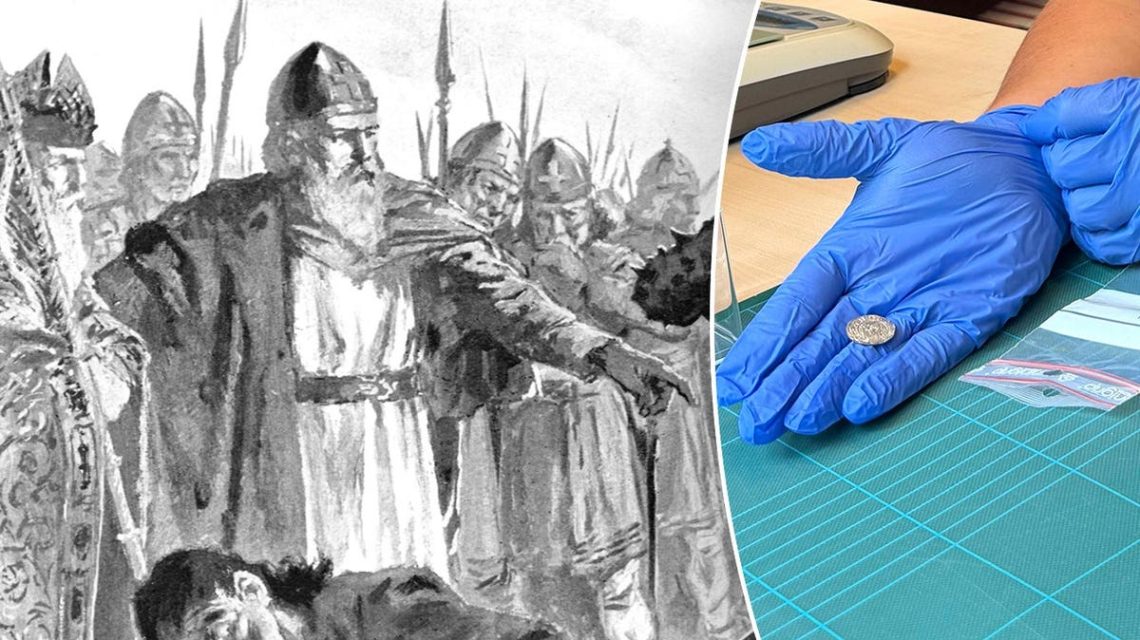
Archaeologists in Norway made an incredible discovery: a rare 1,000-year-old coin from the reign of Viking King Olaf Haraldsson, commonly known as Saint Olaf. This find is part of the largest Viking Age coin hoard ever uncovered in Norway, announced by the Museum of Cultural History in Oslo.
The Olaf coin marks the first discovery of its kind in Norway since 1924. It went on display on November 20 at the Historical Museum in Oslo, affiliated with the University of Oslo’s Museum of Cultural History. The exhibition showcases the Mørstad Hoard.
The hoard was uncovered on April 10 by metal detectorists Vegard Sørlie and Rune Sætre in Rena, Innlandet County. The site has been secured for extensive research since.
Officials report the cache contains 5,500 coins, with the potential to exceed 6,000. The standout of the hoard is the Olaf Haraldsson coin, depicting the king who ruled from 1015 to 1028 and later became a saint. His importance holds a unique place in Norwegian history.
“Fewer than 20 of his coins have survived, and most are found outside Norway,” stated an official release. “Only four of the type in the Mørstad Hoard have been discovered before, with just one in Norway.”
The coin, dated between 1024 and 1028, might have circulated for up to 25 years before its deposition in the Mørstad Hoard. Archaeologist Anne Skogsfjord identified the coin, initially misclassified as an Anglo-Saxon type.
“I could see the inscription ONLAF R+ NORMANORV,” Skogsfjord noted. “It was indeed the Olaf Haraldsson coin, a moment of national significance.” Her realization marked the find as a national treasure.
Featuring a cross on both sides, the coin signified Olaf’s use of currency to establish Christian legitimacy. Numismatics expert Svein H. Gullbekk explained how the coins were closely linked to the king himself.
Olaf Haraldsson may have even been present during their minting, suggesting the coin could have passed through his own hands.
Norway’s cultural heritage director, Hanna Geiran, highlighted the rarity and historical significance of the coin. She called it a tangible testament to the foundations of the Norwegian kingdom and its Christianization.
Anne Skogsfjord, who identified the coin, shared excitement about continuous discoveries within the treasure. “When you think this Viking treasure cannot become any more captivating, new surprises emerge,” added the museum.
Research will continue on the coin hoard. Each coin undergoes a meticulous process before joining the museum’s collection, requiring collaboration from numismatists, archaeologists, conservators, managers, and photographers.
Recently, other significant European coin discoveries have come to light. In Germany, archaeologists found 11 ancient Celtic coins at a construction site. While in Finland, a metal detectorist uncovered a Viking Age silver cache with about 4,000 coins and artifacts.
 Japan’s LDP Proposes Financial Support for Families to Counter Population Decline
 Netanyahu Faces Setback Amid Unity Government Talks
 The Silence of Women in Tech Regarding Jensen Huang’s Return
 Concerns Rise Over Death Sentence of Pakistani Christian Accused of Blasphemy
 The Controversy Surrounding Lake Ontario’s Renaming
 Pakistan to Bolster Saudi Defense Amid Houthi Attacks