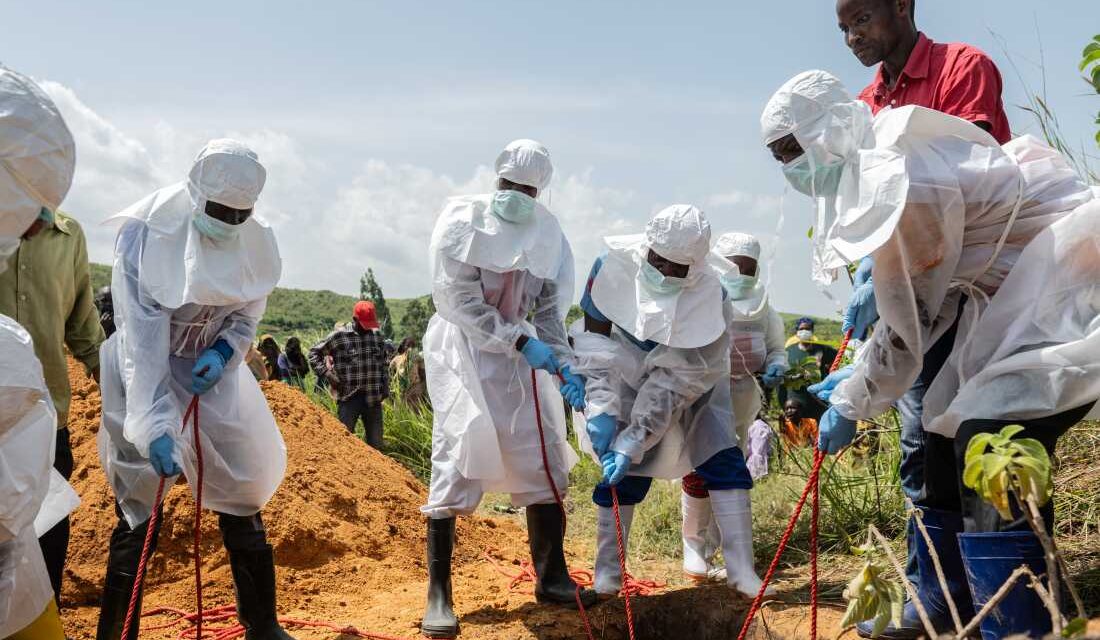
Kinshasa, Democratic Republic of Congo: Health workers in the Democratic Republic of Congo are urgently working to manage an Ebola virus outbreak, which is suspected of claiming more than 200 lives and poses a risk of spreading internationally. Congo’s government data, revealed on Saturday, reports 867 suspected Ebola cases and 204 fatalities.
The outbreak was first declared by the Congolese government on May 15. Since then, both confirmed and suspected cases have emerged in an area larger than Florida. Uganda, a neighboring country, has also reported five confirmed Ebola cases. The World Health Organization (WHO) has raised its national risk level for the disease to “very high.” Abdirahman Mahamud, WHO director of health emergency alert and response operations, emphasized the danger of rapid virus spread.
Ebola, a viral illness, induces vomiting, fever, and sometimes bleeding. Symptoms may take weeks to appear, and the disease is often fatal. Following the outbreak confirmation, Congolese health workers, UN staff, and aid organizations promptly launched large-scale containment efforts. However, some estimates suggest that Ebola spread unnoticed for weeks before being identified by health authorities, complicating response efforts.
The first identified case involved a nurse who exhibited symptoms on April 24 in Bunia, Ituri province.
An internal report from the Congolese health ministry states the nurse was buried in Mongbwalu, a gold-mining town in Ituri. Throughout April, Mongbwalu witnessed a series of mysterious deaths, including four health workers dying within a week. The report described widespread panic fueled by rumors of supernatural causes. The Red Cross reported that three volunteers in the region died from suspected Ebola after handling infected bodies.
Challenges in Response
Delays in identifying the outbreak partly arose due to a less common virus strain. Congo has experienced 17 official Ebola outbreaks since 1979, mostly attributed to the Zaire strain, which has an available vaccine. The current outbreak involves the Bundibugyo strain, according to Congo’s National Institute for Biomedical Research.
Aid workers have begun establishing Ebola treatment centers in eastern Congo. However, U.S. aid cuts pose obstacles, as noted by Congo’s Health Minister Roger Kamba. He urged increased funding to combat the disease, stressing that Ebola knows no borders, race, or tribe.
Tackling the outbreak in one of the world’s poorest countries, where 80% of the population lives on $3 per day or less, is daunting. Violent armed groups and poor road infrastructure further hinder efforts. Ituri, the outbreak epicenter, is plagued by groups like Codeco and the ADF. Areas like Mongbwalu and Rwampara face difficulties due to their status as rough mining towns with cramped, unsanitary conditions.
Community Trust Issues
A critical challenge for health responders is a lack of community trust. Mixed reactions exist, with some residents actively seeking information while others remain suspicious, believing Ebola to be fabricated, according to Gabriela Arenas, IFRC Regional Operations Coordinator. Incidents of health clinics being attacked and medical tents set on fire have occurred twice in Mongbwalu and Rwampara.
Risk of International Spread
Confirmed cases have also emerged in North Kivu and South Kivu provinces, complicating efforts due to governance by Rwanda-backed M23 rebels. Concerns persist about Ebola spreading to nearby countries, as eastern Congo’s economy is connected with Uganda, Rwanda, and Burundi.
Uganda shares a land border with Ituri and is managing a smaller outbreak after two infected Congolese traveled there. The Ugandan health ministry recently reported three new Ebola cases involving nationals exposed to the infected travelers. To prevent further spread, Uganda has temporarily halted flights to and from Congo and limited border crossings.
 Increased Funding Needed for Psychiatric Hospitals
  Trump Administration Distributes ACA Refund Checks
  Higher Consumption of Ultra-Processed Foods Linked to Increased Health Risks
  Understanding Inflammation: Myths and Facts
  Calm Parenting: Strategies to Manage Stress
  Trump’s Executive Order to Combat Mosquitoes and Ticks in D.C.