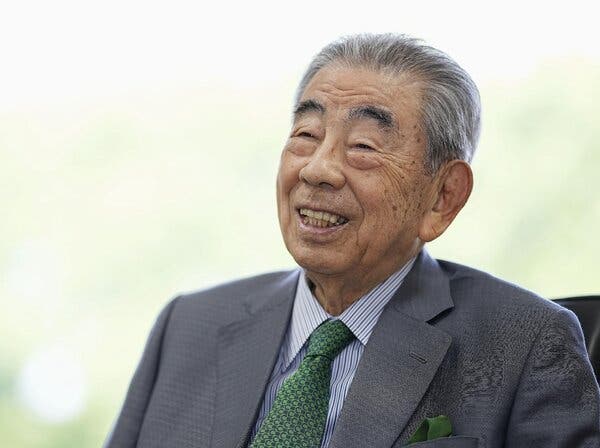
Toshifumi Suzuki, a key figure in transforming 7-Eleven into a daily staple in Japan, passed away last week due to heart failure at 93. His work over four decades solidified 7-Eleven’s dominance in the convenience store sector across the country.
Seven & i Holdings, the Japanese operator of 7-Eleven, where Mr. Suzuki held the position of honorary adviser, confirmed his death on Monday. During his leadership, he expanded the business from a single outlet in Tokyo’s eastern bay to a vast network with tens of thousands of locations. Mr. Suzuki is remembered for his relentless innovation, introducing several features that are now synonymous with modern Japanese convenience stores. These innovations included services such as in-store banking and popular products like crisp, seaweed-wrapped rice balls.
After his resignation in 2016, 7-Eleven faced various challenges, such as stagnant profits and a turbulent takeover attempt by a Canadian competitor. The company also struggled with leadership transitions aimed at reigniting growth. Many within the organization feel that some of the culture of innovation dissipated following Mr. Suzuki’s departure.
Mr. Suzuki was born in Nagano Prefecture, located northwest of Tokyo. His career began in publishing sales, but he was later recruited by Masatoshi Ito, founder of the Ito-Yokado retail chain, to join the company. By 1971, Mr. Suzuki became a director. A few years later, he envisioned adapting the American 7-Eleven chain, operated by Southland Corporation in Dallas, for the Japanese market. At the time, this concept met with skepticism, as the market was dominated by smaller, family-run businesses.