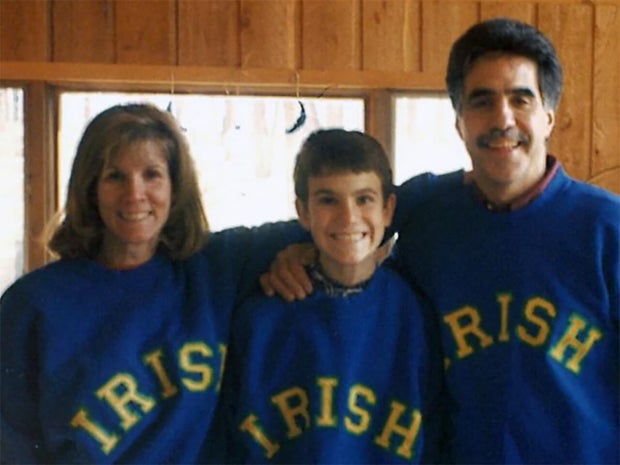
“I hate to say it, but when I knocked people out – and I did knock people out – I did consider that an accomplishment,” reflected Jim Musuraca. “It’s just a very violent sport, and that’s an example of violence at its height, knocking somebody out.” Although his name and face may not be widely recognized, Jim Musuraca, a lawyer from New York City, was once a prominent lineman for the Notre Dame Fighting Irish. His dream of playing for Notre Dame started early in Catholic grammar school. “They had a trophy case, and in that trophy case was a football signed by Knute Rockne, and I was fascinated by that,” he explained. “And from some reason, I latched onto the notion that I wanted to go to Notre Dame.”
His performance statistics are recorded in the USA Today College Football Encyclopedia. Co-editor Paul Guido, who interviewed Musuraca in 2016, highlighted that numbers alone don’t capture what playing football meant for working-class families. “Italians and Irish were still moving up in society in the ’60s,” Guido noted. “In some ways, they hadn’t made it yet.” Musuraca, the fourth of six children, hailed from Southeastern Ohio, where his father worked as a steel mill foreman. Securing a college scholarship was a path to a different life. “That was your way to sort of be the Big Man in town,” said Guido. “But it was also his ticket to get out, because it was either mining, factory, or steel mill.”
Like many boys of that era, Musuraca began playing tackle football at age nine and continued for the next 12 years, accumulating both trophies and injuries. “I remember in ninth grade in an all-star game, I got hit, and I played the whole game, and I don’t remember anything about the game,” Musuraca recounted. In college, despite being smaller than most linemen, Musuraca felt the need to prove himself: “When practice started, I was just like a maniac. I thought I had to be that way to keep up. And I was noticed for hitting hard and going full-go. But it was really because I was scared to death of these huge guys.” After graduating from Notre Dame in 1973, Musuraca realized football had taken its toll. “I was all beat up. My body’s a wreck. I just don’t want to beat it up anymore,” he stated.
Opting against the NFL, Musuraca pursued law school and a career in legal practice. Over time, however, he couldn’t ignore the lingering damage from football. “My brain just started to get foggy. I was just forgetting all sorts of things,” he said. By the time of this interview, Musuraca, then 65, feared he had Chronic Traumatic Encephalopathy (CTE). “I’m actually in the process of retiring because I just can’t remember things,” he explained.
CTE, a neurodegenerative disease caused by repeated head impacts, was once thought to affect only boxers. In 2002, an autopsy on former NFL player Mike Webster revealed he had CTE. Since then, numerous studies have emerged with alarming data. One study published in October showed nearly 75% of former NFL players likely had CTE at their time of death. “It’s a tough disease,” said Chris Nowinski, a former Harvard football player and founder of the Concussion and CTE Foundation. “We know it causes dementia and serious cognitive issues.”
Nowinski explained that CTE often goes undetected in non-NFL players because there is no definitive test for CTE in living individuals. “The problem we have is that the college players aren’t as famous as the NFL players,” he said. “They’re sort of quietly suffering.” This challenging story is deeply personal. The author met Jim after law school, and they studied for the Ohio Bar exam together. He was described as a fun and funny husband, an excellent father to Nick. When the Jim they knew began to fade, the search for answers began. Musuraca recalled visiting a neurologist who dismissed his condition as “a slight cognitive impairment.”
In 2019, Jim joined a Boston University CTE Center study with nearly two dozen former football players. These participants agreed to testing in life and brain donation after death to advance research. “If we can tell someone they have CTE, we can really start to open doors for treatment,” said Dr. Michael Alosco, co-director of clinical research. “We want a biomarker that provides insight into what’s going on in the brain.” Jim’s MRIs showed damage leading to his memory loss and confusion. Further tests ruled out Alzheimer’s, leading Alosco to suspect CTE, only confirmable through autopsy.
On January 8, 2026, Jim died at age 74. Neuropathologist Dr. Thor Stein examined his brain. “We staged the disease from a one-to-four scale. He had the most severe form – Stage 4 CTE,” Stein said. The autopsy confirmed the presence of toxic tau tangles, characteristic of CTE. “When we looked under the microscope, the reason that he had lost that brain tissue was because of the tau pathology of CTE,” Stein explained.
Though answers arrived too late for Musuraca and others in the study, their contribution holds potential for future breakthroughs. Data collected during the study, particularly a unique protein marker, may lead to a diagnostic test for CTE. Dr. Alosco conveyed optimism: “We saw the marker all the way up here for high-stage CTE, and then the marker all the way down for no or low-stage. And we’re like, ‘Oh my gosh, we haven’t seen this before.'”
Of the 21 men in the study, 16 had Stage 4 CTE. Importantly, their blood contained a protein known as eMTBR-tau, distinct to CTE. Alosco described it as a breakthrough: “We got the blood while they were living. We got the brain, so we know CTE is there or not. It’s the best way to develop these tests.” While further studies and FDA approval are required, a diagnostic blood test could be crucial for treating CTE.
CTE took Jim Musuraca from his loved ones. Yet, his and his teammates’ legacy endures through their significant contribution to science. Dr. Alosco emphasized, “Their legacy will live on, not just with this study and discovery, but with many other research initiatives.”
Produced by Kay Lim. Editor: George Pozderec.
For more information:
Concussion & CTE Foundation
Boston University’s Chronic Traumatic Encephalopathy (CTE) Center
Photos courtesy of University of Notre Dame Archives.
 Texas Governor-elect Expanding Abortion Exceptions and Pennsylvania’s Abortion Rights Debate
 Understanding Iron Deficiency and How to Address It
 Safety Concerns Arise After Louisville Shooting
 Surge in Stroke Survivors and Costs Predicted by 2050
 Lab Tests Show No Lead Contamination in Iowa Water After Detonation
 Short Walking Breaks May Stabilize Blood Sugar Better for Desk Workers