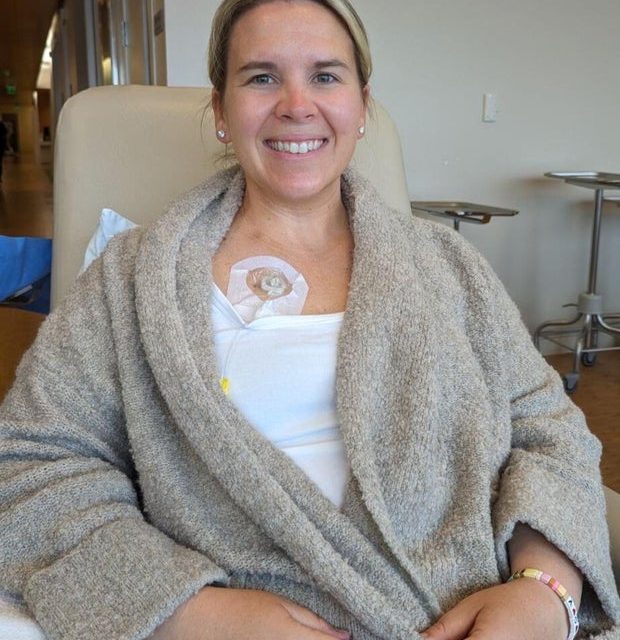
In May 2024, Amy Piccoli’s encounter with a common stomach bug unfolded into something unexpected. As a mother of three from Los Angeles, she was accustomed to dealing with seasonal illnesses.
Piccoli soon experienced severe dehydration and ended up in the emergency room. During a series of evaluations, a CT scan revealed spots on her liver and a mass in her colon. An MRI and subsequent biopsy confirmed what she feared the most.
“My doctor called me and said ‘We think that the liver spots are cancer that has spread from the colon,'” Piccoli, 39, recounted. “I was in complete shock. I had no symptoms … I have no family history of any type of cancer.”
Her diagnosis of Stage IV colon cancer came just before Memorial Day weekend. She spent the holiday searching online, only to find distressing statistics that left her and her husband anxious and tearful.
Piccoli had always been vigilant about her health, regularly visiting her doctor and noticing bodily changes. Her inability to detect the cancer earlier bewildered her.
An Unexpected Diagnosis
Colon cancer usually manifests through symptoms like gastrointestinal discomfort, blood in the stool, and unexplained weight loss, according to Dr. Robin Mendelsohn from Memorial Sloan Kettering Cancer Center. Receiving a late-stage colorectal cancer diagnosis without symptoms is extremely unusual. Some warning signs, like fatigue, might not be immediately recognized.
Piccoli began chemotherapy in June 2024. Further genetic tests suggested immunotherapy could also be effective for her case. The medications led to a significant reduction in tumor size, allowing for the removal of the tumor in her colon. However, removing the liver tumors surgically was not feasible.
A New Hope for Treatment
Dr. Zachary Dietch, a transplant surgeon at Northwestern Medicine, explained that without further intervention, Piccoli’s chances of surviving more than five years with ongoing chemotherapy were about 10%. However, European studies revealed that patients who had the cancerous section of the colon removed and received a liver transplant showed significantly better outcomes, with five-year survival rates reaching up to 80%.
To qualify for this treatment, strict conditions apply. Patients must have a low recurrence risk, and the cancer should be confined to the liver. Due to these constraints, only a few patients are eligible.
At the recommendation of her oncologist, Piccoli sought an evaluation at Northwestern, led by Dr. Satish Nadig. In September 2025, she traveled to Chicago for an assessment, which confirmed she could receive a liver transplant from a living donor. Several friends and family members were tested for compatibility, and Lauren Prior, a family friend, was chosen as her donor.
The Road to Recovery
In December 2025, Piccoli, accompanied by Prior, returned to Chicago for the procedure. Piccoli was optimistic about the surgery despite the inherent risks.
“I was just so excited for the surgery. I was excited for a transplant. I had no fear around such a major surgery,” Piccoli said. “I knew I would be cancer-free. For me, it was the end of a long, terrifying, draining experience, and I just wanted to put it past me.”
Dr. Dietch reported that both surgeries went smoothly. Piccoli stayed in Chicago for three months following the transplant to adjust to anti-rejection medications and undergo regular monitoring.
Though being away from her family proved challenging, Piccoli viewed the ordeal as a necessary step for a long, fulfilling life with her children.
“It was hard, it was hard on everyone, but at the end of the day, I did this so that I can live a long life for my kids,” Piccoli said.
She returned home in March, remaining vigilant with regular scans to ensure early detection of any potential cancer recurrence. Nadig confirmed that the risk of recurrence is typically low for qualified patients, and any recurrence tends to appear in localized areas.
“It’s not a death sentence anymore,” Nadig said.
With encouraging results so far, Piccoli is looking forward to spending the summer with her young children, savoring her renewed perspective on life.
“Cancer is horrible, but it’s a blessing, in the sense that it gives you a new perspective on life,” Piccoli noted. “I’m just excited to live my life with this fresh perspective and spend time with my kids and not be on chemo and have a really fun summer with them.”
 Early Detection of Atherosclerosis and Heart Disease Prevention
  Church Attendance Linked to Increased Sexual Satisfaction for Married Couples
  Dining with Loved Ones May Benefit Blood Sugar Levels
  Urgent Need for Action in East Africa’s Food Crisis
  Facing Terminal Illness: Embracing Life’s Moments
  Eating with Partners May Impact Blood Sugar Regulation