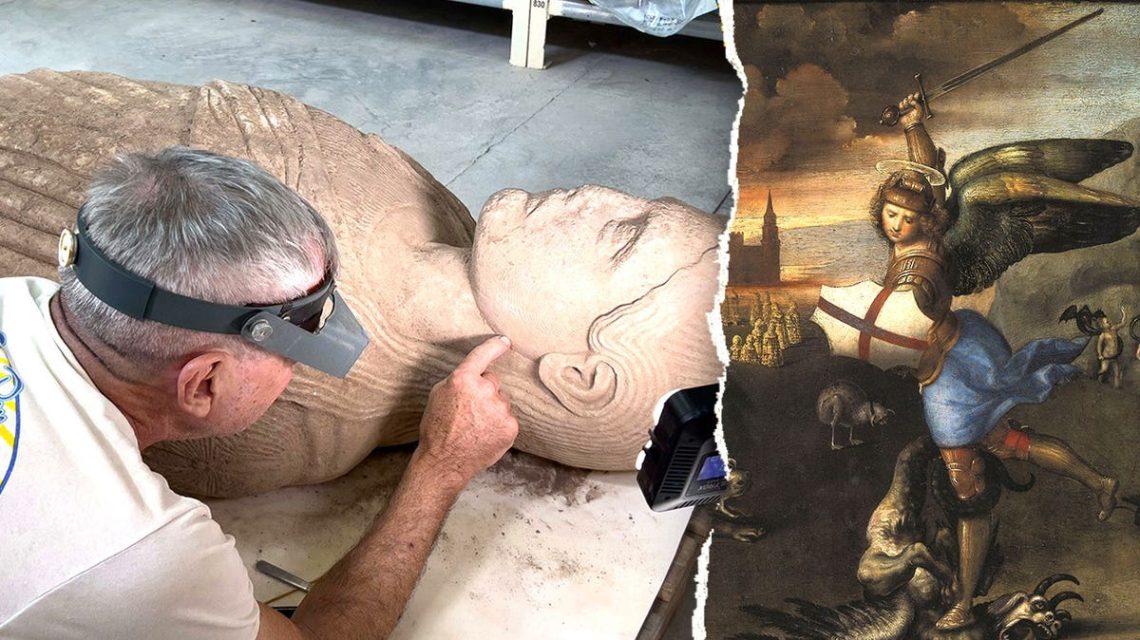
A rare marble statue, dating back 2,500 years, has been discovered in Sardis, an ancient city featured in the Book of Revelation. This significant find, from the fifth century B.C., was announced by the Turkish Ministry of Culture and Tourism in August. Sardis is located in Salihli, Manisa, approximately 45 miles from İzmir.
Photos reveal excavators carefully retrieving the statue, which retains its detailed facial features. The statue represents a young man and stands roughly 7.2 feet tall. Culture and Tourism Minister Mehmet Nuri Ersoy called the find an “extraordinary discovery” in a translated social media post. Positioned face-down and repurposed as paving, the statue’s features remained protected throughout the Roman period.
The unusual details of its clothing bear traces of Lydian culture. This type of clothing is not seen on comparable statues from Anatolia and Greece, highlighting the work’s local characteristics and its connection to Lydian culture.
The statue’s clothing features horizontal lines, not typically seen in similar statues from Anatolia and Greece, signifying its local origins. It provides critical insights into the cultural interactions and religious beliefs of life in Sardis during its era.
Sardis was the capital city of the ancient Lydian Kingdom and later became a central hub of the Persian Empire. It is listed among the seven churches in Asia Minor in the Book of Revelation, alongside Ephesus, Pergamum, Thyatira, Smyrna, Philadelphia, and Laodicea.
Researchers plan to investigate the statue for remnants of original pigment, as marble statues were often painted. Conservators will delicately remove hardened deposits, preserving any traces of paint. Specialists will also analyze the surrounding soil for color evidence.
Upon completion of conservation and restoration efforts, the statue is set to be displayed at the Manisa Museum in western Turkey. This discovery adds to a series of recent archaeological finds in ancient cities mentioned in the Book of Revelation.
Earlier discoveries include a mosaic in Smyrna and a Roman-era marble bathtub and statue fragment in Ephesus, both located in modern-day İzmir, Turkey.
 Ukraine Converts APCs to Explosive Devices in Donetsk Offensive
  Dutch Review Board’s Euthanasia Ruling and International Debate
  Israeli PM Commends Heroic Actions in Flight Emergency
  Rabbi and Jewish Leaders Criticize Adam Brody for ‘Genocide’ Comment
  Flydubai’s Emergency Landing Highlights Cockpit Security
  Former Israeli PM Naftali Bennett Commends Passengers and Crew for In-Flight Heroism