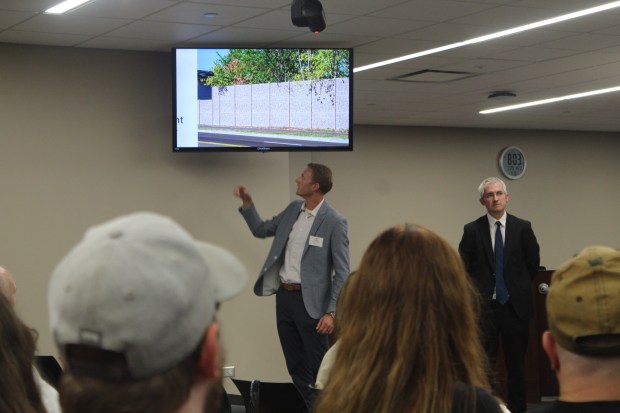
After years of delays, Aurora is developing plans to curb vehicle noise for residents along Orchard Road by next summer. However, the precise design for the new sound wall remains uncertain, and residents have expressed concerns about safety, wall height, and materials.
During a recent meeting at Aurora City Hall, city-hired engineers suggested a sound wall with noise abatement materials on both sides of Orchard Road, between Prairie Street and Indian Trail. The proposed height is 13 to 14 feet, exceeding the current 10 to 12-foot high wooden wall, which has proven ineffective at reducing noise.
The designs stem from a five-month sound and engineering study under a $169,000 contract with Thomas Engineering Group, LLC, approved earlier this year. Ian Wade from Aurora’s engineering division indicated that the final design might be put to bid later this year, aiming for construction before the end of 2026.
“Long story short, we’re on the cusp right now,” Wade stated. “I think we’ve got a pretty good product, and we’ve got a lot of information.”
Officials underscore urgent action to bid the project as winter approaches. Plans involve removing the existing wall before starting new construction to minimize the time without a barrier.
Carl Franco, representing Aurora’s 5th Ward, stressed urgency. “You take it down, you’ve got to put something up.”
Three materials are proposed for the wall: precast concrete, linear low-density polyethylene plastic, and fiberglass composite. Each varies in construction time, lifespan, and cost. Residents initially favored concrete for its durability but shifted interest to a 16-foot wall using polyethylene plastic, available only in 12 or 16-foot heights.
Despite initial support for concrete due to its safety benefits as a barrier, engineers clarified that the materials are not barriers, and road safety warrants separate initiatives. Concrete construction is hampered by costs and complexity, particularly with underground power line adjustments.
Residents consistently rejected fiberglass composite, noting its hollow structure and tendency to reflect rather than absorb sound—an opinion reinforced upon examining a sample at the meeting.
Residents also requested taller walls than proposed and sought access doors. Franco urged compromise, advocating for completion by next summer within the $6 million budget.
“I want it done now. I want something good,” Franco declared.
A special service area property tax, previously floated for project funding, faced opposition from residents. The project anticipates $800,000 in state grants, with Kane County contributing over $1 million following a 2024 agreement. Franco has pledged $600,000 from ward funds, with the remaining $3.6 million from the city’s capital improvement fund.
Post-construction, the city will handle basic wall maintenance, while Kane County assumes capital upkeep, per a 2024 agreement approved by the Aurora City Council.
Throughout the meeting, safety concerns along Orchard Road remained a priority. Residents shared incidents where vehicles damaged their property. Brittany Charmelo, a resident, highlighted safety alongside noise reduction: “I’m happy about the sound being dampened. I’m thrilled about it, but we have got to be safe on the properties that we own.”
This sentiment resonated with residents, urging officials to address safety in tandem with noise mitigation, given new developments affecting the area.
 Patrick McEnroe Advocates for Collegiate Athletic Reform
  Push for Reparations Faces Challenges and Calls for Strict Eligibility
  Texas Man Arrested for Threatening State Capitol Attack
  The Key Debate Between Xavier Becerra and Steve Hilton: What You Need to Know
  Physicians Urge Senate to Reject FDA Nominee
  Trump’s Executive Order to Combat Mosquitoes and Ticks in D.C.