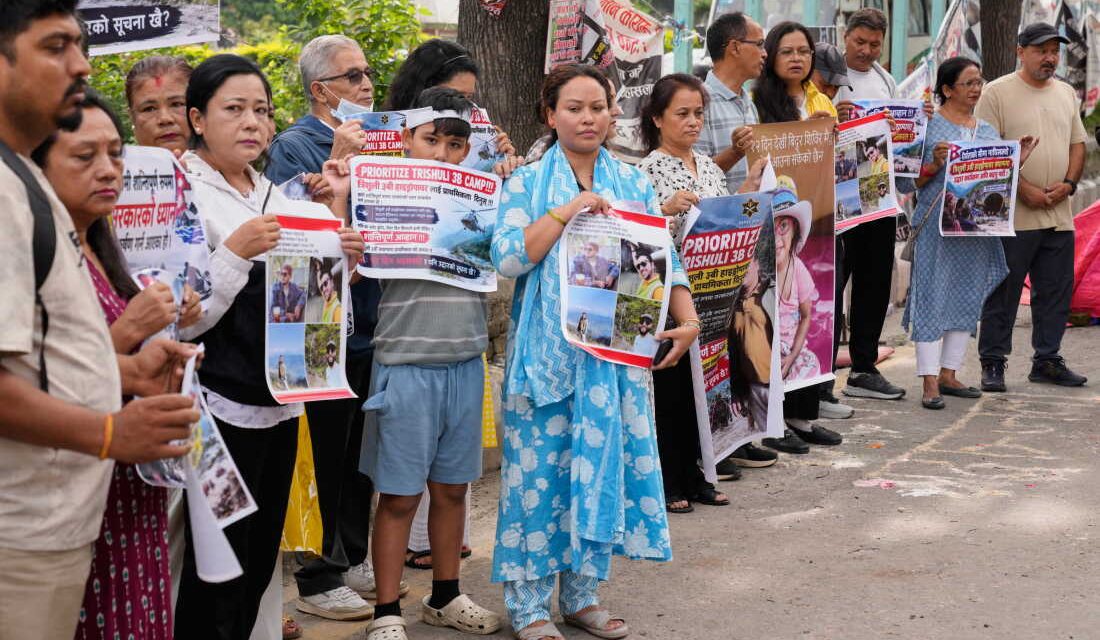
Relatives of victims from recent flash floods are urging authorities in Kathmandu to increase efforts in locating their missing loved ones. Demonstrators gathered in Nepal’s capital on Monday holding signs and demanding action.
When flash floods struck the Nepal-China border on August 26, Nepalese officials released a list detailing the missing foreigners. Chinese authorities took five days to confirm that 261 foreigners were missing in Tibet, spanning 23 countries.
Nepal reports over 1,300 deaths and nearly 5,000 missing persons due to the flooding. China reports more than 40 deaths and over 500 missing individuals.
“Xinhua and CCTV exercise full control over information,” said David Bandurski from the China Media Project, highlighting the expected role of guiding public opinion.
Over the past decade, information censorship levels have become unprecedented in China. Rights groups have noted the lack of independent access to flood-affected areas in Tibet.
Ryan Fioresi from the International Campaign for Tibet highlighted the immediate access granted on the Nepal side for journalists and relief organizations, compared to China where foreign journalist access is heavily restricted.
Nepal’s authorities, including its police and disaster management office, actively provide social media updates. In contrast, foreign journalists were only granted access to Tibet after repeated requests and careful arrangements by the Chinese government.
The International Campaign for Tibet reports around 300 homes destroyed in Gyirong County, with potential casualty numbers higher than official Chinese reports. Fioresi mentioned that affected Tibetans have been relocated to controlled zones with limited external communication.
China’s foreign ministry did not comment when approached by NPR but previously claimed openness in communication regarding the disaster.
“Smear and disinformation during disaster response are unwelcome,” stated foreign ministry spokesperson Guo Jiakun.
Chinese media coverage contrasts sharply with past disasters like the 2008 Sichuan earthquake, where commercial media quickly mobilized journalists despite censorship restrictions. Currently, outlets such as Southern Metropolis Daily exhibit restrained coverage, largely republishing state news agency reports.
“Xi Jinping has curtailed commercial press development,” Bandurski explained, noting tight control over narratives and information.
While Guo denied the deletion of videos online, Bandurski noted authorities actively removed numerous videos post-floods.
Ten individuals were penalized by Chinese police for spreading perceived misinformation.
State media journalists joined rescue teams, trekked overnight, and faced adverse weather to report from heavily affected areas, concentrating on rescue efforts and government responses.
Reports focused more on operations logistics and leadership reactions than on flood victims.
NPR contributors Diaa Hadid in Mumbai and Mamita Bhandari in Kathmandu supported the report.
 British Police Arrest Man Suspected of Terror Plot
  Activists Push for Nationwide Ban on Child Marriage in the U.S.
  Investigation into Alleged Incident at Cornell University
  Rising Drone Threats Highlight Vulnerabilities in Moldova’s Airspace Defense
  Bolivia Faces Security Test Amid Unrest
  Incident on FlyDubai Flight Raises Security Concerns