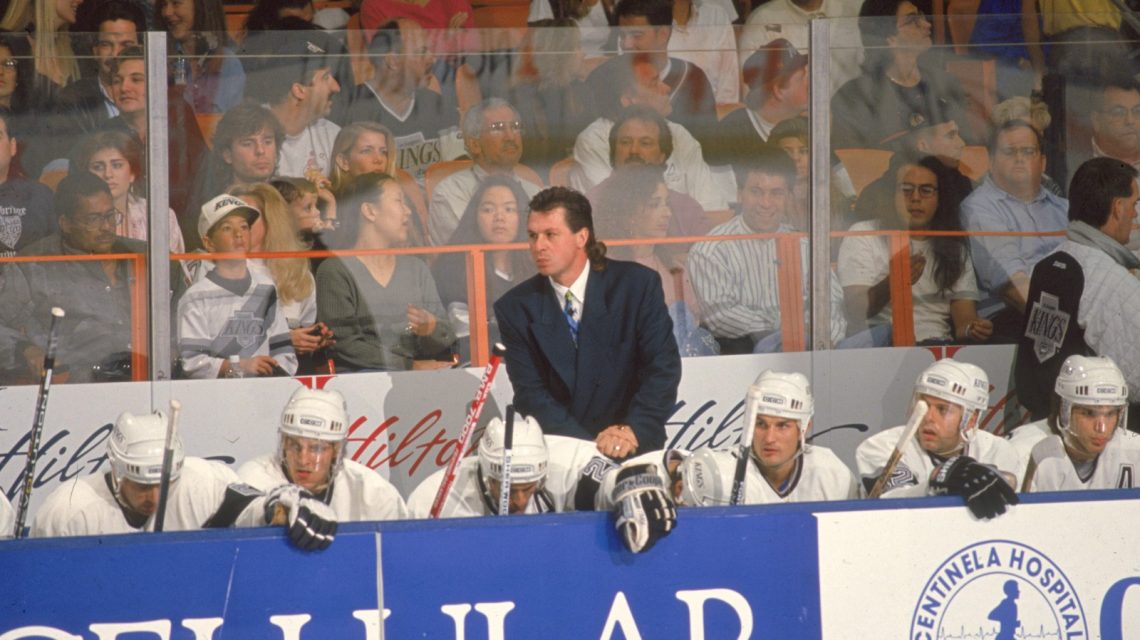
Barry Melrose, known for his contributions both on the ice and as a prominent hockey analyst, has passed away at the age of 70. ESPN announced his death on Wednesday, mentioning that Melrose had been diagnosed with Parkinson’s disease in 2023, which led to his retirement from broadcasting earlier that year.
Born on July 15, 1956, in Kelvington, Saskatchewan, Barry Melrose started his trajectory in the world of professional hockey when he was picked by the Montreal Canadiens in the second round of the 1976 NHL Draft. His early career began with the Cincinnati Stingers in the World Hockey Association (WHA), where he played for three seasons until the league’s dissolution. He then transitioned to the NHL, making his first appearance with the Winnipeg Jets in 1979, followed by stints with the Toronto Maple Leafs and Detroit Red Wings.
Known for his defensive skills, Melrose was more recognized for his play away from the puck. Over his NHL career, he played 300 games, scoring 10 goals and securing 33 points, while serving 728 penalty minutes. In the WHA, he accumulated five goals and 32 points in 178 games.
Barry Melrose found coaching to be a quicker route to prominence. His career behind the bench began with the Medicine Hat Tigers in 1987, where he won the Memorial Cup in his inaugural season. He then coached the Seattle Thunderbirds and Adirondack Red Wings, leading Adirondack to victory in the 1992 Calder Cup championship.
The major breakthrough for Melrose came with his role at the Los Angeles Kings. In the 1992-93 season, Melrose was hired to coach the Kings and immediately impacted the team’s performance. Under his guidance, the Kings, led by Wayne Gretzky, made it to the Stanley Cup Final, overcoming teams like Calgary, Vancouver, and Toronto before succumbing to the Montreal Canadiens in a five-game series. Despite missing the playoffs in the following two seasons, Melrose’s influence was notable.
Barry Melrose then transitioned to television, becoming a defining figure for a generation of American hockey fans. In 1996, he joined ESPN as a studio and game analyst, known for his extensive hockey knowledge and distinctive style, including his humorous commentary, mullet, and flamboyant suits. Over his 27 years at ESPN, Melrose covered significant events like All-Star Games, Stanley Cup playoffs, and Stanley Cup Finals, often working with colleagues Steve Levy and John Buccigross.
Barry was my best friend at ESPN,” Buccigross wrote on Twitter/X, deeply mourning the loss. He described Melrose as a big brother figure with unwavering values, recalling how he learned of Melrose’s passing while at a hockey rink in Las Vegas, a fitting place to remember his friend whose life was devoted to the sport.
Melrose briefly left ESPN in 2008 to coach the Tampa Bay Lightning, but returned to broadcasting after being dismissed halfway through the season. He continued his work at ESPN until his retirement in 2023.
Barry Melrose’s contributions extended beyond his professional achievements. Bill Hofheimer, ESPN’s vice president of public relations, praised Melrose for his nearly three-decade tenure at ESPN, noting his deep passion for hockey and his ability to bring enjoyment to fans. Barry Melrose’s legacy in hockey, both on and off the ice, remains impactful.
 Nick Saban’s Comments on ESPN Spark Debate Over College Sports Regulations
  Freddy’s American Adventure: From Soccer to College Football
  Brock Purdy’s Impressive Start in the 2026 NFL Season
  The Value of Retaining Miles McBride for the Knicks
  Penguins Make History with Dominant Season Opener
  Sonny Gray Expresses Frustration After Game Against Yankees