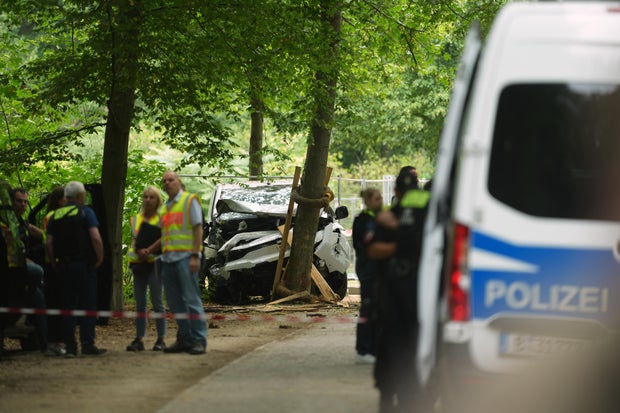
The car ramming attack at the Berlin LGBTQ+ Pride parade on Saturday is believed to have been driven by Islamist extremist ideology, according to authorities on Sunday. The attack at one of Europe’s largest LGBTQ+ events resulted in one death and 29 injuries.
German police have identified the suspect as 21-year-old Abdul Ballout. Police described him as part of Berlin’s ‘Islamist scene’ and someone previously known to authorities. Interior Minister Alexander Dobrindt stated, ‘Everything we see here points to us dealing with an Islamic terror attack.’
Ballout was born in Germany, and his mother became a naturalized citizen in 2002, three years before his birth. He has a prior conviction and was given a suspended sentence of 1 year and 10 months, though details of the conviction were not provided.
Early Sunday, police searched an apartment in Berlin’s Schöneberg district but found no one there. The suspect’s heavily damaged vehicle remained at the attack site on Sunday morning.
In a wanted notice Sunday, police warned that Ballout may be armed and dangerous and advised the public to avoid ‘direct contact.’
There are efforts to determine if Ballout acted alone. Investigators suspect that one or more individuals may have exited the vehicle after it stopped. Some victims suffered stab wounds, indicating possible involvement of others; however, this has not been confirmed.
Dobrindt mentioned that Ballout is believed to have used a machete for causing injuries. Berlin’s fire service reported that among the injured, three have life-threatening injuries, eight are seriously injured, and five have slight injuries. The deceased victim has not yet been identified.
Before the attack, large crowds celebrated peacefully in front of Berlin’s iconic Brandenburg Gate, featuring numerous floats, live music, and a march. ‘It’s a dark day for the community,’ said Julian Miethig, an event attendee planning for an afterparty when news of the incident surfaced.
Emergency personnel and police gathered in Berlin following the cancellation of Christopher Street Day festivities.
Rise in Ramming Attacks
The incident is the latest in a series of attacks causing concern over public safety. In December 2024, a car attack on a Christmas market in Magdeburg resulted in six deaths and hundreds of injuries. Another attack in Munich two months later killed a woman and her 2-year-old daughter. Mannheim saw two fatalities in March 2025 from a similar type of attack.
Though motives of these attacks vary, they have heightened debates concerning immigration, security, and extremism in German politics. They have also increased support for the far-right Alternative for Germany party and exerted pressure on Chancellor Friedrich Merz and mainstream political parties as they attempt to assure voter safety.
Merz described the ramming on Saturday as ‘an attack on freedom’ and committed to bringing those responsible to justice. ‘What an abhorrent act in Berlin,’ Merz commented on social media, emphasizing Germany’s commitment to preserving freedom.
In: Pride, LGBTQ+, Germany
 British Police Arrest Man Suspected of Terror Plot
  Activists Push for Nationwide Ban on Child Marriage in the U.S.
  Investigation into Alleged Incident at Cornell University
  Rising Drone Threats Highlight Vulnerabilities in Moldova’s Airspace Defense
  Bolivia Faces Security Test Amid Unrest
  Incident on FlyDubai Flight Raises Security Concerns