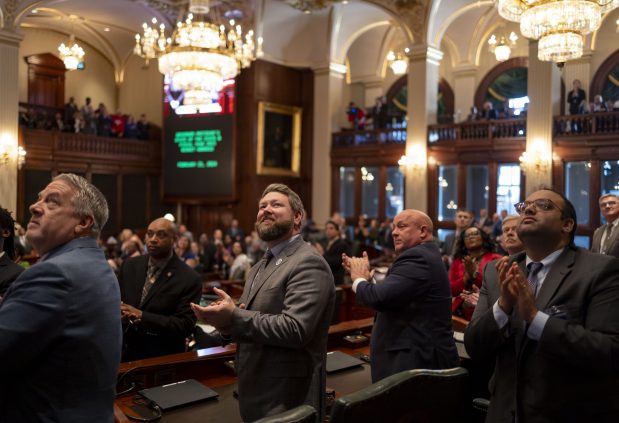
With the general election approaching on November 3, significant attention has been drawn to Democratic House Speaker Emanuel “Chris” Welch’s management of sexual harassment allegations against former state Rep. Harry Benton. This scenario could have posed an opportunity for Republicans to gain ground in a chamber dominated by Democrats. However, several factors complicate this prospect.
The Republican Party in Illinois faces limitations, partly due to dwindling influence. This decline is reflected in the lack of substantial donors and the shift in the suburban demographic, which has become more diverse in terms of ideology, race, and ethnicity. Additionally, Illinois’ political landscape, formed by Democratic gerrymandering, challenges the GOP’s competitiveness.
One major factor impacting the GOP’s potential success is its alignment with a president who enjoys little backing in the state’s largest counties. Political expert Kent Redfield from the University of Illinois Springfield emphasized that in a state characterized by an uneven fundraising race and predominant Democratic control, the GOP may seem marginalized to some as primarily a downstate conservative group.
Redfield also pointed out that the Democrats can deflect Republican efforts by highlighting former President Trump’s controversies, such as paying $5.6 million after a civil jury found him liable for abusing writer E. Jean Carroll in the 1990s. This acts as a diversionary tactic for state Democrats.
Further compounding the matter, some Republic lawmakers might hesitate to oppose Welch. They fear backlash, potentially from a well-supported Democratic opponent in the future. Redfield suggests that Democrats are currently in a strong position to maintain such divisive topics due to the Republican Party’s relative weakness.
The Republican Party is in danger of becoming just a regional, downstate conservative MAGA kind of organization.
The Legislative Ethics Commission, comprising four Democrats and four Republicans, unanimously voted to disclose Inspector General Michael McCuskey’s report on Benton. Benton’s resignation on July 3 followed this investigation, but the report will not be public until later in the month, permitting Benton time to respond and any personal data to be redacted.
A detailed investigation by the Tribune uncovered that Speaker Welch’s office was informed of Benton’s questionable behavior early in 2023. It took three months for action against Benton, during which the initial complainant resigned due to concerns about her mental health.
In several discussions with House Democratic caucuses, Speaker Welch claimed the staffer requested no action until after leaving her role. However, she does not recall making such a request. Welch also maintained that although her case could not be pursued with the Legislative Inspector General’s office, her concern was for Benton’s behavior not to be repeated in the future. Despite these claims, Benton faced no repercussions initially and received Welch’s financial support for reelection in 2024.
More issues arose following a complaint from a female lobbyist in early 2024, prompting an investigation by the Inspector General. Despite potential revelations from this investigation, McCuskey hinted at lower expectations, stating the Tribune might have more information than he does.
While calls for Welch to clarify his actions increased, with critics like the House Democratic Women’s Caucus denouncing his response, specific details have yet to be disclosed. Rep. Kelly Cassidy voiced her concerns over the handling of the Benton case, advocating for a safer legislative environment.
Redfield highlighted that despite the controversy, Welch’s political position appears secure due to the substantial Democratic majority in the chamber. The Speaker’s support remains crucial for Democratic lawmakers seeking reelection support, making criticism from within less likely.
Jessica Dixon Heitman, Benton’s replacement and Democratic nominee, expressed openness to Welch’s political support despite past reservations about working under Benton. She acknowledged the need for broad support for her campaign from those committed to improving affordability in Illinois.
Looking forward, discussions on legislative reforms addressing ethics and harassment have been proposed. Yet, given the Democratic dominance in Illinois, changes have been limited. Alisa Kaplan of Reform for Illinois noted that genuine competition and legislative balance are necessary for meaningful reform.
Redfield remarked on the broader implications, lamenting the situation as detrimental to all parties involved and fostering negative perceptions about legislative integrity.
 New Jersey Voter Fraud Prompts Renewed Push for SAVE Act
  Concerns Over Changes to Voter-Registration Form for Americans Abroad
  Trump’s 2024 Campaign Targets Young Men Through Cryptocurrency
  Trump’s White House Visitor Center Proposal Gains Bipartisan Support
  State Department Simplifies Passport Process with Online Applications
 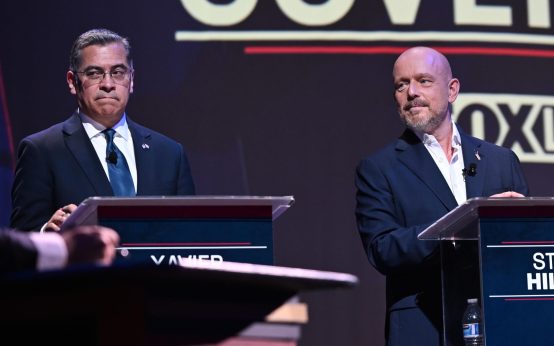 Becerra and Hilton Clash in California Gubernatorial Debate