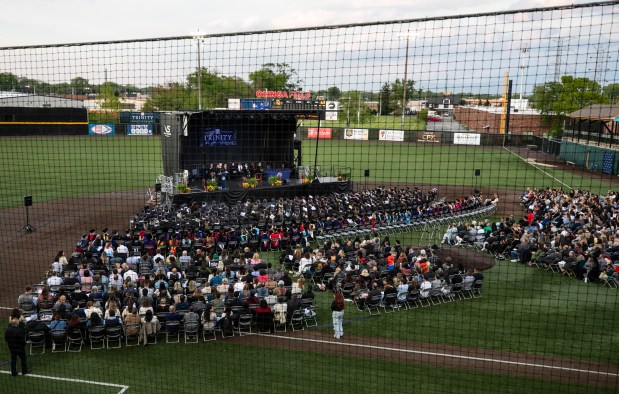
Over a decade ago, Andrew and Casey Kowitz met on their first day of biology class at Trinity Christian College. Today, they remember those early days fondly. The couple got engaged through a romantic scavenger hunt that Andrew had set up on the southwest suburban Palos Heights campus. Their story unfolded at various campus locations, including South Hall, where Andrew asked Casey to be his girlfriend, and the science center, where he proposed. The couple now has two young children and recently celebrated their sixth wedding anniversary. However, the college that played such a pivotal role in their lives is closing.
In November, the board of trustees announced that Trinity Christian College, a private Christian liberal arts institution, would close by the end of the academic year due to declining enrollment and financial constraints. Acting President Jeanine Mozie stated, “The board has worked faithfully and tirelessly to consider every possible option in the face of significant and rapidly evolving financial challenges.” Despite their efforts, the school found no sustainable path forward, leading to its final commencement ceremony on May 8, 2026, at Ozinga Field in Crestwood.
The news of the closure affected many students, parents, and alumni who scrambled to make alternative arrangements. Casey and Andrew Kowitz expressed deep sadness as they mourned the loss of their alma mater. “Trinity was so integral to who we are and our story,” Casey remarked.
In recent years, several local Christian colleges, including Trinity, have faced similar challenges. Lincoln Christian University ceased academic operations in 2024 after 80 years, and its seminary was acquired by a Missouri-based Christian school. Trinity International University sold its campus in Bannockburn earlier this year and will end operations there after the 2025-26 school year. Although the Illinois campus was sold, Trinity International University spokesman Chris Donato emphasized that the institution is not closing, stating, “What we’re holding onto is the mission, not the property.”
Nationwide, approximately 40 Christian colleges have closed, merged, or announced plans to merge since 2020, accounting for half of all not-for-profit closures in higher education. Perry Glanzer, Baylor University professor and editor in chief of Christian Scholar’s Review, noted that these struggles reflect broader issues facing higher education institutions, including declining enrollment, financial constraints, and a demographic cliff due to fewer high school graduates.
The COVID-19 pandemic further exacerbated these issues, forcing many colleges to adopt virtual formats. Glanzer argued, “There is a lot of alarm — but it is the same alarm as all higher education institutions.” Despite these challenges, certain religiously-affiliated schools have weathered the storm better than others.
Protestant institutions, in particular, experienced enrollment growth from 2023 to 2024. A Council for Christian Colleges and Universities report found that 44 of its member institutions saw increased enrollment, driven partly by expanded online programs. Strong local demographics also benefited some campuses.
Despite struggles among small, private Christian colleges, some experts note that their religious identity can attract students during broader higher education challenges. Rick Ostrander, author and executive director of the Michigan Christian Study Center, said, “Having a particular religious identity actually enables small colleges these days to weather the headwinds more effectively.” However, this solution may not apply to all schools, as many smaller religiously-affiliated colleges continue facing hardships.
Families and students affected by closures face difficult transitions. Julia Leidecker, a sophomore at Trinity, recalled feeling shocked when learning of the school’s closure. She described the campus vibe as abruptly changing, with students and professors anxiously seeking new opportunities and discussing job losses.
Trinity’s “teach-out” partnerships offer students similar tuition and graduation timelines with other Christian colleges, but Leidecker remains apprehensive about forming new relationships. She plans to transfer to St. Xavier University and said, “At Trinity, we’re like a family. All my professors know everybody.” The closure of Trinity eliminated anticipated milestones and final college rituals.
Tracy Schorle attended a “Family and Friends” weekend at Trinity shortly before receiving the closure announcement. “I took something away from three young ladies who had all of their plans for college completely ripped away from them,” she said.
Other notable Christian colleges announcing closures include Providence Christian College and Siena Heights University. Despite closures, Glanzer asserts many Christian colleges thrive, citing growth in Protestant institutions. “It’s a complex picture. There are the Trinity Christian Colleges out there,” said Ostrander. “But there are a lot of Christian colleges and universities that are doing quite well.”
Nevertheless, the impending national “enrollment cliff” threatens smaller institutions. Higher education faces an unfavorable public opinion, as a Pew Research Center survey found 7 in 10 Americans believe the system is headed in the wrong direction, a trend potentially hindering enrollment.
Trinity alumna Kylla Hutcherson hoped her children might attend her alma mater, which she cherished for its small, close-knit environment and student-driven spiritual life. “They were very open to receiving you as you were,” she recalled.
As students reflect on their college experience, Hutcherson advises it’s natural to reminisce about formative places, stating, “Because they could be gone. And you may only be left with memories.”
 Understanding Misperceptions Around Sexual Violence and Intervention
  Colleges Adapt to Supreme Court’s Impact on Race-Conscious Admissions
  Cornell University Responds to Allegations of Sexual Assault at Fraternity
  Gen Z College Students Opt for Online Learning at Home
  Reevaluating Sexual Consent and Gender Dynamics
  Democratic Governors Face Pressure on Federal School Choice Program