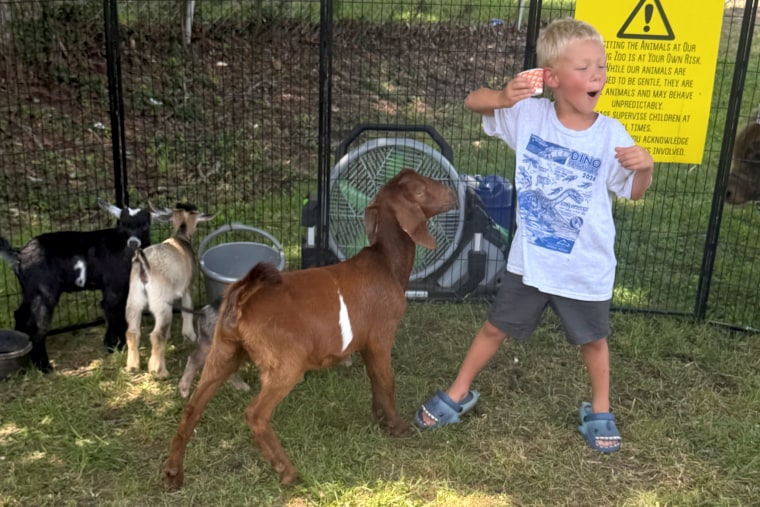
Rebecca Lanning received distressing news last Friday. Her 4-year-old son was exposed to rabies during a family outing. The exposure occurred on August 15 at a dinosaur exhibit in Mocksville, North Carolina. The event included food trucks, carnival games, and a petting zoo where her son fed baby goats.
Lanning, 30, from Marion, recounted, “I didn’t think anything of it until Friday, when his aunt called me and said, ‘Hey, we have a situation.’” Lanning chose to keep her son’s name private.
Three baby goats from the petting zoo tested positive for rabies, as announced by the North Carolina Department of Health and Human Services. Another goat was also suspected to be infected. All four goats were euthanized.
Concerned for her son’s health, Lanning immediately took him to a doctor. He received the first two of six recommended rabies vaccine shots. These vaccines are post-exposure prophylaxis, aimed at stopping the virus before symptoms appear. Rabies, attacking the brain and spinal cord, is almost always fatal if symptoms develop. However, early administration of the vaccine is nearly 100% effective.
People can contract rabies through contact with the saliva or scratches and bites from an infected animal. Lanning expressed her fears, “My concern is whether he touched his mouth or eyes while feeding the goats. I am terrified of losing my child.”
Her son has now received three of the necessary six rabies vaccinations. Rabies symptoms can take weeks or even months to appear, initially resembling flu-like signs such as weakness, fever, and headaches. There may also be a “prickling or itching sensation” at the site of contact, the North Carolina health department noted.
The department did not specify how many people were exposed to the infected goats. The goats belonged to a mobile petting zoo called Farm Adventures and attended events from July 28 to August 23, including private gatherings and an assisted living center visit. Farm Adventures did not respond to inquiries for comments.
A Facebook post from the company indicated that the goats, too young for rabies vaccination, may have been infected by a skunk that entered their pen. Skunks, along with bats, raccoons, and foxes, are known rabies carriers.
The state health department stated they are “coordinating with local health departments and healthcare systems to ensure rabies post-exposure prophylaxis is available to those in need.”
Rabies outbreaks in the U.S. seem to be on the rise. The Centers for Disease Control and Prevention report that 1.4 million Americans are monitored annually for potential rabies exposure, with around 100,000 receiving post-exposure vaccine shots.
 Understanding Inflammation: Myths and Facts
  Calm Parenting: Strategies to Manage Stress
  Trump’s Executive Order to Combat Mosquitoes and Ticks in D.C.
  Overcoming Weight Loss Challenges: Brain Health and GLP-1 Medications
  Supporting Children’s Mental Health at Home: Practical Steps for Parents
  Abdul El-Sayed’s Strategy to Attract Health-Conscious Voters in Michigan