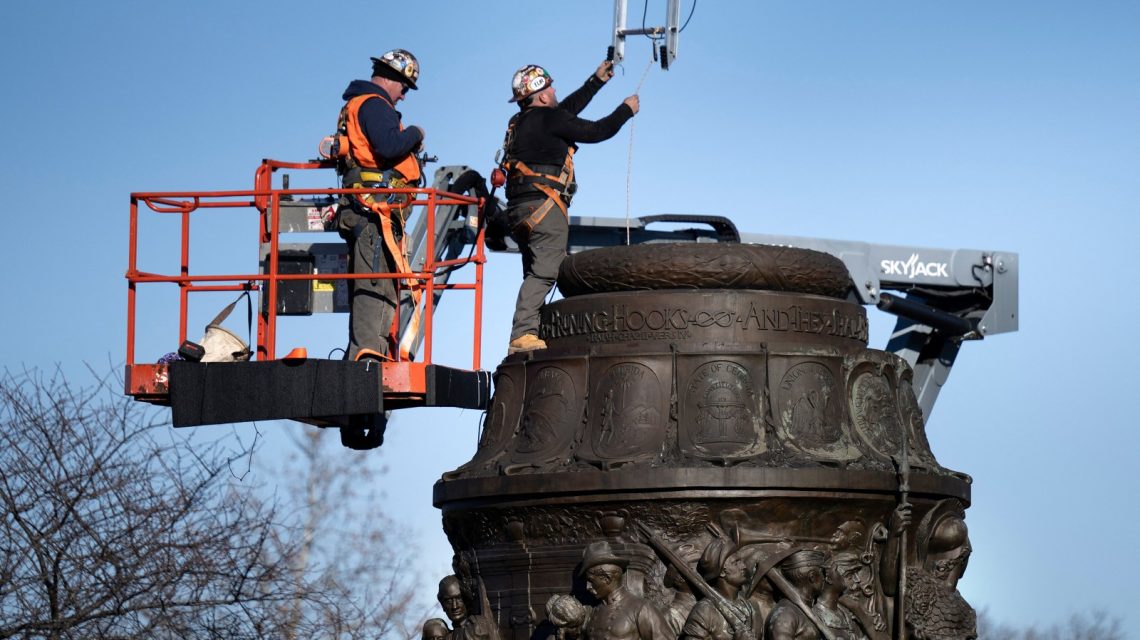
The Trump administration has taken steps to alter references to the Confederate Memorial at Arlington National Cemetery. This involves removing descriptions that previously highlighted the memorial’s portrayal of the Confederacy and its sanitized depiction of slavery. Changes have been made to a marker at the cemetery and a Department of Defense webpage, effectively eliminating mentions of the ‘Lost Cause’ narrative. This narrative depicted Confederate soldiers as primarily fighting for states’ rights rather than to preserve slavery. It also portrayed the institution of slavery as a relatively benign system.
The administration plans to return the Confederate Memorial to Arlington in 2027 after it was removed in 2023, following a congressional mandate targeting Confederate symbols on military property. Secretary of Defense Pete Hegseth expressed regret over the removal and emphasized the significance of preserving American history rather than erasing it.
The changes come as part of the administration’s broader initiative to reinstate the monument. Newsweek reached out to the White House and Arlington National Cemetery for comments.
Understanding the Confederate Memorial
The Confederate Memorial, standing 32 feet tall, was unveiled in 1914 and stood at Arlington National Cemetery until its removal in 2023. This monument, consisting of a bronze statue on a granite base, commemorated the Confederate army soldiers who fought in the Civil War. Notably, it also included figures of Black servants who appeared to support the Confederate cause. Created by former Confederate soldier and sculptor Moses Jacob Ezekiel, the memorial aimed to counter what Ezekiel believed were false narratives propagated by the North.
In response to a renewed focus on civil rights and racial justice, Arlington National Cemetery placed a plaque in 2020. This plaque informed visitors about the monument’s ‘highly sanitized depictions of slavery.’
Reasons Behind the Memorial’s Removal
A bipartisan commission, established by Congress in 2021 after nationwide protests following George Floyd’s murder, recommended the memorial’s removal. This was part of a broader effort to reevaluate military associations with the Confederacy. The Department of Defense agreed, leading to the memorial’s removal in December 2023. Despite opposition from groups like the Sons of Confederate Veterans, who filed lawsuits, the memorial was placed in a secure Department of Defense facility in Virginia. The Trump administration later announced plans to reinstate the monument by 2027.
Removed Language
The administration eliminated paragraphs from the description that detailed the memorial’s controversial aspects. These included depictions of a nostalgic and mythologized vision of the Confederacy and sanitized representations of slavery. The text described the memorial’s artistic elements, such as a classical female figure symbolizing the American South, and figures including African Americans portrayed in ways that supported outdated narratives of slavery.
Descriptions of mythological gods, Southern soldiers, and civilians alongside the image of the ‘faithful slave’ were among the removed references. These aspects contributed to a ‘Lost Cause’ narrative that romanticized the South and overlooked slavery atrocities.
Language That Remains
What remains is a focus on the sculptor’s role and details. It mentions that the monument was the creation of Moses Jacob Ezekiel, a Confederate veteran. It also states that Ezekiel was buried at the base of his monument in 1921. The text invites visitors to reflect on the complex history of the Civil War, slavery, and the intersection of military service and race in America.
Similar edits were implemented at the marker of the memorial’s former location, as reported by The Washington Post.
Further Edits by the Administration
Since President Trump’s return to office, the administration ordered revisions of plaques and exhibits addressing topics like slavery, racism, and immigration. These are found at several federal sites and include:
- Bunker Hill Monument, Boston: Removal of quotations addressing slavery and immigration.
- President’s House Site Slavery Exhibit, Philadelphia: Exhibit details were initially removed but later restored after a court order.
- Francis G. Newlands Memorial Fountain, Washington, D.C.: Sign explaining the former senator’s white supremacist policies was removed.
- Fort Sumter National Historical Park, South Carolina: Signs discussing climate threats were removed.
- Fort Pulaski National Monument, Georgia: A display featuring a famous Civil War-era photograph was flagged for removal.
- Selma-to-Montgomery National Historic Trail, Alabama: Plans were made for removal or revisions of signs relating to the 1965 voting-rights march.
Critics argue these changes remove critical historical context, whereas the administration aims to present a more balanced view of American history.
 Concerns Over Changes to Voter-Registration Form for Americans Abroad
  Trump’s 2024 Campaign Targets Young Men Through Cryptocurrency
  Trump’s White House Visitor Center Proposal Gains Bipartisan Support
  State Department Simplifies Passport Process with Online Applications
  Becerra and Hilton Clash in California Gubernatorial Debate
  California Voters to Decide on $7.5 Billion State Research Fund