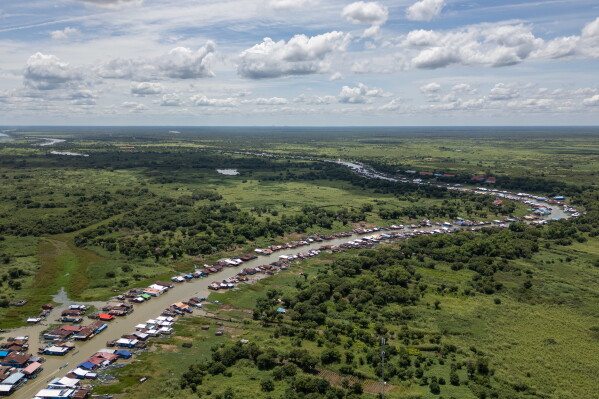
Sou Sreynich dreams of becoming a teacher. At 13 years old, she is acutely aware of how far behind she is. She began school at the age of 10, a significant delay by Cambodian standards. The decision was influenced by her mother’s concerns about safety, as traveling by boat to school carried risks of capsizing. This is a common situation for families living around Cambodia’s Tonle Sap, the largest freshwater lake in Southeast Asia.
Recent spikes in gasoline prices due to the conflict in Iran add further strain. Although not as visible as school closures during COVID-19, this conflict’s impact on education hits poorest families hardest. Rising fuel costs make travel to school for children and teachers more expensive, and stretch government education budgets.
The unpredictable floods and droughts, a result of climate change, complicate matters on the lake where travel has always required navigating water routes. Teachers report that 10 students have drowned over the years in this floating village, Kampong Prahok, on the Tonle Sap Lake.
The United Nations Children’s Fund warns that if the conflict continues, it could push 23.4 million more children like Sreynich into poverty by year-end, primarily in Africa and Asia.
Each morning, a gas-powered boat steered by students shuttles others dressed in uniforms. These daily journeys are a testament to the community’s resilience, yet rising fuel prices hinder families like Sreynich’s from affording trips to deeper waters where fish are abundant. Sreynich occasionally skips school to assist her family financially, a decision that pains her.
Impact on Vulnerable Families
The conflict forces families already on edge to make difficult decisions about whether to allocate funds for food, fuel, and rent, or continuing their children’s education. According to Sabrina Hervey of the Education Above All Foundation, this war may force millions of children out of school entirely, as educational affordability declines.
Examples span the region. In Southeast Asia, children such as Ly and Nhi from Vietnam have dropped in and out of school as their fishing family struggled financially. The Iran conflict exacerbated this by inflating diesel prices beyond the reach of boat owners, forcing the girls to work in unsafe conditions. The Hanoi-based Blue Dragon Children’s Foundation eventually helped them return to school.
Michael Brosowski of the foundation highlights that financial strains often lead families to prioritize immediate income over education, leaving children susceptible to exploitation or homelessness.
Fuel-related costs impact all educational facets. From transporting students to equipping classrooms, everything becomes more expensive. Tonle Sap already sees inflated costs due to supply constraints. Samphors Vorn from Aide et Action notes the electricity for school labs costs ten times more.
Global Educational Disruption
Developing countries dependent on energy imports feel the war’s repercussions acutely. Rising fertilizer costs and decreasing remittances contribute to their economic strain. In Bangladesh, a U.N. Development Programme report warns of potential reductions in education funding.
In South Asian nations, girls may suffer more as families often prioritize educating sons, potentially increasing dropout rates and child marriages, according to Arshad Malik of Save the Children International. South Asia holds 45% of the world’s child brides, the largest share globally, as per UNICEF.
School meal programs, crucial for child nutrition and education retention, are at risk. With global disruptions in fertilizer supply and rising transportation costs, countries in West and Central Africa face heightened challenges, says Hervey with Education Above All.
An escalation in child malnutrition rates is noted across northern Nigeria, raising concerns among local health and aid workers. Hervey conveys fear about future developments.
The Associated Press receives funding for climate and environmental reporting from various private foundations but maintains sole responsibility for its content.
 British Police Arrest Man Suspected of Terror Plot
  Activists Push for Nationwide Ban on Child Marriage in the U.S.
  Investigation into Alleged Incident at Cornell University
  Rising Drone Threats Highlight Vulnerabilities in Moldova’s Airspace Defense
  Bolivia Faces Security Test Amid Unrest
  Incident on FlyDubai Flight Raises Security Concerns