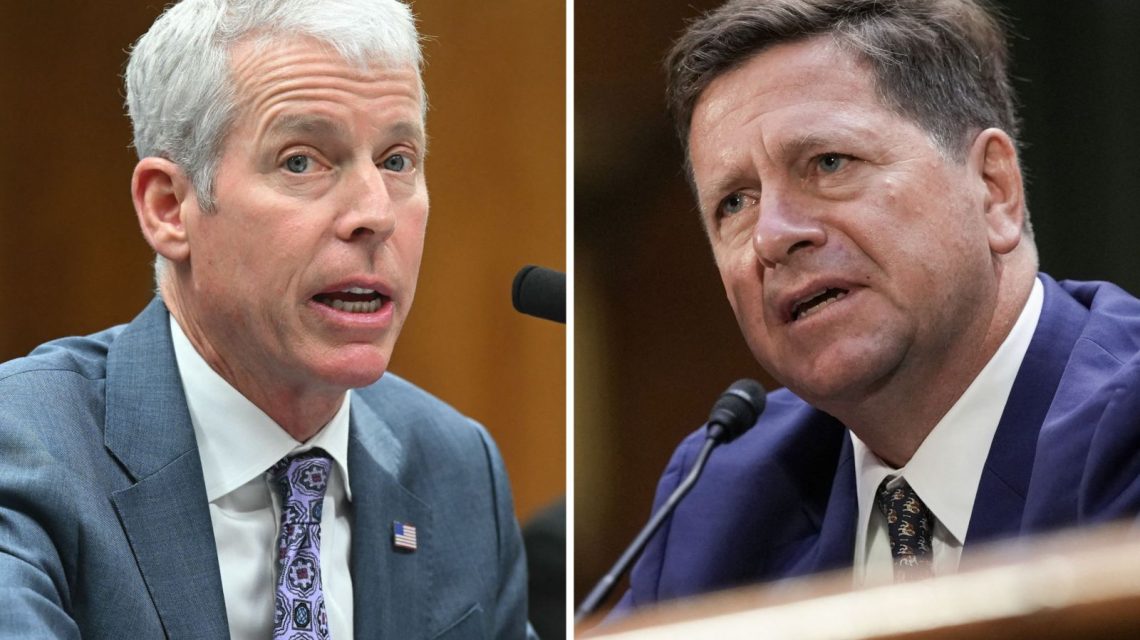
Energy Secretary Chris Wright and Director of National Intelligence nominee Jay Clayton have presented notably different perspectives when asked about the outcome of the 2020 election. This highlights ongoing divisions within the administration, as President Donald Trump reasserts his focus on the race years after the event.
Their contrasting statements come soon after a primetime speech by Trump, where he alleged foreign interference and questioned the integrity of the 2020 election. The issue remains sensitive within the administration, as officials often face scrutiny regarding their acceptance of Joe Biden’s victory over Trump.
Despite numerous audits and court rulings affirming Biden’s victory, Trump continues to assert that the 2020 race was tainted by widespread fraud. His latest address and the release of declassified intelligence documents have reignited the debate and revealed rifts among Republicans, several of whom have openly challenged Trump’s claims.
Chris Wright Says Biden ‘Sure Seems’ to Have Won
Appearing on ABC News’ This Week, Wright was directly asked whether Biden won the 2020 presidential election. He stated, “He was president for four years. Clearly so.” When pressed further by host Jonathan Karl, Wright responded, “Look, I’m not an election evaluator, but it sure seems to me like he did.”
Wright’s remarks stand out due to Trump’s frequent clashes with officials who have opposed his election narratives. Former Attorney General Bill Barr and ex-cybersecurity chief Chris Krebs both faced consequences for disputing Trump’s fraud claims. Wright’s comments align with other Republicans like Representative Don Bacon of Nebraska who declared the election was “not stolen,” and GOP lawyer Ben Ginsberg who confirmed no evidence of inaccuracies.
Jay Clayton Declined to Give a Direct Answer
Wright’s straightforward statements contrast with Clayton’s responses during his Senate Intelligence Committee confirmation hearing. Clayton repeatedly avoided directly addressing the 2020 election outcome. When questioned by Senator Jon Ossoff, he stated he would not “engage in the theater” surrounding the issue. Although Clayton acknowledged Biden was certified as the winner and claimed not to deny the election, he refrained from explicitly declaring Biden’s victory.
This deflection attracted criticism from committee Democrats. Senator Mark Warner of Virginia, a top Democrat, cited this exchange as his reason for opposing Clayton’s nomination. Warner remarked, “I’ve known Jay for a long time. I like him, but after his performance before my committee, his inability to answer the question about who won the 2020 election… I am not going to vote for him.” Despite Warner’s stance, he believes Clayton will eventually be confirmed by the Republican-majority Senate.
Trump’s Renewed Focus on 2020
The divide follows Trump’s recent speech in which he suggested China had obtained data on millions of American voters and pointed to systemic vulnerabilities as ongoing concerns. He also released intelligence documents he claims support his assertions.
Before Trump’s speech, Chinese Embassy spokesperson Liu Chang denied allegations of interference, stating, “China has never and will never interfere in the presidential elections of the U.S.” Jonathan Karl noted that the released documents did not substantiate Trump’s claims, citing an intelligence assessment that considered it difficult to manipulate election systems on a scale large enough to alter the election outcome.
The differing rhetoric from Wright and Clayton illustrates the persistent volatility within Trump’s political sphere, where officials and nominees remain challenged by the question of Biden’s legitimacy nearly six years post-election.
Contact Newsweek editor for this story: Anthony Murray.
 The Trump Team’s Challenge to the Military Leadership
  Maryland First State to Restrict Electronic Pricing in Grocery Stores
  Activists Push for Nationwide Ban on Child Marriage in the U.S.
  Democratic Hopes and Historical Warnings in 2026 Senate Race
  Republicans Face Challenges Amidst Cost of Living Concerns
  A Different Kind of Fall for Congress This Year