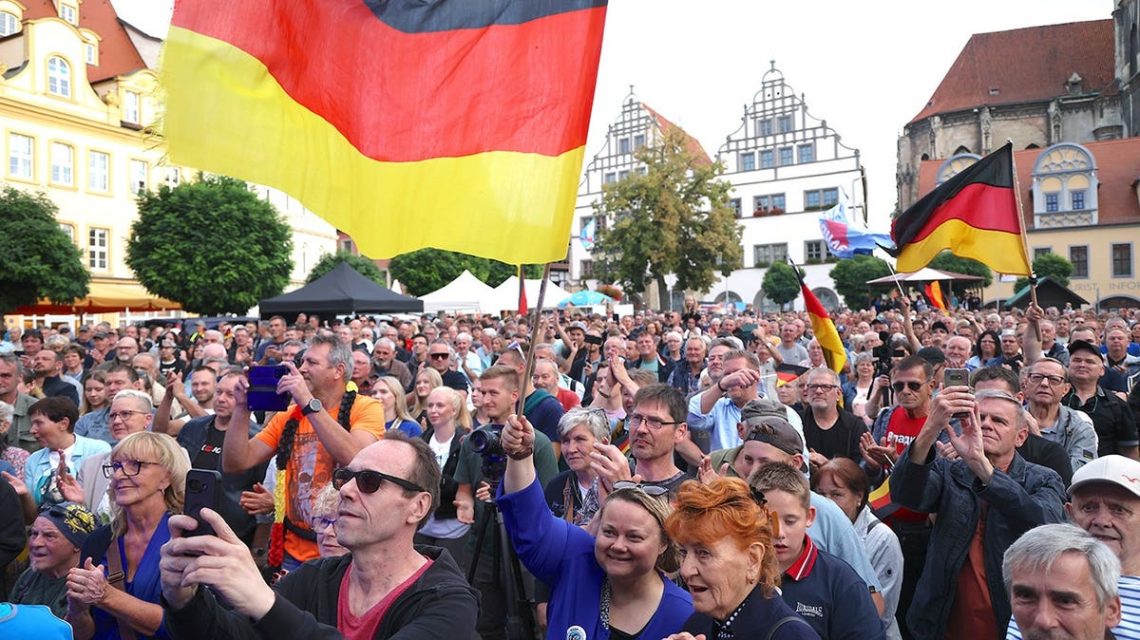
A significant political shift is on the horizon in eastern Germany as the far-right Alternative for Germany (AfD) party seems poised for a historic victory. This Sunday’s state elections in Saxony-Anhalt might see the AfD achieving an unprecedented success. Historically, the Social Democratic Party (SPD) and the Christian Democratic Union (CDU) have dominated such political landscapes. However, AfD’s potential to secure an outright majority in a German state parliament could change that dynamic.
The AfD previously gained attention in the national elections, backed by influential figures like Elon Musk, and now faces both support and criticism. The German domestic intelligence office labels the AfD a “right-wing extremist endeavor” due to its pro-Russia stance. Despite this, the party could break the historical pattern, being the first since World War II to disrupt the SPD and CDU’s stronghold.
“The reason Saxony-Anhalt matters,” asserts foreign policy expert Daniel Schatz, “is that the AfD is no longer just knocking on the door of power. It may be close to kicking it open.”
In Saxony-Anhalt, Ulrich Siegmund emerges as a significant influencer, with his leadership boosting the AfD to 43% in recent state polls. Should the AfD achieve a majority, this would mark a first instance where a party, outside the SPD or CDU, governs independently since 1949. According to Janek Treiber, a political science researcher, while the party’s federal policy influence may be constrained, the symbolic implications of such a win are extensive.
The AfD’s platform emphasizes nationalism and restricted immigration, promoting stronger national identity and a more lenient stance towards Russia. The potential rise in power challenges what has traditionally been regarded as a “firewall” by mainstream parties that refuse collaborations with the AfD.
AfD’s lead candidate Ulrich Siegmund, popular in Saxony-Anhalt, appeals widely with a significant following on social media, notably TikTok. The Center for Strategic & International Studies (CSIS) highlights Siegmund’s adept communication as pivotal in driving the populist narrative that connects with the local electorate.
The German Federal Office for the Protection of the Constitution previously classified the AfD as a “confirmed right-wing extremist” group. However, this ruling was paused due to legal findings questioning the adequacy of evidence. Despite such controversy over its extremist image, especially related to views on migration and national identity, the AfD remains influential in regional politics.
As elections approach, Saxony-Anhalt’s outcome could become a bellwether for future elections in Mecklenburg-Western Pomerania and Berlin, both holding their assembly elections in two weeks. This regional political scenario is further underscored by the electoral system, where a party requires 5% to claim seats. Currently, smaller parties hover around this threshold, which could shift power dynamics considerably.
The appeal of the AfD, especially among younger voters, stems largely from economic concerns such as rising costs and unemployment. A CSIS report suggests a notable portion of AfD’s support base harbors extremist views, yet the party is gaining traction among voters aged 18-25.
Saxony-Anhalt’s election could be the start of broader changes influencing neighboring regions. In places like Mecklenburg-Western Pomerania, traditional party dominance is already being contested by the AfD.
 The Trump Team’s Challenge to the Military Leadership
  Maryland First State to Restrict Electronic Pricing in Grocery Stores
  British Police Arrest Man Suspected of Terror Plot
  Activists Push for Nationwide Ban on Child Marriage in the U.S.
  Democratic Hopes and Historical Warnings in 2026 Senate Race
  Republicans Face Challenges Amidst Cost of Living Concerns