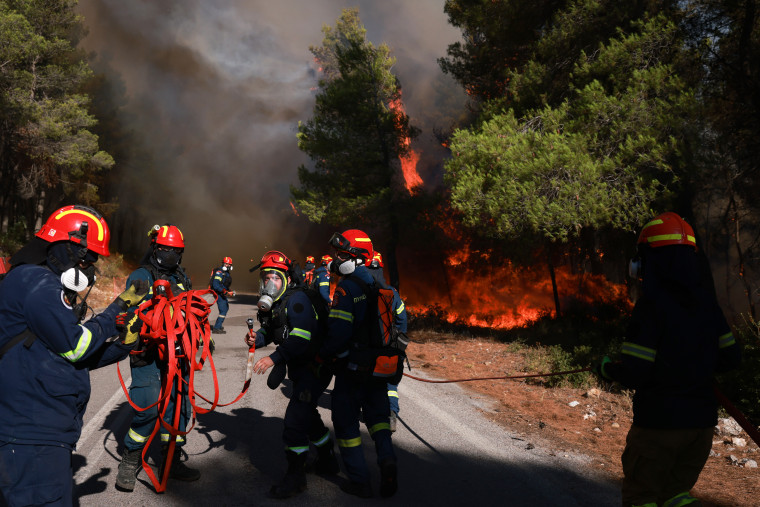
Greek firefighters confronted a massive wildfire on Sunday that destroyed over 100 homes northwest of Athens. A new fire forced evacuations on the tourist island of Kefalonia. Europe has faced severe wildfires this summer due to record-breaking heat and minimal rainfall. Scientists attribute this to climate change.
Fires in France and Spain showed signs of easing over the weekend, but several erupted in Greece after a period of calm. Strong winds worsened the fire near Porto Germeno, 40 miles northwest of Athens. Although the winds have calmed, the fire reached the settlement of Veniza and a military firing range, causing unexploded ordnance threats.
Nearly 500 Greek firefighters with vehicles, heavy machinery, and aircraft are working on the blaze, supported by teams from France and Romania. In Agios Konstantinos, residents are actively trying to stop the fire’s spread. “The fire has been burning since last night,” said Tasos Tzempelikos, 61, who was attempting to douse the flames with his son. Efforts focus on preventing the fire from moving from Veniza to the coastal town of Megara. It’s estimated that over 38 square miles of land have burned.
On the Ionian island of Kefalonia, several areas were evacuated overnight after a fire broke out in Pastra in the south.
In France, wildfires in the Gironde and Var areas are moderating, with only minor flare-ups reported in the southwestern Gironde area. The fire in the southeastern Var department did not spread overnight.
In central Spain, wildfires that affected tens of thousands of hectares have been mostly controlled. However, firefighters continue to address flare-ups. In Caceres, a blaze erupted on Saturday, leading to the evacuation of around 800 people, who returned on Sunday but must stay indoors due to active fires.
Many European countries face drought and low water levels in major rivers like the Rhine and Danube, which recorded its lowest levels in Hungary, Serbia, and Romania. Hungary faces a critical situation as the Danube’s decline forced the shut down of the country’s only nuclear power plant for the first time in over 40 years, with another heatwave approaching.
Water level drops have disrupted shipping and tourism in Hungary, leading to water-use restrictions in more than 100 cities and villages. Danube levels in Serbia fell to their lowest since 1985, reducing the output of the country’s largest hydropower plant to 20%, according to the energy minister.
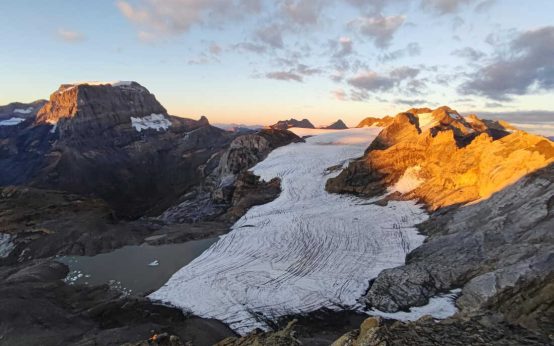 Swiss Glaciers Show Effects of Ice Loss Amid Global Warming
  Climate-Resistant Rock Glaciers: Hidden Water Resources
  Dutch Review Board’s Euthanasia Ruling and International Debate
  Israeli PM Commends Heroic Actions in Flight Emergency
  Rabbi and Jewish Leaders Criticize Adam Brody for ‘Genocide’ Comment
  Senators Reach Bipartisan Agreement on Permitting Reform