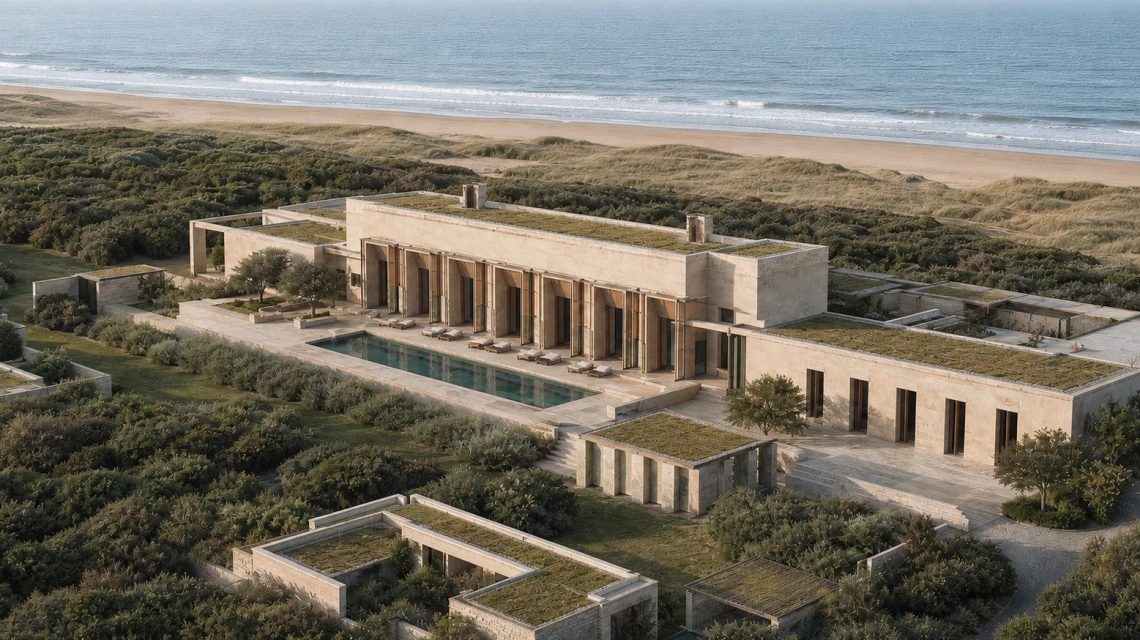
Plans for a billion-dollar waterfront community in South America highlight a growing trend in city planning. These developments focus on sustainability, technology, and economic innovation. Praxis, the company behind this project, has chosen Uruguay for its stability and space. The new city, called “+Colonia,” will be built near Colonia del Sacramento and aims to welcome residents by mid-2027.
Praxis plans to attract $1 billion in investment over three years to develop “the world’s first digital nation.” This community will prioritize residences, hospitality, culture, and a future influenced by artificial intelligence (AI). Supporters are optimistic about the quality of life +Colonia could offer. However, critics question the viability of an AI-driven community and the feasibility of investment goals.
Globally, other proposed cities are similarly ambitious, aiming to transform urban life for millions.
California Forever in the US
With backing from Silicon Valley investors, California Forever aims to be “America’s next great city,” the first walkable city designed in a century. The project seeks to create a medium-density, walkable city with parks, plazas, and playgrounds. Situated in Solano County, it includes plans for 530,000 new jobs and 170,000 homes.
The development leverages proximity to key transportation corridors. A major project element involves the expansion of Suisun City, and local officials are working on a proposed annexation plan. Progress continues despite controversies over land acquisitions and environmental concerns.
Woven City in Japan
Toyota’s Woven City stands out by focusing on mobility and well-being. Located near Mount Fuji, it was first revealed in 2020 at the Consumer Electronics Show in the US. Serving as a “living laboratory,” the city allows residents and companies to test new technologies. Residents began moving in last September, with the city now hosting around 160 people across 80 households.
Phase 2 of construction started in September 2026, with completion expected in November 2028. While the city operates, questions remain about its scalability beyond a corporate research setting.
Telosa in the US
Billionaire entrepreneur Marc Lore introduced Telosa in 2021. Designed by Bjarke Ingels Group, it focuses on “equitism,” aiming for sustainability and social equality. With no final location selected, the envisioned city plans to eventually house millions in the US.
Praise for its vision exists, but skepticism about the feasibility and financing of building from scratch persists.
Rio AI City in Brazil
Rio AI City aims to feature data centers powered by renewable energy. Developed by Elea Data Centers and supported by Rio de Janeiro’s municipal government, it’s among the largest digital infrastructure initiatives. Situated in the Olympic Park area, the city aims to use innovative cooling and green architecture techniques.
While the first data center is operational, the second is under development. Potential for economic growth exists alongside concerns about energy demands and environmental impact.
Oceanix Busan in South Korea
Plans for Oceanix Busan were disclosed at the United Nations in 2022. Designed as the “world’s first prototype sustainable floating city,” it intends to withstand flooding by rising with the sea. The city plans to generate its own food, energy, and water.
Interest in floating infrastructure innovation coexists with concerns regarding costs and long-term practicality.
The Line in Saudi Arabia
The Line forms part of NEOM, a massive Saudi development. The linear city will stretch 170 kilometers, aiming to house 9 million people. Currently, construction is paused until 2030 as NEOM prioritizes infrastructure such as ports and data centers.
Yasir Al-Rumayyan of the Public Investment Fund has stated that while delays occurred, no NEOM project has been canceled.
 Rabbi and Jewish Leaders Criticize Adam Brody for ‘Genocide’ Comment
  Senators Reach Bipartisan Agreement on Permitting Reform
  Senate Democrats Block Data Center Bill Over Efficiency Concerns
  Experts Warn of Critical Period for the Colorado River
  Flydubai’s Emergency Landing Highlights Cockpit Security
  Former Israeli PM Naftali Bennett Commends Passengers and Crew for In-Flight Heroism