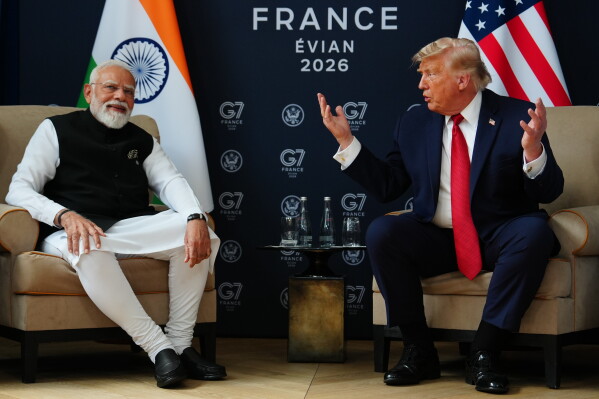
The Group of Seven leaders expressed their endorsement of U.S. President Donald Trump’s provisional agreement with Iran on Wednesday. This accord aims to open the Strait of Hormuz and extend an uneasy ceasefire. French President Emmanuel Macron praised the agreement, stating it addresses a destabilizing situation that negatively impacted global economies.
Trump referred to the deal as historic and noted that other G7 leaders were in favor of it. U.S. officials shared the deal’s details with journalists, clarifying that the official signing is scheduled for Friday in Switzerland. The agreement outlines that the U.S. will lift sanctions on Tehran if Iran’s nuclear program concerns are resolved. Trump expressed optimism about the deal’s completion.
On the final day of the G7 summit in the French Alps, Trump made a notable entrance, humorously asserting his authority. Discussions included the future of artificial intelligence and economic growth, with concerns over China’s trade practices at the forefront. Other session attendees included leaders from India, South Korea, Kenya, and Brazil.
Trump attended a grand dinner at the Palace of Versailles before heading back to Washington. He complimented French President Macron and his wife, Brigitte, calling her amazing. Ensuring the Strait of Hormuz remains open is crucial. Trump must convince skeptical Republicans about the deal’s efficacy in controlling Iran’s nuclear ambitions while maintaining international confidence.
The G7 leaders proposed an international maritime mission by France and the U.K. to secure maritime traffic in the Strait of Hormuz. This mission would protect merchant vessels and verify the removal of naval mines. The strait was effectively closed early in the conflict that began on February 28.
The deal also seeks to cease hostilities in Lebanon between Israel and Hezbollah. This aspect is delicate, as Israel insists on self-defense and maintaining control over Lebanese territories. The U.S. agreement includes provisions for Lebanon’s territorial integrity. Israeli strikes have resulted in significant casualties and displacements.
In additional declarations, the G7 leaders pledged increased support for Ukraine against Russia and vowed tougher sanctions on Russia’s energy sector. Trump described talks concerning the Ukraine conflict as productive, noting both Russian and Ukrainian leaders desire resolution but face challenges.
The summit produced a commitment to intensify efforts against global drug trafficking. U.S. military actions targeting drug operations in Latin America have resulted in casualties, raising legal concerns. Moreover, the G7 reiterated efforts to curb human trafficking and smuggling, which undermine national sovereignty and endanger lives.
President Trump also praised Indian Prime Minister Narendra Modi, referring to him as a tough negotiator. Their discussion took place amid tense U.S.-India relations due to regional conflicts. An earlier U.S. military strike inadvertently resulted in the deaths of Indian sailors, highlighting the importance of maritime safety in ongoing diplomatic engagements.
 British Police Arrest Man Suspected of Terror Plot
  Activists Push for Nationwide Ban on Child Marriage in the U.S.
  Investigation into Alleged Incident at Cornell University
  Rising Drone Threats Highlight Vulnerabilities in Moldova’s Airspace Defense
  Bolivia Faces Security Test Amid Unrest
  Incident on FlyDubai Flight Raises Security Concerns