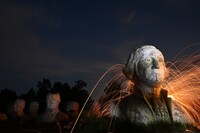
On July 6, 1776, John Hancock, president of the Continental Congress, sent General George Washington a letter along with the Declaration of Independence. Washington was with his army in New York at the time. Hancock detailed that the congress had been focusing on significant matters, culminating in a declaration of independence from Britain. He urged Washington to announce it according to his discretion at the head of the army.
This moment ties Washington indelibly to America’s founding. His legacy remains celebrated in various ways, particularly in areas around the city that bears his name. Photographer Matt McClain captured these commemorations as the nation’s 250th birthday approached, illustrating Washington’s enduring legacy as a symbol of unity amidst present-day divisions.
Doug Thomas, portraying Washington at Mount Vernon, his former residence in Virginia, participates in Revolutionary War reenactments. On July 9, 1776, Washington, then 44, instructed thousands of Continental Army soldiers to gather in Manhattan to hear the Declaration read.
The General hopes this important event will serve as a fresh incentive to every officer, and soldier … knowing that now the peace and safety of his country depends (under God) solely on the success of our arms.
These words from a general order stirred the troops. Historian Emily Sneff noted Hancock likely sent the declaration via courier. Both civilians and reenactors celebrate Washington’s legacy, illustrated by scenes like people standing before “Surrender of Lord Cornwallis” in the U.S. Capitol Rotunda and Washington bobbleheads for sale in Mount Vernon’s gift shop.
The declaration’s reading caused a sensation. According to Samuel Blachley Webb, Washington’s aide-de-camp, soldiers responded with cheers. Washington informed Hancock the men were enthusiastic about their task. Meanwhile, the British prepared to challenge them with a large force headed for New York.
Reenactors like John Williams and Peter Peterson, portraying historical soldiers, engage visitors at Mount Vernon, while scenes of daily life from the era play out in locations such as Shields Tavern in Colonial Williamsburg. Washington’s significance as a leader during these formative years is underscored by Sneff, who described him as a key figure in turning the declarative words of independence into reality.
Washington’s pivotal role was not immediately evident in 1776. The Continental Army’s victory at Yorktown in 1781, aided by French allies, was crucial. Visitors to the Yorktown battlefield, the American Revolution Museum, and surrounding historical sites, such as a French cemetery, reflect on this defining victory.
In 1776, Washington did not foresee being chosen to lead the fledgling nation. He could not imagine his future as a national icon, with places bearing his name, or that his personal history, down to his dentures, would be celebrated.
Katelyn Brown observes Washington’s dentures on display at Mount Vernon. The Washington family coat of arms is found at a burial site, where many relatives, including his parents and half-brother, are interred. Artifacts in the George Washington Office Museum in Winchester and reconstructed spaces at the Washington birthplace complex offer further glimpses into his life. The lasting reflections on Washington’s impact are evident through experiences shared by reenactors and visitors, from Mount Vernon to the American Revolution Museum at Yorktown.
 Historical Events in Chicago on October 1st
  Patrick McEnroe Advocates for Collegiate Athletic Reform
  Push for Reparations Faces Challenges and Calls for Strict Eligibility
 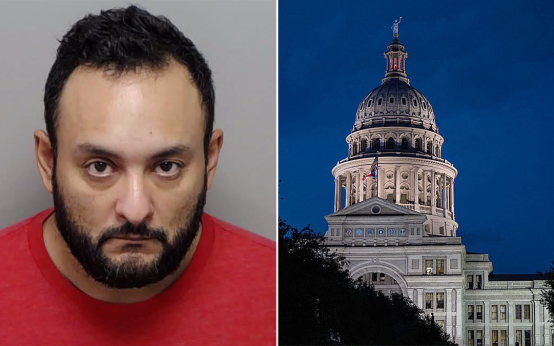 Texas Man Arrested for Threatening State Capitol Attack
 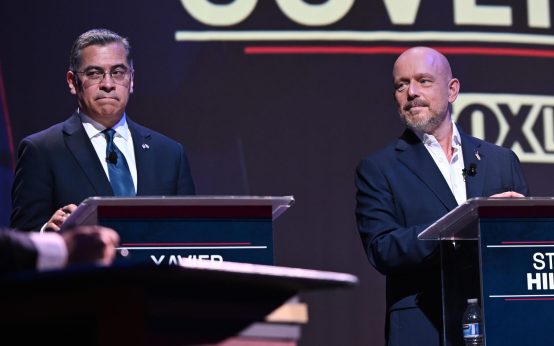 The Key Debate Between Xavier Becerra and Steve Hilton: What You Need to Know
  Physicians Urge Senate to Reject FDA Nominee