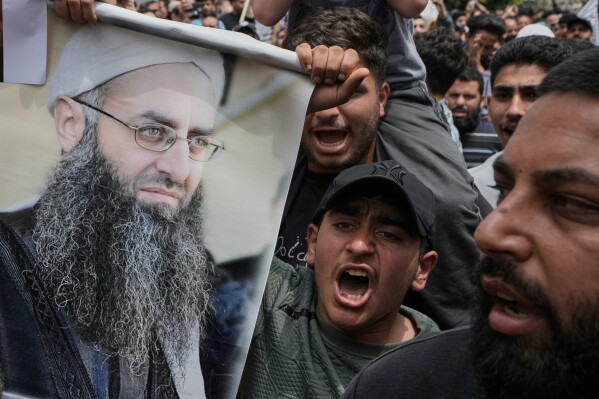
This month, Abdul El-Sayed made headlines in Michigan as the first Muslim nominated by the Democratic Party for the U.S. Senate. His nomination has been met with mixed emotions among Muslim Americans, highlighting ongoing challenges of anti-Muslim sentiment nationwide. Some Republicans, including President Donald Trump, emphasized his full name, Abdulrahman Mohamed El-Sayed, framing him as a potential threat. U.S. Rep. Nancy Mace, R-S.C., posted on X: “Every single Muslim holding public office in America is a Trojan horse, and a threat to both national security and our republic.”
El-Sayed criticized such attacks, viewing them as a reflection of weakness in their proponents. “We all pray for the same things. We want what’s good for our kids and our families,” he stated to MS NOW following his primary victory. Despite political advances, communities across the U.S. still face resistance to building new mosques.
“American Muslims have made incredible political and societal progress in recent years,” commented Edward Ahmed Mitchell, national deputy director of the Council on American-Islamic Relations (CAIR). He cited increased visibility in different sectors and highlighted Democrat Zohran Mamdani’s election as New York City’s first Muslim mayor.
Mitchell emphasized the backlash against progress, evident in the resurfacing of anti-Muslim rhetoric and targeting of mosques.
A Focus on McKinney, Texas
McKinney, Texas, a suburb in the Dallas-Fort Worth area, serves as a focal point for these tensions. Despite fierce anti-Islam remarks, the city council on August 4 approved a site plan for the McKinney Islamic Association’s proposed mosque. Former McKinney Mayor George Fuller, a nonpartisan figure, advocated for the mosque’s fair treatment and faced hostility, including being called a traitor.
U.S. Rep. Keith Self, whose district includes McKinney, spoke at the meeting, advocating against the mosque and receiving applause for his opposition. He warned of supposed cultural threats.
Fuller, speaking to broader issues, remarked on the divisive nature of political rhetoric today. He stated, “Sadly, we live in a time when some have discovered that the easiest way to gain attention or win elections is not by offering solutions but by manufacturing fear, dividing communities, demonizing neighbors and turning misinformation into a political strategy.”
Challenges in Mooresville, North Carolina
Similar events unfolded in Mooresville, North Carolina, during a town commissioners’ meeting on August 3 concerning a proposed mosque already under construction. Residents expressed hostility, with speakers linking unrelated violence in Nigeria to the local mosque proposal.
CAIR’s regional manager, Al Rieder, condemned the rhetoric and advocated for the safety and acceptance of Muslims in the community.
The mosque proposal, initially approved, called for a two-building Islamic center. Officials stressed zoning compliance and equal treatment for religious sites.
Ongoing Mosque Debate in Broken Arrow, Oklahoma
Controversy persists in Broken Arrow, Oklahoma, where plans for the suburb’s first mosque were rejected by the city council. Residents voiced anti-Muslim sentiments at a January meeting. The council cited infrastructural concerns, but the Islamic Society filed a lawsuit alleging discrimination based on religion.
Attorney Meghan Murphy, representing CAIR’s Legal Defense Fund, argued the decision was rooted in bigotry and violated legal standards.
This debate echoes previous efforts, such as the case in Murfreesboro, Tennessee, where attempts to block a mosque dragged through courts amid hostility and threats.
Political Rhetoric and Its Impact
The rise in anti-Muslim rhetoric among Republican officeholders, including bills targeting sharia, coincides with broader discussions of Muslim populations. Critics view such rhetoric as politically motivated fearmongering.
CAIR and other rights organizations have countered claims linking Islam to terrorism, deeming them as exploitation for political gain. Efforts by certain Republican governors to close CAIR branches have been met with lawsuits citing unconstitutional actions.
According to CAIR’s Mitchell: “Every election year, we expect a rise in anti-Muslim hate. It’s been worse this year than it has been in years.”
 The Trump Team’s Challenge to the Military Leadership
  Maryland First State to Restrict Electronic Pricing in Grocery Stores
  British Police Arrest Man Suspected of Terror Plot
  Activists Push for Nationwide Ban on Child Marriage in the U.S.
  Democratic Hopes and Historical Warnings in 2026 Senate Race
  Republicans Face Challenges Amidst Cost of Living Concerns