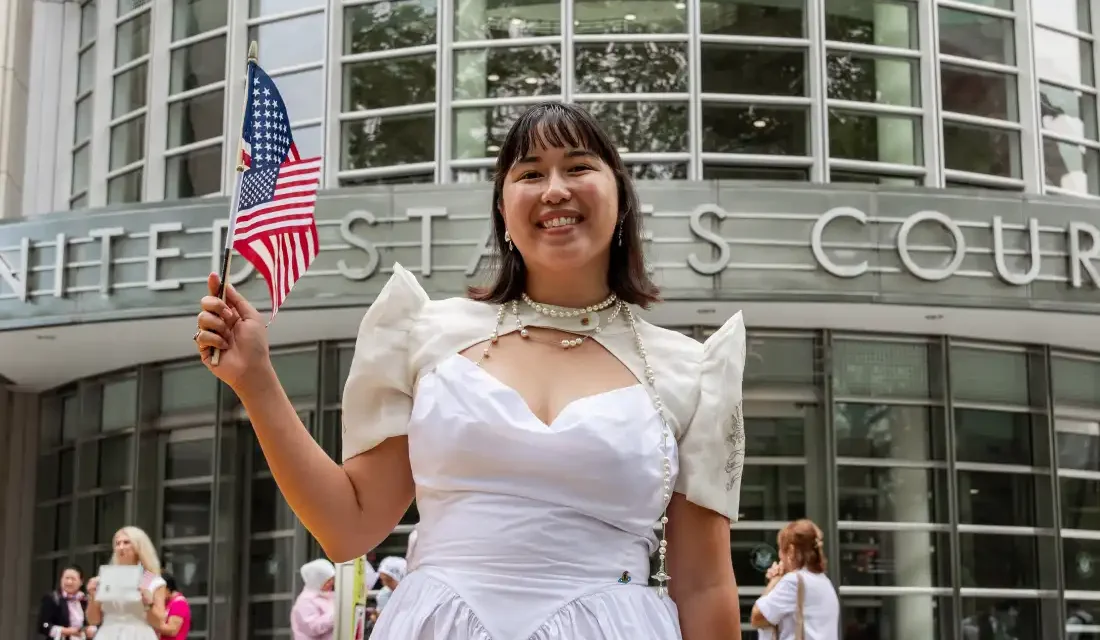
Nicole Solis-Sison moved to the U.S. from the Philippines at the age of seven. Her family sought asylum from the Philippine government and landed in Los Angeles, believing their stay would be brief. However, the government pursued them, demanding their return.
An Immigration and Naturalization Services (INS) agent, now part of Immigration and Customs Enforcement (ICE), interviewed her family. Instead of deportation, they were advised to apply for asylum. This legal guidance allowed them to remain in the U.S. Adjusting to the complex immigration process, Solis-Sison eventually became a U.S. citizen after over 20 years.
Now, at 34, Solis-Sison is voting in her first election in New York City. She feels a responsibility to protect others who face similar immigration challenges and sees her vote as a means to offer hope.
“I feel like I do have a weight to protect people who are going through this process, who are getting left behind and harmed because when I tell you, I’ve only gotten out of it with like a sliver of hope,” she expressed.
For Juan Escalante, originally from Venezuela, his path was different. Living as an undocumented immigrant from the age of 11 in Florida, he discovered his status during high school. Despite challenges, the Deferred Action for Childhood Arrivals (DACA) program provided a path forward.
Escalante became a U.S. citizen in 2025 and is preparing to vote for the first time. Though overwhelmed by the voting process, he meticulously researched ballot propositions to ensure his choices reflect his values.
“Being a first time voter here in the United States is something that’s profoundly personal and emotional for me because I understand the power of what a vote can do in service of the greater good,” he remarked.
In Wisconsin, Deisy España, part of a mixed-status family, votes with the weight of her parents’ experiences as undocumented immigrants. Her mother now has a green card, but the fear remains.
España votes not only for herself but for her family’s future, especially concerning immigration policies under Trump’s administration.
“I’m voting for my parents. I have to do it for my parents who can’t vote,” España stated.
Similarly, Leydi Gonzalez from Texas, whose parents are from El Salvador, feels the stakes are high as she votes. Now able to sponsor her parents, she remains concerned about their safety. She is motivated by recent events and the current political climate in Texas.
Gonzalez sees her vote as pivotal for her family’s security and echoes España’s sentiment.
“It definitely feels like I’m voting for my family,” she said.
These stories reflect the profound impact personal experiences can have on voting motivations, with family histories shaping how these individuals engage with the electoral process in the U.S.
 Mayor Mamdani’s Policing Reform Plans
 Gen Z Voter Shifts and Their Impact on the 2026 Midterm Elections
 Disappearance of US Senate Candidate Raises Questions
 DOJ Rule Change Reduces Appeal Time for Immigrants Facing Deportation
 Hakeem Jeffries’ Bid for House Speaker Faces Progressive Hurdles
 Ohio Judge Dismisses Defamation Lawsuit by Rep. Max Miller