
The U.S. Supreme Court recently ended one of its most contentious terms amid increasing partisan tensions. In response, Justices Amy Coney Barrett and Elena Kagan addressed Congress on the importance of enhancing judiciary security. Supreme Court justices are concerned about how partisan narratives influence public understanding of their decisions, not only for personal safety but also for maintaining judicial integrity.
Chief Justice John Roberts highlighted this issue in his 2024 annual report. He noted that courts are particularly ill-equipped to address misinformation since judges primarily communicate through their rulings rather than press events. Apart from these rulings, the only regular public insight into the Supreme Court comes from live audio of oral arguments, which has been available since 2020.
Data tracked by C-SPAN in 2022 and again in 2026 showed changes in public engagement with these live audios. Awareness regarding Supreme Court’s live oral argument audio increased from 46% in 2022 to 55% in 2026. This growth was driven by voters from Gen X, Millennials, and Gen Z, while older generations, particularly Boomers and those above 80, remained largely unaware.
The generational divide extends to how people consume Supreme Court information. Gen X, Millennials, and Gen Z are more inclined to use social media for updates, with 75% of respondents noting this preference. In contrast, older generations rely more on traditional media outlets such as national and local TV news, with 70% adherence.
There is a clear correlation between exposure to live audio and a more favorable view of the Court. Among Gen X, Millennial, and Gen Z voters, 58% reported a positive impact on their perception of the Court compared to only 27% of Boomers. Traditional media typically filters information through commentators, which could skew perceptions.
The experience of directly hearing justices through live audio has gradually improved trust, especially within younger generations using digital platforms. These platforms, despite being criticized for spreading misinformation, allow listeners to hear court proceedings in full context. Examples include clips from oral arguments or podcasts featuring discussions between justices and lawyers.
Given live audio’s success in enhancing public trust, introducing courtroom cameras could be a beneficial next step. Like live audio, televised oral arguments could further demonstrate the seriousness with which justices approach their work. This broader access might help counteract partisan misinformation and enhance the court’s transparency.
Robert Green is the principal and Ian Green is vice president at Pierrepont Consulting and Analytics.
 State Department Simplifies Passport Process with Online Applications
 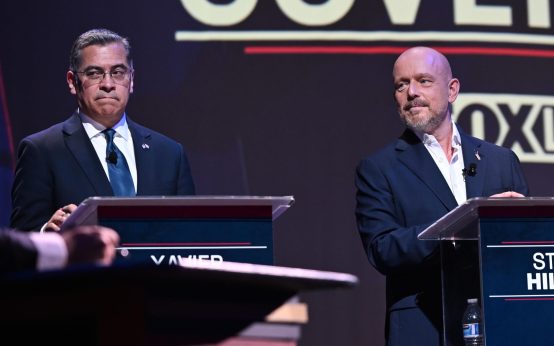 Becerra and Hilton Clash in California Gubernatorial Debate
  California Voters to Decide on $7.5 Billion State Research Fund
  Highlights from the California Gubernatorial Debate: Becerra vs. Hilton
  Becerra vs. Hilton: The Debate and Key Issues in the California Governor Race
  Senate Confirms New Labor Secretary