
While the United Nations General Assembly convened in New York, I attended an event organized by The David Network focusing on the Pentagon’s Office of Strategic Capital (OSC). The David Network links conservative students and professionals from Ivy League schools, MIT, and Stanford with mentors in technology, finance, and defense sectors.
Just blocks away, the General Assembly engaged in its annual routine, advocating for a world without weapons and passing non-binding resolutions. Despite sincere intentions from global leaders, the institution has repeatedly shown ineffectiveness over decades.
Conversations at the event were centered on protecting the U.S. and its allies. Acknowledging that peace is supported by power and military strength is uncomfortable for some, but remains essential.
My experience working with Donald Trump for nearly 25 years, including at the White House, informs my perspective. Trump approaches problems as transactions to be resolved efficiently and successfully. Though OSC did not originate with him, Trump invigorated the office during his tenure, transforming it from an underutilized entity to a vital component for national security.
Modern conflicts are increasingly decided by advanced technologies. To maintain military and economic leadership, the U.S. must stay competitive. OSC’s primary mission is to ensure that U.S. industries like satellites, semiconductors, and drones remain independent from foreign control.
Their work involves bringing private investment into essential industries, providing technical and financial support.
Significant progress resulted from these efforts. For example, OSC facilitated a $150 million loan to MP Materials for rare earth processing in California. China currently dominates this critical area, and OSC aims to eliminate such dependencies. Another notable initiative is an $820 million conditional loan to Performance Drone Works, bolstering domestic drone component manufacturing.
Their strategy involves directly consulting with the private sector. OSC inquires about ongoing challenges and obstacles preventing optimal speed and efficiency in technological advancements. Recognizing that private companies possess insights often beyond those within government, OSC works to dismantle these barriers, fostering a dynamic market for defense industries.
This proactive approach extends to significant procurement decisions. Historically, the Pentagon ordered munitions yearly, leading suppliers to act cautiously. Recently, collaboration between the White House and Congress facilitated multi-year purchase agreements. For instance, a seven-year agreement with Lockheed Martin aims to significantly boost production of Patriot and THAAD interceptors.
Media narratives often mischaracterize the use of interceptors in conflicts, viewing them as inventory depletion. These interceptors, however, fulfill their intended purpose—defending against threats like those from Tehran. U.S. strategy focuses on accelerating production to counter such threats effectively.
OSC remains involved through constant collaboration and support, ensuring projects progress and investments bear fruit. This reflects Trump’s vision of government operation—engaged and results-driven.
The contrast between the UN’s symbolic gestures and OSC’s practical actions underscores the current state of global affairs. OSC and its partners are actively working to safeguard the U.S. and its allies.
Jason D. Greenblatt previously served as the White House Middle East envoy under Trump. He authored “In the Path of Abraham,” established Abraham Venture LLC, and runs the “How to Watch” Substack. Follow him on X: @GreenblattJD. Opinions in this article are his own.
 Concerns Over Changes to Voter-Registration Form for Americans Abroad
  Trump’s 2024 Campaign Targets Young Men Through Cryptocurrency
  Trump’s White House Visitor Center Proposal Gains Bipartisan Support
  State Department Simplifies Passport Process with Online Applications
 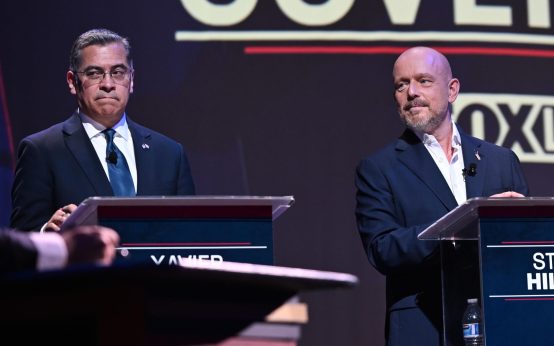 Becerra and Hilton Clash in California Gubernatorial Debate
  California Voters to Decide on $7.5 Billion State Research Fund