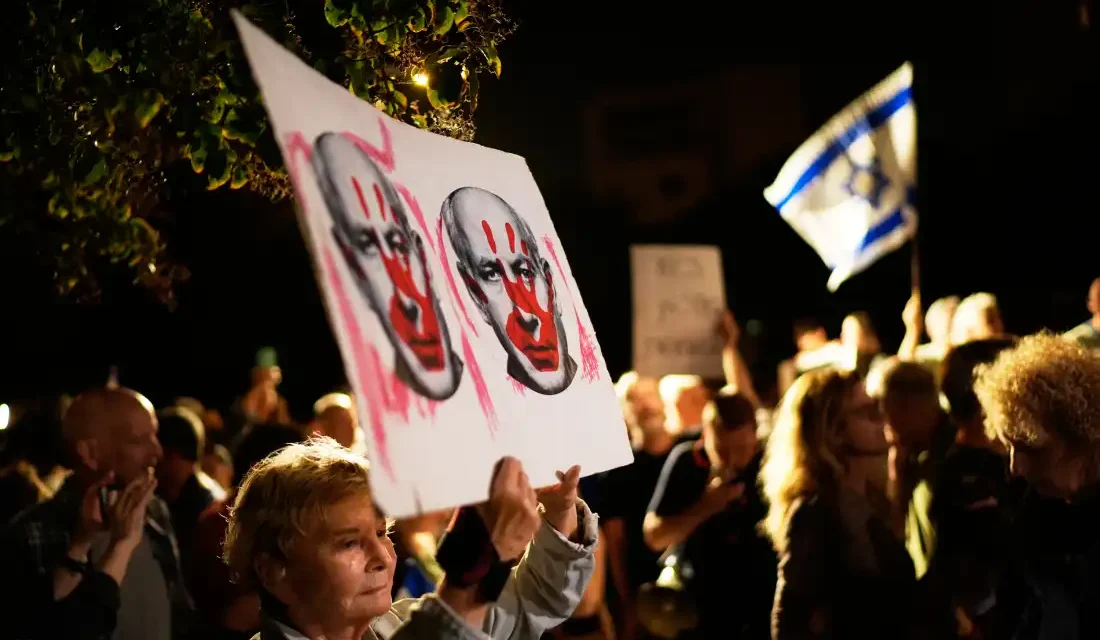
Israeli left-wing activists are urging the formation of a government with Arab parties outside the Yashar party leader Gadi Eisenkot’s home in Herzliya. The recent Israeli election has resulted in a political stalemate. Neither Prime Minister Benjamin Netanyahu nor his primary opponent, Gadi Eisenkot, has a clear path to establishing a government. Final results show opposition parties securing more seats than Netanyahu’s right-wing bloc. However, Eisenkot, a center-right former military chief of staff, cannot reach a majority without support from predominantly Arab parties, which he and his allies have consistently rejected during the campaign.
Netanyahu’s Likud party has received the most votes, yet his bloc also lacks a majority. The coalition of right-wing, far-right, and ultra-Orthodox parties backing his previous administration does not control the necessary 61 seats to achieve a majority in the 120-seat Knesset. Here is what may transpire next and the potential routes to forming an Israeli government.
How Does Israel Form a Government?
In the coming days, Israel’s president will consult leaders of each party elected to the Knesset. These parties will recommend which leader they believe should have the first opportunity to form a coalition. The president’s choice is not restricted to the leader of the largest party. Instead, the president selects the candidate deemed most capable of assembling a governing coalition. This candidate has 28 days to secure support from at least 61 lawmakers. If necessary, the president may grant a 14-day extension. Should this attempt fail, another candidate may be given a chance. This process could last weeks or months, or end without anyone establishing a majority.
Who Might First Form a Coalition?
Based on election outcomes, Eisenkot seems more likely than Netanyahu to gain the majority of recommendations from newly elected lawmakers. However, Eisenkot—a political newcomer—may still struggle to form a coalition since his bloc lacks a majority without Arab-led parties, which he has pledged to exclude. The Arab parties represent 21% of Israel’s population, generally self-identified as Palestinian citizens. Eisenkot and his allies have dismissed the possibility of governing with these parties due to their positions on Hamas and Gaza, which differ from Israel’s military goals.
Netanyahu faces a similar issue, as his traditional coalition partners also lack sufficient seats to reestablish his leadership.
Potential Outcomes
- Unity Government: A coalition between Netanyahu and Eisenkot is a possibility. Reports indicate President Trump favors this option. It might include centrist and right-wing parties, facilitating cooperation with the Trump administration on priorities like Gaza reconstruction. Eisenkot has vowed not to join a Netanyahu-led government, and they would need to settle leadership roles, possibly rotating the prime ministership.
- Eisenkot Government with Arab Support: Eisenkot’s bloc and Arab parties would control over 67 seats, forming a majority. However, Eisenkot and his allies have consistently rejected this, and campaign promises contradict such a coalition. Arab parties could support from outside, yet this still clashes with previous pledges.
- Another Election: The president encourages avoiding a new election after such high voter turnout. Yet, if no candidate wins a majority, another election might occur. A repeat election could disadvantage Netanyahu, with possible reduced Arab and overseas liberal turnout.
- Defector Strategy: Attracting defectors is a challenging strategy given the current seat distribution. Netanyahu would need approximately eight defectors, while Eisenkot would need 13 without involving Arab parties, which appears improbable.
Opposition Strategies Against Netanyahu
A majority opposed to Netanyahu might push legislation before a government forms, aligning with Arab lawmakers. Eisenkot’s bloc may seek to replace the Knesset speaker and launch inquiries into security failures before the Hamas-led attack on Oct. 7, 2023. They might also attempt to undo laws critics say weakened democracy and judicial independence. These moves would not establish a new government, but would enable significant parliamentary influence while negotiations continue.
Impact of Renewed Conflict with Iran
In his election night speech, Netanyahu emphasized Israel’s mission against Iran. Eisenkot cautioned him against using security for political aims. Renewed conflict with Iran could disrupt legislative moves and prompt pressure on Eisenkot to join a unity government, as seen following the Oct. 7 attack when Eisenkot initially joined an emergency government but later resigned. Israeli analyst Danny Citrinowicz suggests Netanyahu might see political advantage in renewing conflict to pressure for unity.
Daniel Estrin contributed additional reporting from Tel Aviv.
 In-Flight Altercation on Qatar Airways Leads to Police and FBI Response
 Mayor Mamdani’s Policing Reform Plans
 Virginia Residents Sue Over Alleged Immigration Violations
 Gen Z Voter Shifts and Their Impact on the 2026 Midterm Elections
 Disappearance of US Senate Candidate Raises Questions
 DOJ Rule Change Reduces Appeal Time for Immigrants Facing Deportation