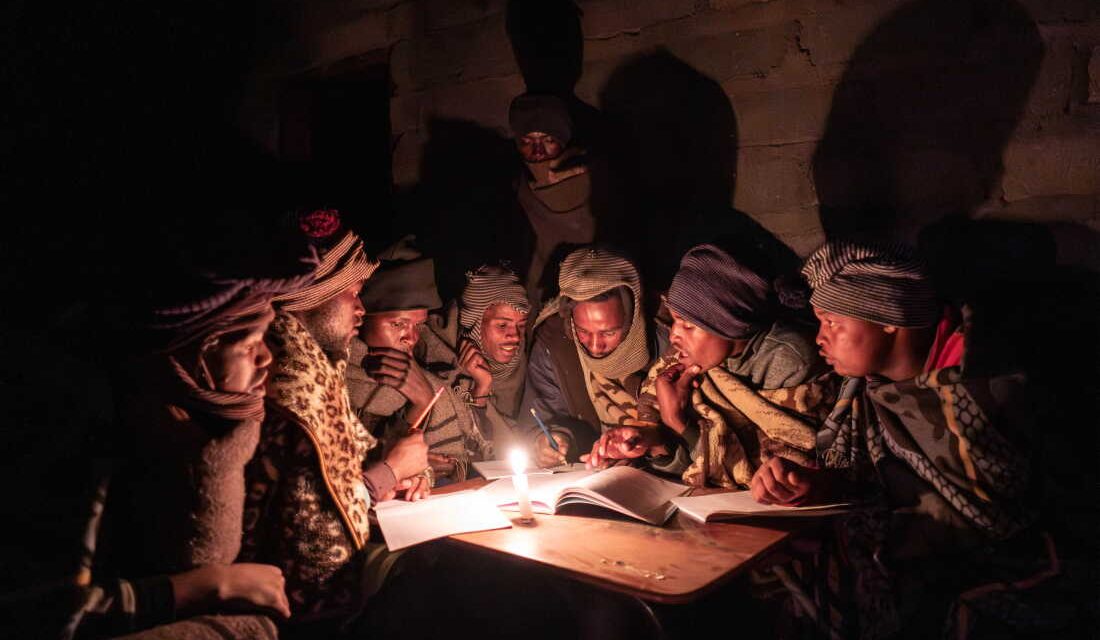
Shepherds in the mountainous region of Mokhotlong, Lesotho, attend a part-time night school. For many, these classes offer the only form of accessible education. The endeavor takes them on a long trek, as dusk descends, over rocky paths nearly 8,000 feet above sea level. They head towards the lights of Semonkong, gathered at a building that stands bright under fluorescent lights: the Good Shepherd School.
Here, more than 40 herders congregate each evening for night classes. Kabelo Mohai and Lepeli Maapesa, among tens of thousands working as shepherds in Lesotho, navigate cultural and economic traditions that often require school-aged boys to herd livestock. Wool and mohair make up almost 60% of agricultural exports, supporting a quarter of the rural population. A World Bank analysis found that close to half of all boys in Lesotho were engaged in herding, often at the expense of their formal education.
“I started working with animals when I was 9. I only finished primary school,” shares Mohai, now 20.
To provide an educational lifeline, night schools like the Good Shepherd have emerged across the country. Volunteers run these schools on minimal budgets, offering basic education in reading, writing, and arithmetic. Despite constant financial struggles, these schools represent hope for students dreaming of a different future.
Mohai, at age 15, took over herding full-time, moving into a cattle post to care for his family’s flock. His isolated life contrasts starkly with his aspirations: “It’s very important for us to have some knowledge and learn,” he explains, dreaming of becoming a soldier. Every weekday, after tending to the sheep, he attends his Grade 7 class before returning to his mountain hut.
The Good Shepherd School was founded in 2003 on the grounds of a convent by the Good Shepherd Sisters of Quebec. Sister Rosemary Mokebe leads classes for more than 40 students, aged 15 to 55. Most schools like this one were initially supported by NGOs, and while the Ministry of Education seeks to formalize these volunteer-led classes, challenges persist.
In Semonkong, Sister Mokebe emphasizes the importance of educating shepherds, vital to the nation’s economy. “Without the school, they are sitting in the dark,” she warns, highlighting the schools’ role in combatting illiteracy.
Around 150 miles away in Thaba-Tseka district, Mampho Makha runs another night school. Inspired by teaching her father to read after a painful incident, she began teaching voluntarily in 2003. Her school teaches basic literacy and numeracy skills to shepherds and villagers who missed out on education.
Despite challenges, educators like Makha continue their teaching mission. In her small, illuminated tin shack, students huddle over notebooks. For many, these rudimentary classes provide a chance not only to learn but to step into a world of possibilities and connection, breaking away from their isolated routines.
 David Madigan Appointed as USC’s Chief Academic Officer
  North American Values Institute Questions Pittsburgh Schools’ New Curriculum
  Debate Over Proposed English-Only Rule for Head Start Programs
  Impact of Removing Regents Requirement on Education
  Impact of College Rankings on Lesser-Known Institutions
  Evaluating Accountability in Missouri’s Education System