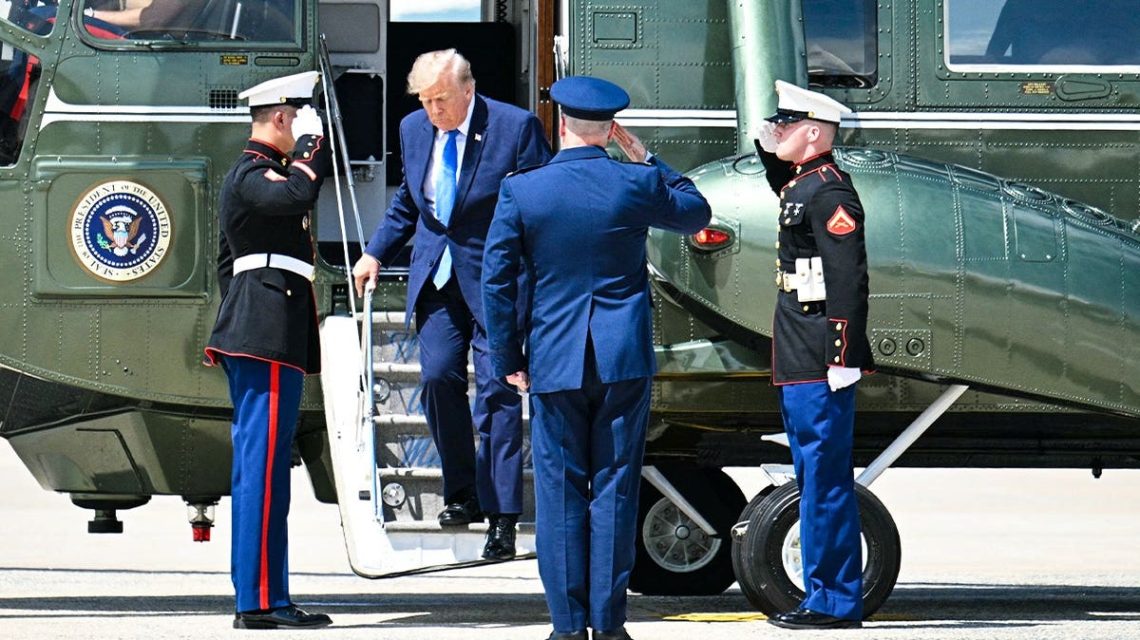
On August 4, the crew of Marine One faced communication challenges before President Donald Trump’s helicopter departed near Reagan National Airport, according to a preliminary report from the National Transportation Safety Board (NTSB). The crew attempted several times to notify the airport, but the initial call was not received. The second attempt was described as “broken and completely unreadable.” Efforts to relay the notification through Joint Base Anacostia-Bolling were also unsuccessful.
The communication breakdown meant Reagan National controllers did not receive the necessary notification to halt departures before the helicopter took off. Envoy Air Flight 3742, headed to Pensacola, Florida, was cleared for departure from Runway 1 as Marine One was leaving the White House for Los Angeles.
The NTSB report noted that the commercial jet began climbing as Marine One took off from the Ellipse, located approximately two miles north of the airport. The Federal Aviation Administration (FAA) estimated that the two aircraft came within about 0.82 nautical miles laterally and roughly 700 feet vertically. Both flights continued without incident, and there were no injuries or damage.
The Envoy flight crew heard the traffic-collision system announce “Traffic, Traffic” as the jet climbed. Pilots did not spot Marine One visually but saw the helicopter to the right and below on their cockpit display. The system did not issue a resolution advisory, which would instruct pilots to climb or descend to avoid another aircraft.
Eventually, Marine One managed to contact the tower after gaining enough altitude, at which point controllers issued a traffic advisory. The helicopter crew then reported having the Envoy jet in sight.
Prior concerns had been raised about communications, as noted in a meeting on July 30 between Marine Helicopter Squadron One, known as HMX-1, and Reagan National tower staff. During this meeting, HMX-1 mentioned that communications were “spotty.” Both sides agreed on backup methods for notification, including relaying through another aircraft if direct radio contact failed.
FAA technicians later found inadequate line-of-sight coverage between the radio transmitter site and the Ellipse, where Marine One operated due to construction at the White House. The FAA relocated the radios used for helicopter-control frequency to the top of Reagan National’s control tower. Post-movement checks revealed no deficiencies.
The FAA and NTSB, reviewing the incident, considered it a “momentary loss of separation.” The aircraft were estimated to be less than 1.5 nautical miles apart horizontally, but the 700 feet of vertical separation met FAA standards. In that Class B airspace, standards require a minimum of 1.5 nautical miles of lateral or 500 feet of vertical separation.
The NTSB continues to analyze surveillance data to confirm the closest point between the aircraft. The White House confirmed that President Trump was never in danger, stating that Marine One is operated by highly skilled aviators.
The NTSB’s preliminary report outlines factual details without analysis or conclusions related to probable cause. The investigation is ongoing, and further findings will be released through public processes.
 TikTok Couple Arrested for Alleged Arson in West Virginia
  21-Year-Old University of Georgia Student Survives Eight-Story Fall
  Texas Authorities Arrest Suspect Over Potential Capitol Attack
  Arizona State University Hockey Incident Leads to Coach’s Administrative Leave
  Senate Vote on Data Center Electricity Cost Legislation
  Fatal Hit-and-Run Leads to Additional Shooting Incident in Miami-Dade