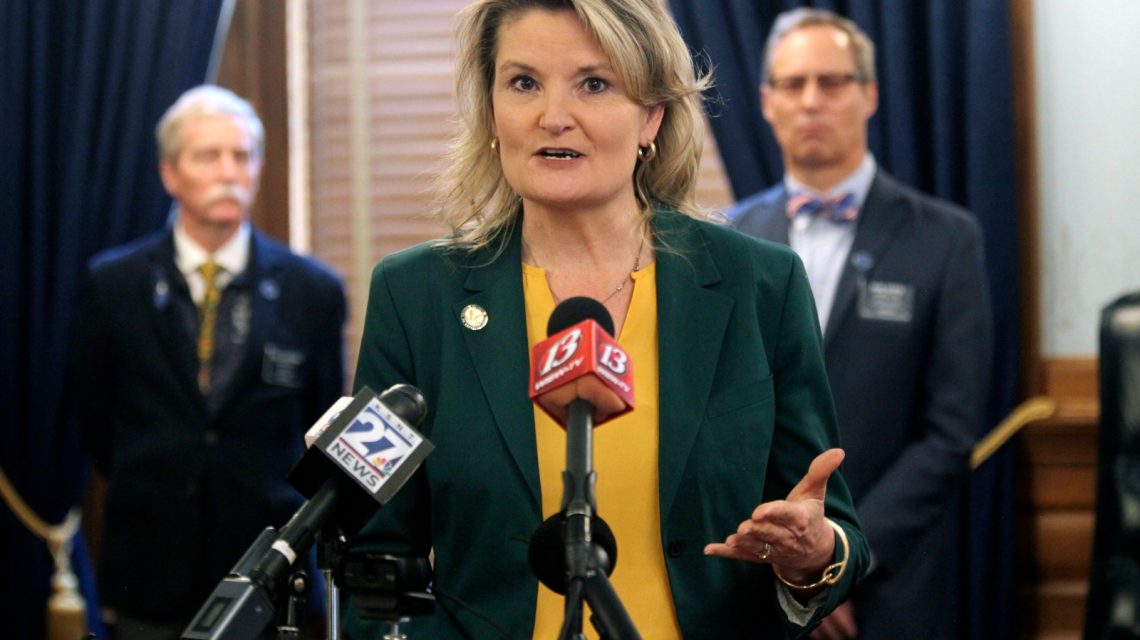
The Cook Political Report has adjusted its predictions for two gubernatorial contests, moving both toward Democratic candidates just a week before the midterm elections. This change affects Nebraska and Kansas, two states in the Midwest that President Donald Trump secured in the 2024 presidential election.
The Nebraska governor’s race has moved from ‘likely Republican’ to ‘lean Republican,’ while the Kansas contest is now considered a ‘toss-up’ rather than ‘lean Republican.’ These elections are often seen as an assessment of the political challenges faced by the party in power, with the president’s party historically losing seats. Despite winning Kansas and Nebraska in the 2024 election against Kamala Harris, Trump’s approval ratings have recently declined. Economic concerns and issues such as immigration and the conflict in Iran are key factors contributing to this dip in popularity.
Trump’s overall approval rating and stance on policy issues have slipped, reflecting household affordability concerns across America.
Efforts by Trump to rally support for GOP candidates continue as the November 3 election date approaches. Requests for comments have been made to the campaigns of Republican candidate Ty Masterson and Democrat Cindy Holscher in Kansas, as well as Republican incumbent Jim Pillen in Nebraska.
What To Know
In the 2024 presidential election, Trump secured Kansas with 57.2% of the vote compared to Harris’ 41%, and in Nebraska, he claimed 59.3% versus Harris’ 38.9%. The Cook Political Report notes a more competitive U.S. Senate race in Kansas between Democrat Adam Hamilton and Republican Roger Marshall. Internal polls from Holscher have played a role in shifting the forecast as well.
Despite significant spending against Holscher, Cook has updated the race status. Holscher, in response to Cook’s reevaluation, stated that momentum is on her side. Similarly, in Nebraska, Cook attributes the shift to internal polls and additional candidates on the ballot, such as Rick Beard from the Legal Marijuana Now Party and Brett Lindstrom with the America First Party.
Jim Pillen, leading in most recent polls and supported by Trump, may face challenges from the presence of these third-party candidates. Lynne Walz’s campaign spokesperson, Sophie Mestas, expressed confidence in the change, highlighting Walz’s commitment to Nebraskans over special interests.
Lynne Walz will always answer to Nebraskans, not special interests.
Currently, Democrats are poised to secure up to four additional gubernatorial seats. The Republicans have dominated governorships for nearly 20 years, except a brief Democratic term from 2007 to 2011. Thirty-six state seats are contested, evenly split between parties.
What the Polling, Prediction Markets Show
In Nebraska, YouGov’s recent survey reports Walz with 43% against Pillen’s 44%, with a margin of error of 3.3%. Similarly, prediction markets like Kalshi and Polymarket show Pillen holding 82% to Walz’s 18%.
In Kansas, YouGov’s poll shows Masterson leading with 47% over Holscher’s 44%. The margin of error is 3.2%, with remaining voters undecided. The New York Times and Siena Research Institute observe Masterson with 49% and Holscher at 44%, with a 4.6% margin of error. Prediction markets also indicate strong prospects for Masterson with a 73% chance.
Overall, these shifts in forecast reflect evolving dynamics in key governor races ahead of the midterms.
 Mayor Mamdani’s Policing Reform Plans
 Gen Z Voter Shifts and Their Impact on the 2026 Midterm Elections
 Disappearance of US Senate Candidate Raises Questions
 DOJ Rule Change Reduces Appeal Time for Immigrants Facing Deportation
 Hakeem Jeffries’ Bid for House Speaker Faces Progressive Hurdles
 Ohio Judge Dismisses Defamation Lawsuit by Rep. Max Miller