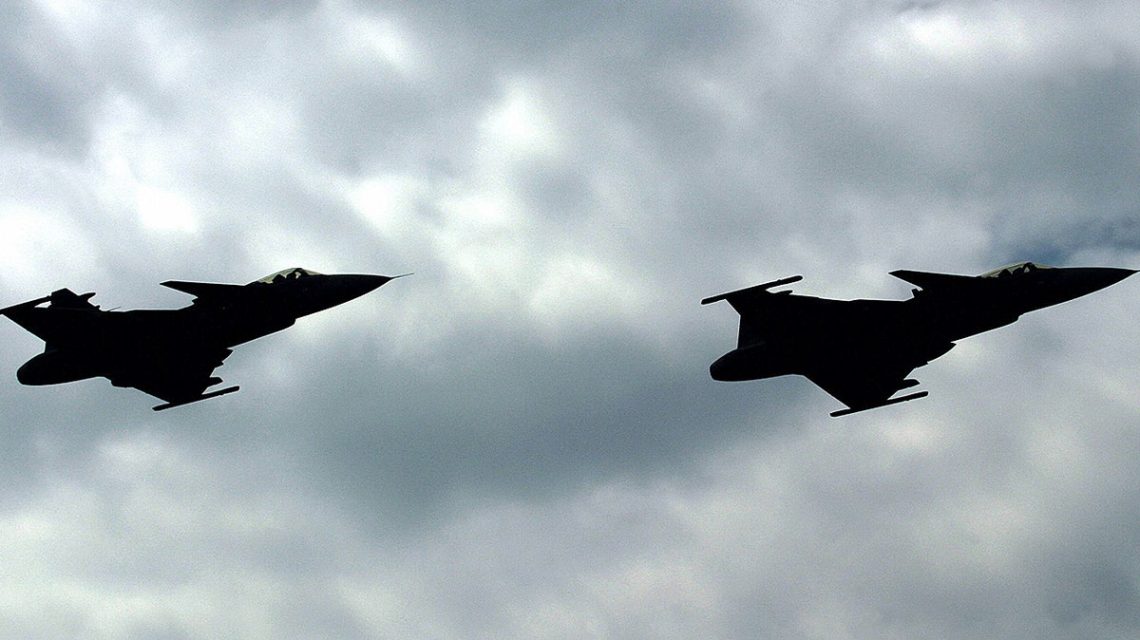
Finnish and Swedish fighter jets took action on September 24 to intercept Russian supersonic military aircraft over the Gulf of Finland. This event marks a significant step in Nordic defense collaboration during a time of increased tension with Moscow.
The intercept occurred shortly before Russian President Vladimir Putin dismissed European warnings about the threat from Moscow in the region, mocking Estonia’s defense preparations against a potential Russian assault.
The Finnish F/A-18 Hornets and Swedish JAS 39 Gripens swiftly responded after detecting Russian aircraft in international airspace according to the Swedish Armed Forces.
US ALLIES NEED TO SHOOT DOWN RUSSIAN AIRCRAFT TESTING NATO BOUNDARIES, CZECH PRESIDENT WARNS.
The Russian aircraft formation included a Tu-134 transport plane, MiG-31 interceptors intended for long-range threat engagement, and Su-30 multirole fighter jets designed for diverse combat scenarios.
Major General Jonas Wikman, commander of the Swedish Air Force, emphasized the practical cooperation during the operation:
This is what close cooperation looks like in practice. Built over years on trust and strong personal relationships, we can now operate seamlessly together—as air forces, as nations and as Allies.
Concerns are growing over Russian military activities along NATO’s eastern flank. Recent incidents include Russian drones in Polish airspace, a Mi-8 helicopter from Kaliningrad crossing into Poland, drone crashes in Romania and Moldova, and armed Russian jets entering Estonian airspace before interception by NATO aircraft on September 18.
BATTLE-TESTED ZELENSKYY SOUNDS CHILLING ALARM ON WHERE PUTIN’S WAR COULD HEAD NEXT.
Estonia’s Defense Minister, Martin Herem, warned that Russia might use military force against Estonia within a year, urging thorough assessment of Tallinn’s defenses in response.
Prime Minister Kristen Michal affirmed that Estonia is ready to close border crossing points swiftly if threat evaluations change.
In response to warnings of Russian aggression, Putin downplayed the claims at the St. Petersburg International United Cultures Forum:
Many people in Europe say they expect an attack from Russia and therefore claim they must prepare for war with Russia. I want to emphasize once again: we are not preparing for military action against Europe. We have no such plans, no basis for them, and, most importantly, no real motive to escalate the situation with Europe.
As we jokingly say in Russia: ‘The circus has left, but the clowns remain.’ It is political clowning. … Clearly, these statements are complete nonsense and absurdity.
Estonia shares proximity to Finland across the Gulf of Finland, creating part of the increasingly integrated northern and eastern defenses of NATO amid fear over Russian military actions.
Finland officially became the 31st NATO member in April 2023, doubling the alliance’s land border with Russia. Sweden followed as the 32nd member in March 2024. Estonia has been part of NATO since 2004.
The Baltic Sea region remains under heightened vigilance due to incidents involving gas pipelines and hybrid threats since Russia’s invasion of Ukraine in 2022.
NATO announced in June that it is strengthening protection for eastern members by enhancing cybersecurity and aiding resilience against hostile Russian activities.
FINLAND’S STUBB CREDITS TRUMP FOR PUSHING UKRAINE PEACE TALKS WHILE DISMISSING RUSSIAN INVASION FEARS.
NATO Secretary General Mark Rutte stated that any attack on a member would receive a strong response, emphasizing Washington’s critical role in the alliance:
Putin knows that the United States and Europe are totally intertwined. We have to make sure that we are prepared, we are strong, and he knows it. If he does anything silly, he knows our reaction will be tough.
European intelligence officials announced on September 24 the possibility of Russia testing NATO’s defenses.
Denmark’s Defense Intelligence Service assessed the risk of a limited Russian military attack against a NATO member as “low but growing,” with expectations of increased hybrid campaigns by Moscow.
The service also stated that a full-scale Russian invasion of a NATO member remains highly unlikely but cannot be dismissed.
Emma Bussey is a breaking news writer for Fox News Digital. Before joining Fox, she worked with The Telegraph’s U.S. overnight team across various desks, including foreign, politics, news, sport, and culture.
 British Police Arrest Man Suspected of Terror Plot
  Activists Push for Nationwide Ban on Child Marriage in the U.S.
  Investigation into Alleged Incident at Cornell University
  Rising Drone Threats Highlight Vulnerabilities in Moldova’s Airspace Defense
  Bolivia Faces Security Test Amid Unrest
  Incident on FlyDubai Flight Raises Security Concerns