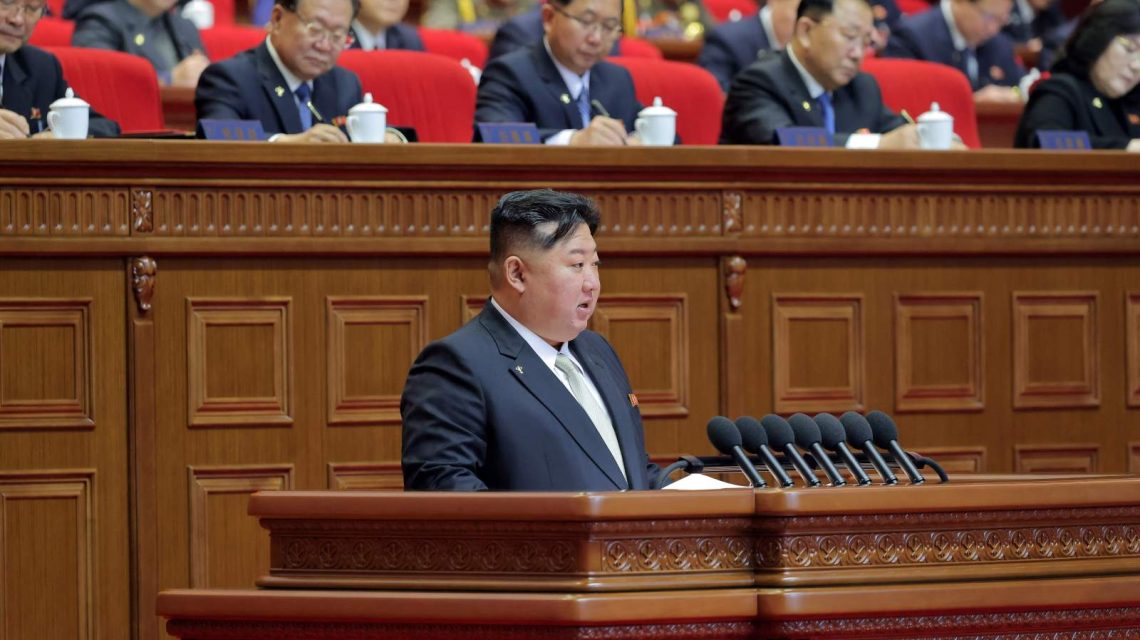
North Korea has made four significant changes to its constitution. These include reinforcing a more aggressive stance toward South Korea and amplifying Kim Jong Un’s control over nuclear capabilities. The updated constitution became public after two and a half years of absence, removing past goals of reunification with South Korea.
Edward Howell, author of A New Axis of Upheaval: North Korea, Russia, China, Iran, told Newsweek, “The constitutional change shows what we have understood for the past three years—North Korea is disinterested in any interaction with South Korea.”
What Happened To North Korea’s Constitution?
The document went offline in March 2024, following Kim’s statement in late 2023 that North and South Korea are distinct, adversarial nations. The constitution was revised at the 15th Supreme People’s Assembly, as reported by Korea JoongAng Daily. This aligns with an iteration obtained by South Korea’s Ministry of Unification earlier this year.
The document became accessible on Wednesday through the propaganda outlet Naenara.
Redefining North Korea’s Territory
Article 2 clarifies North Korea’s territory, describing it as land adjoining China and Russia to the north and South Korea to the south, including the relevant airspace and waters. It does not establish concrete land or sea demarcations with South Korea.
South Korean news organization Asiae.kr indicated that the constitution’s wording likely sustains a two-state acknowledgment while avoiding direct confrontational language. Howell noted, “Pyongyang no longer regards Seoul as part of a united Korean Peninsula. The Kim Jong Un regime now sees South Korea as a lasting, key opponent.”
Reunification Removed
South Korea’s progressive leader, Lee Jae Myung, emphasized reducing tensions by rejecting enforced unification. He advocated for discussions toward a peace system replacing the 1953 armistice. However, Kim Jong Un dismissed these views at a party congress in February, stating North Korea held no interest in dealings with South Korea.
The January 2024 assembly led to the removal of reunification language from their constitution. Howell highlighted that following Lee’s 2025 election, Kim Yo Jong soon criticized Seoul’s reconciliation efforts as “appeasement offensives.” Howell added, “The constitutional update underscores this outlook, signaling to Seoul that North Korea disregards any attempts to mend relations.”
Kim Jong Un’s Powers Increased
The reformed constitution augments Kim’s authority, allowing him to veto legislative decisions and remove representatives lacking public support, as noted by NK News. The preamble downplays the legacy of Kim Il Sung and Kim Jong Il, in line with Kim Jong Un’s intensifying personality cult.
Kim’s Authority Over Nuclear Forces Expanded
The amendments extend Kim’s command over the State Affairs Commission, particularly concerning nuclear forces. This change parallels worries over North Korea’s nuclear developments, including recent missile tests.
Test launches this year encompassed an intermediate-range missile linked to the hypersonic weapons program as a counter-response to South Korea’s hypersonic glide vehicle launch. Jang Do-young, spokesperson for South Korea’s Joint Chiefs of Staff, remarked on the projectile’s significance.
On October 12, Pyongyang conducted further ballistic missile tests, confirming advancements to a tactical missile system. Shortly before, Kim reviewed a weapons museum featuring a Hwasong-20 ICBM, claimed capable of targeting the U.S. mainland.
Latest Tensions Between the Koreas
A landmine explosion on September 21 in the Demilitarized Zone injured three South Korean soldiers, identified as resulting from North Korean ordnance. Despite Pyongyang denying involvement in a letter to the UN Security Council, tensions have escalated.
Pyongyang continues to fortify the DMZ and intensify weapons testing according to Armed Conflict and Location Event Data. Howell mentioned that the constitutional amendments let North Korea depict South Korea as an aggressor and can undermine South Korea’s position in any dialogue between Pyongyang and Washington.
 In-Flight Altercation on Qatar Airways Leads to Police and FBI Response
 Virginia Residents Sue Over Alleged Immigration Violations
 Updates on Key International and Domestic Events
 Pope Leo XIV Completes South American Tour with Farewell Mass in Peru
 President Trump’s Critical Asia Trip: Key Meetings and Implications
 U.S. Plans to Restrict AI Chip Exports Before Trump-Xi Meeting