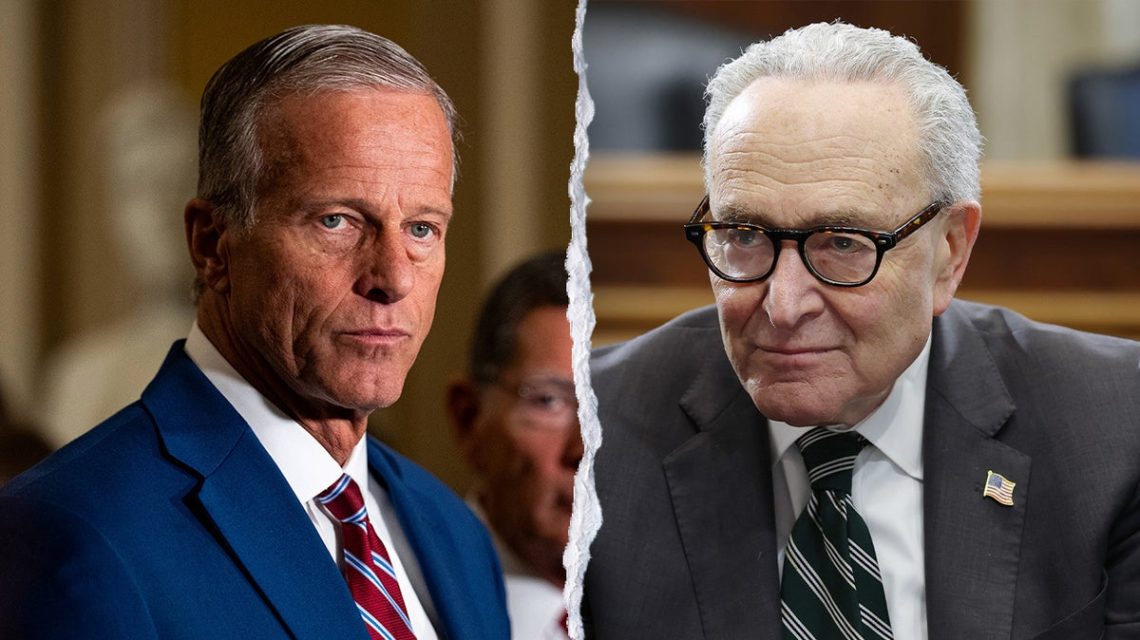
Senate Majority Leader John Thune, R-S.D., enjoys a light-hearted approach to his campaign strategies. He shares with candidates that he will support or oppose them based on what benefits their race the most. This reflects his adaptable stance as he supports Republican candidates nationwide.
Recently, Thune attended a roundtable in Nebraska along with Sen. Pete Ricketts, R-Neb., who is locked in a tight race against independent Dan Osborn. The event occurred in a barn surrounded by cornfields. Thune’s travel has been extensive during this election cycle as he hits states like Georgia, South Carolina, Florida, Minnesota, Nebraska, Iowa, and Ohio.
Contrastingly, Senate Minority Leader Chuck Schumer, D-N.Y., has been less visible on the campaign trail. Schumer has chosen virtual events and relied on high-profile surrogates, such as former President Barack Obama and former Vice President Kamala Harris, to engage key states.
Recently, Schumer hosted a virtual fundraiser for Florida state Rep. Angie Nixon, the Democratic Socialists of America-affiliated nominee running against Sen. Ashley Moody, R-Fla. Meanwhile, several Democratic candidates, from Michigan to Mississippi, have distanced themselves from Schumer.
In Mississippi, candidate Scott Colom is running against Sen. Cindy Hyde-Smith, R-Miss. Despite receiving $1.2 million in advertising support from the Senate Majority PAC, aligned with Schumer, Colom expressed reluctance to support Schumer’s leadership should he win.
“I don’t want to get into hypotheticals,” Colom said about supporting Schumer. He emphasized the need for rural voices in Democratic leadership. “We don’t have enough rural voices in leadership in the Democratic Party,” Colom stated.
Others, such as Abdul El-Sayed in Michigan and Adam Hamilton in Kansas, have openly refused to back Schumer if elected.
Republicans have capitalized on this internal division within the Democratic Party. Ohio’s Sen. Bernie Moreno noted that Republicans do not face similar dissensions regarding leadership. He highlighted Democratic candidates’ willingness to oppose Schumer as indicative of internal party strain.
Thune remains committed to supporting Republicans wherever needed. He acknowledges the Democratic Party’s struggles in defining its identity amid rising socialist influences. Thune points out that this faction causes leadership challenges across both the House and Senate.
Concluding, Thune argues that Democrats have veered too far left, which may disadvantage them in current elections, even in otherwise favorable conditions.
Alex Miller, a writer for Fox News Digital, covers developments in the U.S. Senate.
 Mayor Mamdani’s Policing Reform Plans
 Gen Z Voter Shifts and Their Impact on the 2026 Midterm Elections
 Disappearance of US Senate Candidate Raises Questions
 DOJ Rule Change Reduces Appeal Time for Immigrants Facing Deportation
 Hakeem Jeffries’ Bid for House Speaker Faces Progressive Hurdles
 Ohio Judge Dismisses Defamation Lawsuit by Rep. Max Miller