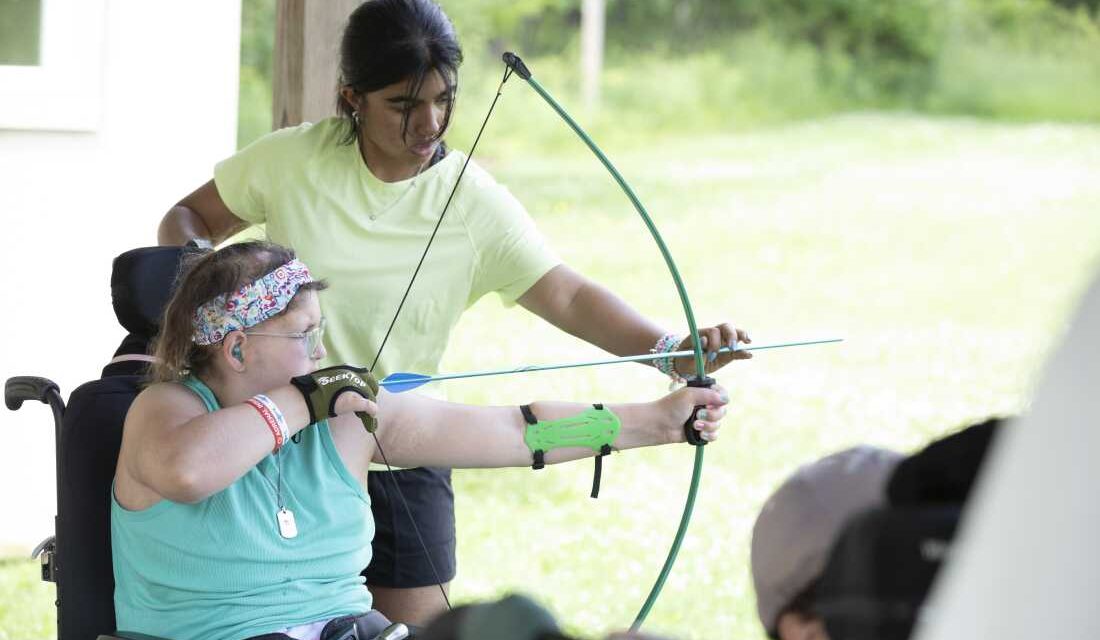
At Camp Cranium in Millville, Pennsylvania, vibrant scenes unfold every June. Children and young adults, all survivors of brain injuries, engage in activities that challenge and empower them. Anvitha Tharra, a camp counselor, guides participant Angelica Zander in mastering archery. The air buzzes with excitement as arrows fly towards targets.
Drew Meyer, the operations director, observes with pride and emotion. Campers, aged 10 to 21, exhibit remarkable spirit. They tackle daily challenges and achieve milestones, like hitting targets in archery after hours of practice. Camp Cranium has been a sanctuary in rural Columbia County since 2008, offering adventures like climbing, swimming, and zip-lining.
The camp mirrors a broader shift. Improved survival rates from brain injuries, due to seat belt laws and investments in trauma care, mean more children than ever live with these injuries. Yet, advocacy for brain injury prevention and research faces hurdles. Congress did not renew a key law affecting funding; staffing cuts at the Centers for Disease Control and Prevention (CDC) impacted ongoing research.
Rebeccah Wolfkiel, from the National Association of State Head Injury Administrators, emphasizes the importance of community support for those affected by brain injuries. Lucas Hardy, a 14-year-old camper, embodies this resilience. With assistance, he climbs a rock wall, resilient in the face of a traumatic brain injury sustained in childhood.
The Brain Injury Association of America reports that around 2.8 million Americans experience traumatic brain injuries (TBIs) annually. This includes approximately 475,000 children. Recent studies suggest these figures underestimate the prevalence of TBIs.
Reductions in CDC staffing in 2025 disrupted plans for a national concussion surveillance system. Despite uncertainty, Emily Hilliard of the Department of Health and Human Services reaffirmed the administration’s commitment to brain injury prevention and research. Efforts now include educational campaigns and injury prevention programs.
Wolfkiel voices concern over resource limitations impacting research and prevention efforts. Tony Sadowski, Camp Cranium’s executive director, recalls when his son, Bryan, faced a life-threatening brain bleed at age 6. Such experiences underline the need for continued support and funding.
Since 1996, the Traumatic Brain Injury Act has supported state programs and research. However, its reauthorization remains pending. Funding, previously $23 million annually until 2024, now operates under constrained budgets. The camp’s operation relies heavily on private contributions, maintaining its mission despite federal funding challenges.
Amid these trials, Camp Cranium thrives as a space where children find community. Brianna Engleman, who began attending as a teen in 2018, now considers a future as a camp counselor. The camp signifies hope, connection, and a break from isolation, reinforcing the belief in the kindness and goodness of people.
 Increased Funding Needed for Psychiatric Hospitals
  Trump Administration Distributes ACA Refund Checks
  Higher Consumption of Ultra-Processed Foods Linked to Increased Health Risks
  Understanding Inflammation: Myths and Facts
  Calm Parenting: Strategies to Manage Stress
  Trump’s Executive Order to Combat Mosquitoes and Ticks in D.C.