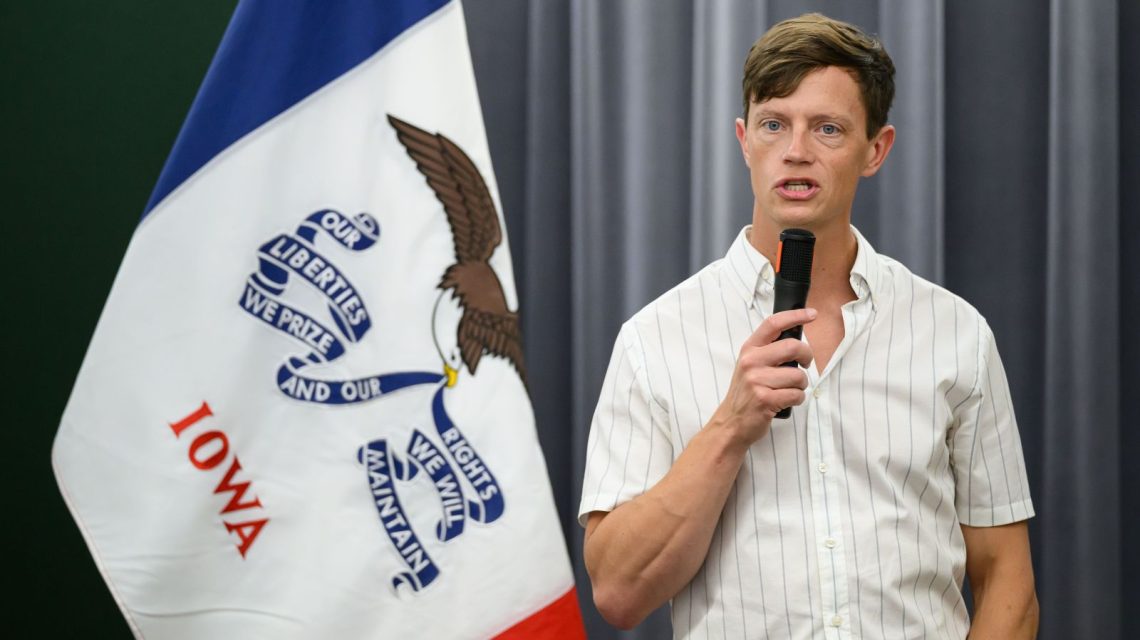
Democrat Rob Sand Leading in Polls
Democrat Rob Sand is leading Republican Zach Lahn by 10 points among likely voters in a recent Iowa governor’s race poll. The survey indicates a shift in voter sentiment in a state previously won by President Donald Trump in his presidential bids.
Despite Iowa’s conservative leanings over the past decade, Democrats remain optimistic about their prospects in the state this November. Sand, currently serving as the state auditor, has consistently led in the polls. This has prompted analysts to reassess the state’s political landscape in favor of Democrats recently.
Iowa supported President Barack Obama in 2008 and 2012. However, the state voted for Trump in the subsequent elections, including a 13-point victory in 2024, suggesting a drift away from competitive territory.
Poll Insights and Voter Trends
The recent poll shows Sand leading by 10 points, with 51 percent of likely voters supporting him compared to 41 percent backing Lahn. His lead extends among all registered voters, standing at 11 points, 50 percent to 39 percent respectively.
Sand’s strength is attributed to winning over voters who previously supported Trump in 2024, while maintaining loyalty among Democratic voters. Sand secured 97 percent of Kamala Harris’ 2024 voter base.
A segment of Trump voters also appears to be supporting Sand, with 12 percent favoring him against Lahn’s 73 percent. Harris voters are showing strong motivation to vote, with 94 percent indicating definite voting intentions, compared to 90 percent of Trump voters.
The poll highlights Trump’s declining approval ratings in Iowa. Only 41 percent of respondents approve of him, while 57 percent expressed disapproval.
The poll surveyed 2,169 registered voters, including 2,043 classified as strict likely voters, between September 3-8. It carries a margin of error of plus or minus 3.5 percent among registered voters and the likely voter subset.
Campaign Responses and Educational Influence
The poll’s sample comprised 38 percent respondents with at least a bachelor’s degree, surpassing the 31 percent average for Iowans with similar educational attainment, as per U.S. Census Bureau figures.
Lahn’s campaign spokesperson dismissed the poll as unreliable, accusing Sand of wasting $7 million on advertising. The spokesperson labeled Sand as a radical liberal advocating controversial policies.
Newsweek reached out to Sand’s campaign for a response via email.
Other Poll Findings and Prediction Markets
Other polls echo Sand’s lead. Emerson College registered a narrower 3-point lead for Sand, and Suffolk University recorded a 4-point lead. A New York Times poll showed an almost equal contest.
Prediction markets are favoring Sand, with platforms like Kalshi and Polymarket estimating his victory probability at over 77 percent.
Democratic Strategy and Challenges
Democrats aim to overcome the loss of ground in the Midwest with economic issues and Trump’s declining approval ratings providing an opening. They hope to connect with voters concerned about cost of living and tariffs impacting local farmers.
The gubernatorial race is not the only contest attracting Democratic attention. There are competitive congressional races where the party hopes to reclaim control.
Sand’s Unique Positioning
Sand has distanced himself from certain national party cultural stances. This approach could be crucial in Iowa, where Democrats are viewed unfavorably by the majority.
Sand’s nuanced positions on issues like transgender athletes display a balance between progressive and moderate principles.
Looking Ahead
The Iowa governor’s race remains one of the most contested this midterm cycle. Political analysts classify it as ‘Leans Democratic,’ signifying a competitive race with Sand holding a slight edge.
 The Trump Team’s Challenge to the Military Leadership
  Maryland First State to Restrict Electronic Pricing in Grocery Stores
  Activists Push for Nationwide Ban on Child Marriage in the U.S.
  Democratic Hopes and Historical Warnings in 2026 Senate Race
  Republicans Face Challenges Amidst Cost of Living Concerns
  A Different Kind of Fall for Congress This Year