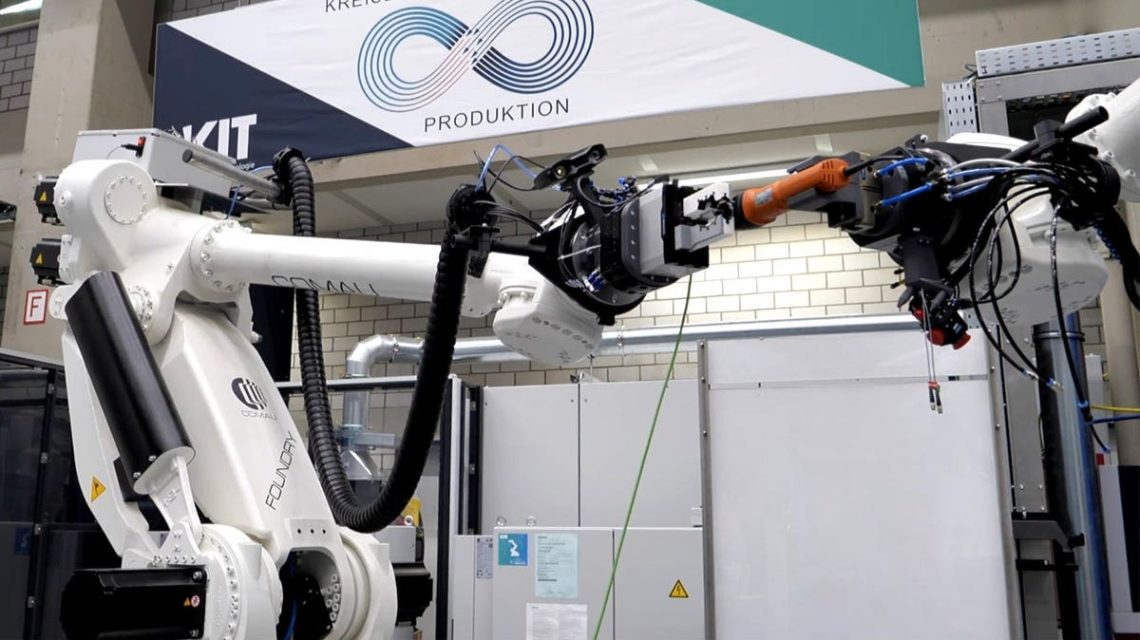
Robots have long assisted in building the products we use daily. Now, researchers are developing new abilities for robots: disassembling products when issues arise. With more than 4.6 million industrial robots operating globally, and the demand for automation rising, the question of handling machines when they wear out becomes significant.
Robotic Disassembly System
At the Karlsruhe Institute of Technology in Germany, researchers have created a robotic disassembly setup. This system acknowledges the unpredictable nature of aging machinery, an issue not typically addressed by traditional robots. It expects that some components may be stuck or missing and can adjust its strategy in response.
A robotic disassembly system uses probabilistic planning to change tactics when damaged or aging machinery creates unexpected obstacles.
For instance, the system begins with a CAD model but also relies on real-time observations of how components behave. It uses a method called Partially Observable Markov Decision Process (POMDP) to assess and update its understanding based on new data.
Challenges of Breaking Down Old Machines
Building products in a factory is often straightforward, with robots following precise sequences. Disassembling old machines is more complex due to wear, corrosion, and previous repairs. Traditional automation can stumble when unexpected obstacles disrupt these sequences.
Researcher Jan Baumgärtner explains that dismantling broken goods requires robots to reassess circumstances, not just follow instructions.
Experimental Successes
In experiments, the robotic system adeptly handled obstructions like stuck screws or missing parts. For example, when facing a stuck screw, it opted to use a milling tool instead of trying to unscrew it. This adaptability shows that probabilistic planning may outperform deterministic methods when unpredictability arises.
The system’s performance highlighted substantial improvements in disassembly speed when various solutions were possible. This research was shared at the IEEE International Conference on Robotics and Automation held in Vienna in 2026.
Potential Applications and Economic Impact
While the current focus is on motors and tools, the technology offers a future where larger systems can be unassembled efficiently. Baumgärtner envisions assembly lines in reverse, extracting valuable components instead of discarding entire devices.
The goal is a circular economy where parts are salvaged and reused, potentially lowering repair costs while reducing electronic waste.
Future of Automated Repairs
Though present technology can’t yet autonomously repair complex systems, this direction hints at a future where automation recovers costly components more economically. Manufacturers might embrace designing products for easier disassembly, making repairs more common and waste less likely.
The research represents a potential shift in how products are treated post-failure, driving the technology toward recovering parts that still hold value.
Kurt “CyberGuy” Knutsson highlights the significance of robots managing uncertainty. Teaching machines to navigate beyond rigid blueprints opens new possibilities. The chance to reclaim expensive parts rather than discarding faulty machines is an exciting prospect for both repair and recycling spheres.
The concept of repair-friendly robotics remains in its formative stage, but its implications for sustainability and cost reduction hold promise.
 Trump’s 2024 Campaign Targets Young Men Through Cryptocurrency
  How Modern Windows Improve Home Insulation
  State Department Simplifies Passport Process with Online Applications
  Senate Democrats Block Data Center Bill Over Efficiency Concerns
  Future Cities: Ambitious Projects Aiming for Innovation and Sustainability
  High-Profile Hearing and AI Developments: Key Political Moves