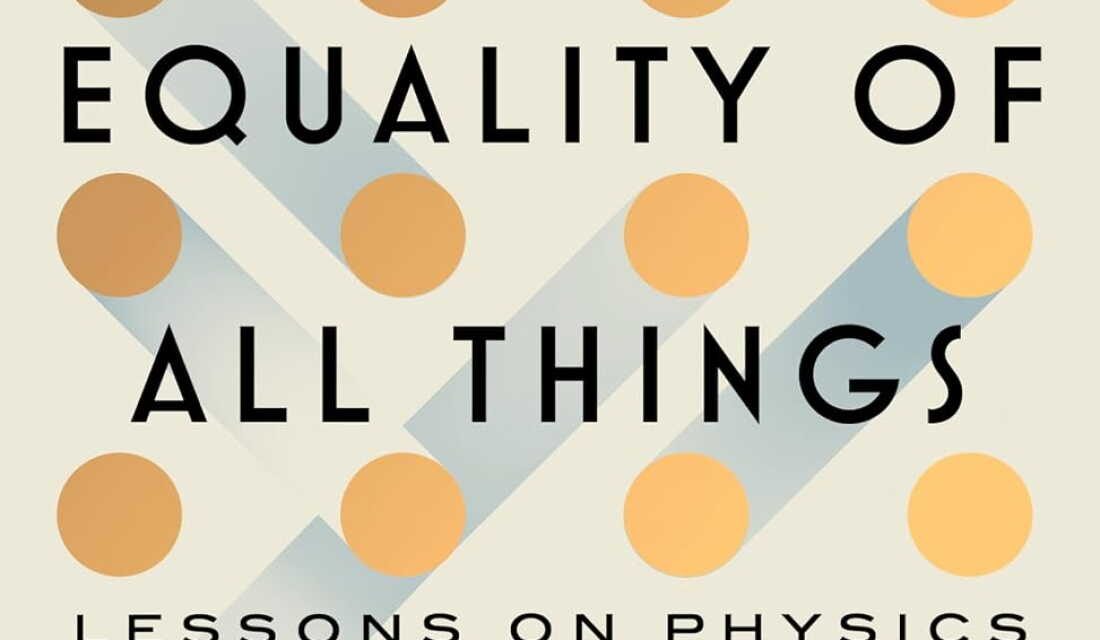
“Physics and Ultimate Reality,” a book on my shelf, encapsulates a common dream among physicists—attaining complete, objective knowledge of a fully understandable universe. This aspiration for a “God’s-eye view” is frequently presented in popular physics literature as the discipline’s goal. However, a new book by physicist Carlo Rovelli diverges, rejecting the notion of accessing a definitive reality. Rovelli’s “On the Equality of All Things” argues compellingly against this idea, offering an engaging and significant read.
Rovelli starts with a straightforward point: human understanding of the universe is limited. Our experience as beings on a planet’s surface influences our perception of solid objects and fixed spatial locations. This leads us to assume absolute measures of movement. Yet, modern physics reveals these beliefs as illusions. Albert Einstein’s relativity shows that time and space measurements are relative. Quantum mechanics indicates the properties we attribute to objects depend on how we measure them. Thus, physics refutes the idea of perfect access to the universe as an outsider, presenting instead an internal view.
Rovelli devotes attention to the relational interpretation of quantum mechanics. This perspective arose when quantum physics first emerged, challenging existing notions of an entirely independent reality. Newton’s laws had convinced physicists their equations described an external, ultimate reality. However, quantum mechanics complicates pre-existing properties without measurement—a concept illustrated by the Schrodinger’s Cat scenario, where a cat remains both dead and alive until observed. Rovelli dismisses alternative interpretations, asserting that all properties are relational, eliminating the possibility of an ultimate viewpoint.
Rovelli asserts that physics’ perceived power to fully explain everything is misplaced. Knowing physical laws does not equate to comprehensive world understanding. His claim contrasts with the scientific enthusiasm found in many popular science books and opposes many contemporary philosophers’ beliefs. Rovelli emphasizes the irreducibility of perspectives, drawing connections between relativity, quantum mechanics, and diverse philosophical traditions, including Asian philosophies like those of Nagarjuna and Zhuangzi. He values their contributions as much as those of Plato and Aristotle by examining reality through different lenses.
Remarkably, Rovelli maintains faith in physics, not as a path to absolute certainty, but as an inspiring scientific endeavor. He views science as a means to pursue knowledge creatively. While acknowledging that science yields profoundly beautiful and useful knowledge, he calls for humility before the universe’s complexity. Rovelli’s approach is an invitation to wisdom and intimacy with the cosmos.
“On the Equality of All Things” offers a stimulating new perspective. While one might disagree with certain omissions, like Rovelli’s dismissal of experience’s primacy—a point raised by philosopher Henri Bergson, who viewed lived time differently than scientific representations—these disagreements invite further dialogue. Rovelli’s concise book presents a powerful argument for a fresh understanding of our universe and our role within it.
Adam Frank, a physics and astronomy professor at the University of Rochester, co-authored “The Blind Spot. Why Science Cannot Ignore Human Experience.”
 Trump Unveils AI-Powered America.gov Platform
  Trump’s 2024 Campaign Targets Young Men Through Cryptocurrency
  How Modern Windows Improve Home Insulation
  State Department Simplifies Passport Process with Online Applications
  Climate-Resistant Rock Glaciers: Hidden Water Resources
  California Voters to Decide on $7.5 Billion State Research Fund